Icon_nebula-1

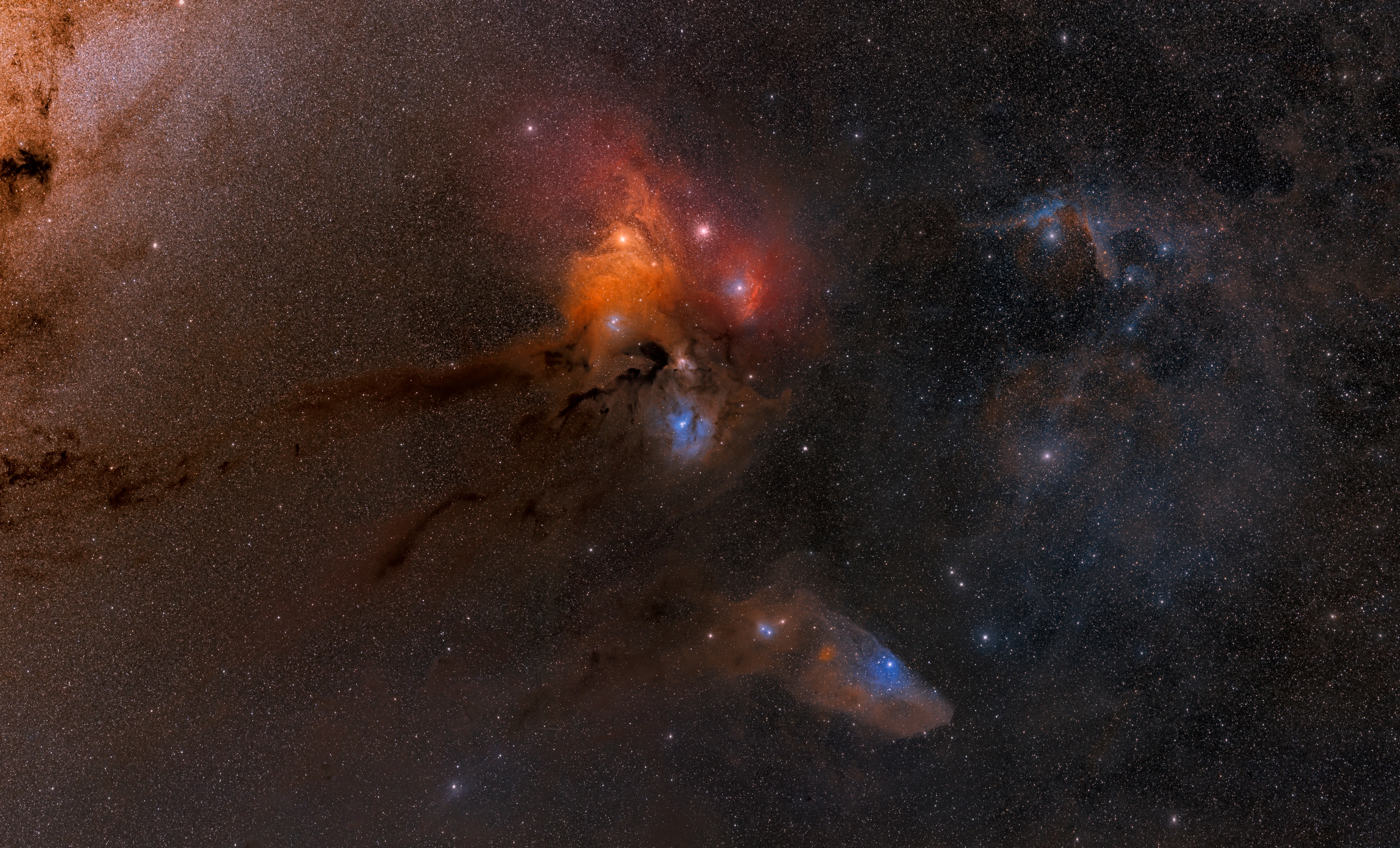
Wide Field of Rho Ophiuchi Complex

IC 4604 & IC 4592

The Rho Ophiuchi complex in wide field, from Antares to the dark lanes running out toward the north

Processed by Nicolas Rolland, Paris. 12 hours gathered by Martin Pugh at Heaven's Mirror Observatory, Yass, Australia.

This image is upside down. Turned the other way, the blue shape at the edge of the field does not read as a horse's head.

Twenty-two degrees of sky

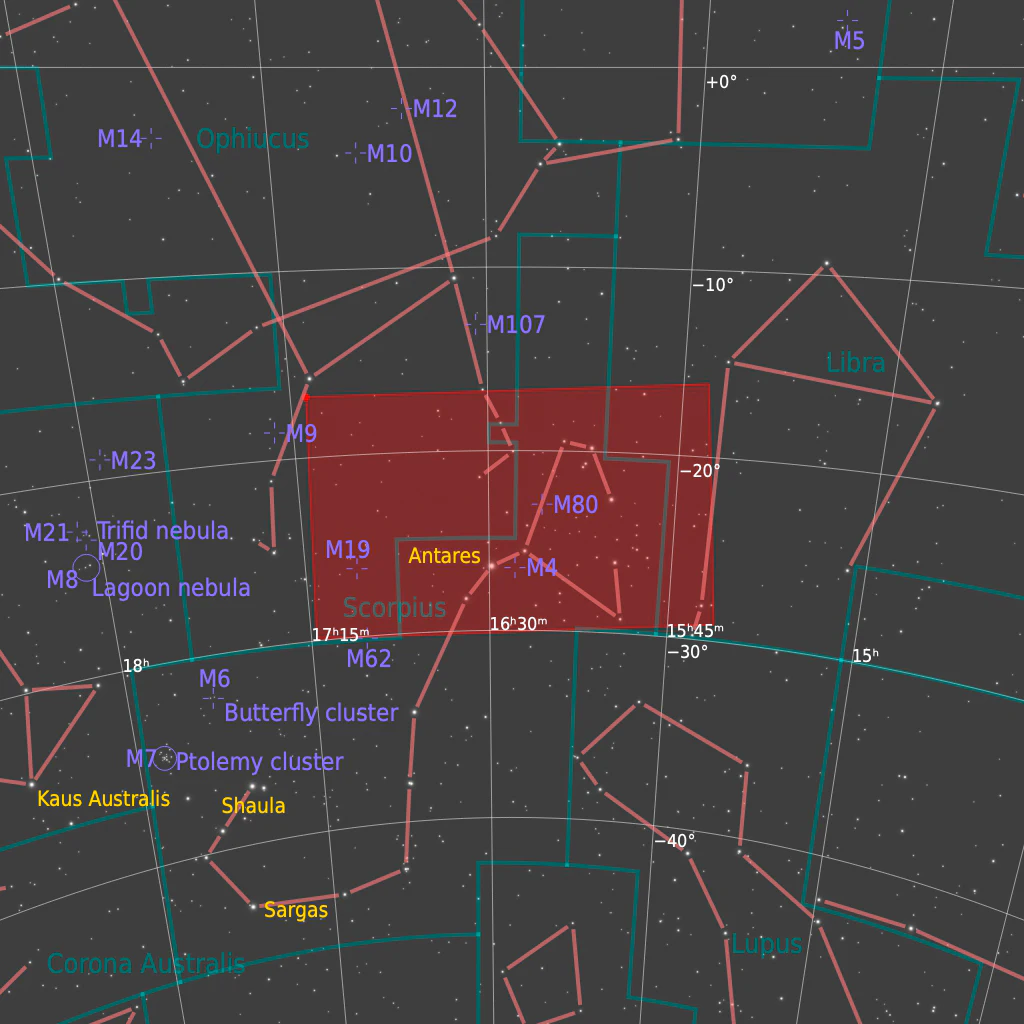
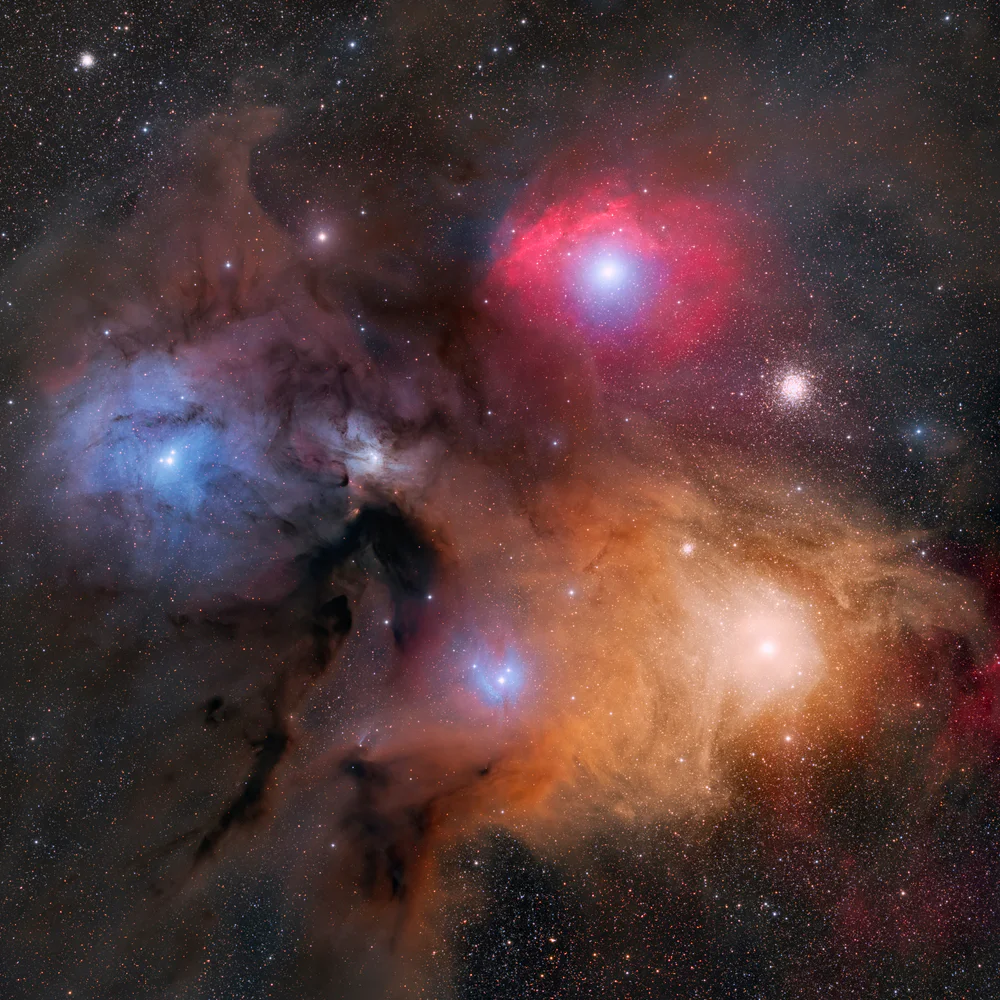
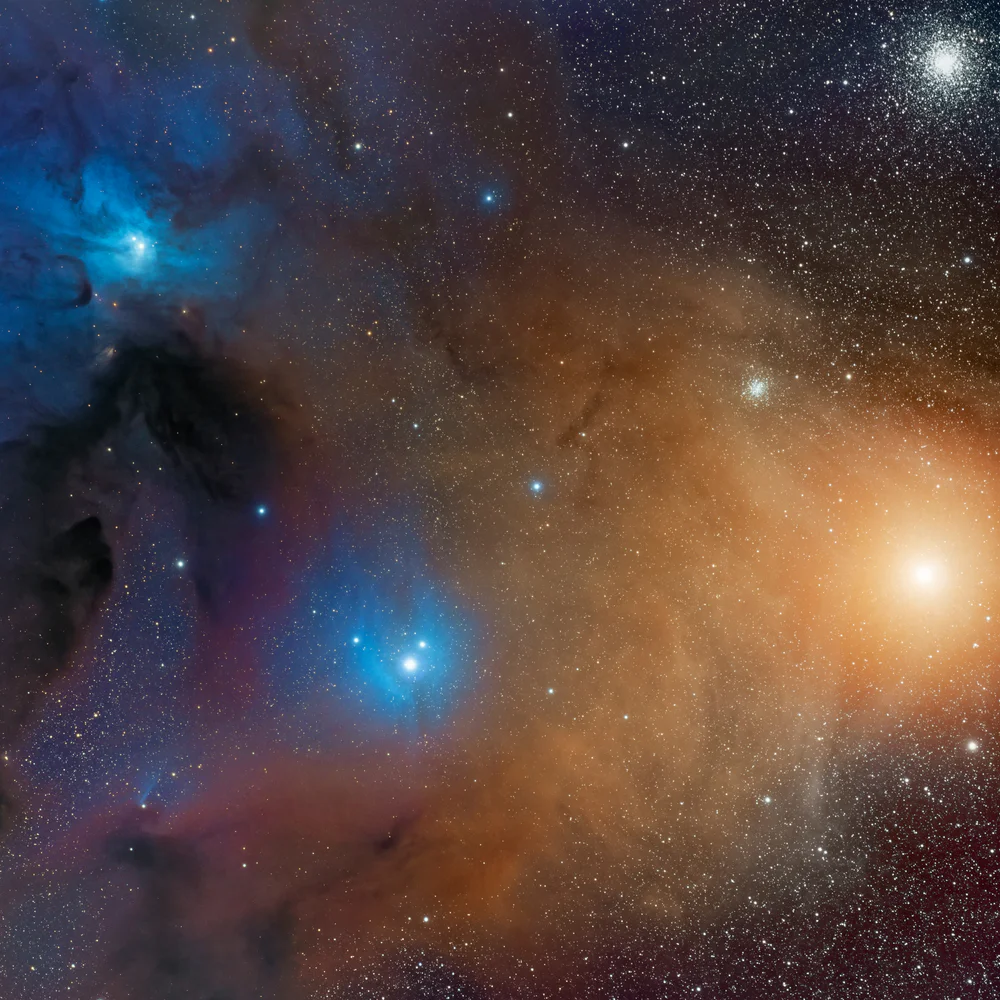
Three panels cover 22 by 13 degrees here, which is the width of a hand held at arm's length several times over. That is what it takes to hold the whole complex: IC 4604 and the blue nebulosity around Rho Ophiuchi at one end, Antares and its amber dust in the middle, and IC 4592 — the Blue Horsehead — out at the edge, a reflection nebula lit by Nu Scorpii. The five-degree view of the junction between Antares and Rho Ophiuchi, and the close-up of IC 4604, both fall inside the left third of this field.

Four hundred and sixty light-years, and some depth

Radio interferometry of young stars in the cloud, confirmed by Gaia, places the complex at about 140 parsecs — some 460 light-years. Over a field this wide that number stops being a single value: the measurements separate L1688 from L1689 by ten parsecs, which is to say the near and far parts of what looks like one cloud are thirty light-years apart along the line of sight.

A supernova, a million years ago

The cloud lies well above the galactic plane, at the edge of the Scorpius-Centaurus OB association. A massive star in upper Scorpius exploded around a million and a half years ago; the shock front reached these clouds roughly half a million years later, compressed them, and started the star formation that is still running. At this field width the shape of that push is visible — the streamers all point away from the same place.

Twelve hours, three panels, and a fast lens

The optic here is a 135 mm photographic lens at f/1.8 with a colour sensor behind it, from Yass in April 2021. Twelve hours across three panels means four hours each, which at f/1.8 is a great deal of light — but the price is paid at the edges. Wide open, a lens of this design leaves the corners aberrated and out of focus, so the panels were overlapped by nearly twenty per cent rather than the usual five, and roughly a third of every frame was discarded. There is no luminance channel either: a colour sensor under a UV/IR filter gathers all three channels at once, which is efficient and shallower than a mono sensor would be over the same twelve hours. What comes out is 21,998 by 13,317 pixels, and the whole complex fits inside it. Martin Pugh gathered the data at Heaven's Mirror.
This image has been selected by
EAPOD
April 17, 2021

Cette image est présentée à l'envers. Dans l'autre sens, la forme bleue au bord du champ ne se lit plus comme une tête de cheval.

Trois panneaux couvrent ici 22 sur 13 degrés, soit plusieurs fois la largeur d'une main tendue à bout de bras. C'est ce qu'il faut pour contenir le complexe entier : IC 4604 et la nébulosité bleue autour de Rho Ophiuchi à une extrémité, Antarès et sa poussière ambrée au milieu, et IC 4592 — la Tête de Cheval bleue — au bord, une nébuleuse par réflexion éclairée par Nu Scorpii. Le champ de cinq degrés sur la jonction entre Antarès et Rho Ophiuchi, comme le gros plan sur IC 4604, tiennent tous deux dans le tiers gauche de cette image.

L'interférométrie radio appliquée aux étoiles jeunes du nuage, confirmée par Gaia, place le complexe à environ 140 parsecs, soit quelque 460 années-lumière. Sur un champ aussi large, ce nombre cesse d'être une valeur unique : les mesures séparent L1688 de L1689 par une dizaine de parsecs, autrement dit les parties proche et lointaine de ce qui ressemble à un seul nuage sont distantes d'une trentaine d'années-lumière sur la ligne de visée.

Le nuage se trouve bien au-dessus du plan galactique, à la bordure de l'association OB Scorpion-Centaure. Une étoile massive du Scorpion supérieur a explosé il y a environ un million et demi d'années ; le front de choc a atteint ces nuages un demi-million d'années plus tard, les a comprimés, et a déclenché la formation d'étoiles qui se poursuit. À cette largeur de champ, la forme de cette poussée devient visible : les filaments pointent tous à l'opposé du même endroit.

L'optique est ici un objectif photographique de 135 mm à f/1,8, avec un capteur couleur derrière lui, depuis Yass en avril 2021. Douze heures réparties sur trois panneaux font quatre heures chacun, ce qui à f/1,8 représente beaucoup de lumière — mais le prix se paie sur les bords. À pleine ouverture, un objectif de cette conception laisse les coins aberrés et défocalisés : les panneaux ont donc été superposés à près de vingt pour cent au lieu des cinq habituels, et près d'un tiers de chaque pose a été écarté. Il n'y a pas non plus de canal de luminance : un capteur couleur sous filtre UV/IR acquiert les trois canaux à la fois, ce qui est efficace et moins profond qu'un capteur monochrome sur les mêmes douze heures. Le résultat fait 21 998 sur 13 317 pixels, et le complexe entier y tient. Martin Pugh a rassemblé les données à Heaven's Mirror.

TECHNICAL DATA

ACQUISITION DETAILS

OPTICS Sigma 135mm DG HSM Art @ F/1.8
CAMERA QHY600C
MOUNT Paramount MEII
FILTERS UV/IR
LOCATION Heaven's Mirror Observatory, Yass, Australia
DATE April 2021
EXPOSURES 12 hours (RGB 24 x 600 sec per panel)
PROCESSING SOFTWARE Pixinsight, CCDstack, Photoshop
COPYRIGHTS Nicolas Rolland & Martin Pugh

TARGET DETAILS

RA 16h 24m 20.3s
DEC -23° 25' 24.6"
SIZE 22.4 x 13.6 deg
ORIENTATION Up is 178 degrees E of N
CONSTELLATION Ophiuchus
DISTANCE 390 ly