NEBULAE
Rho Ophiuchi Cloud Complex
— IC 4604, IC 4605 & IC 4606 —
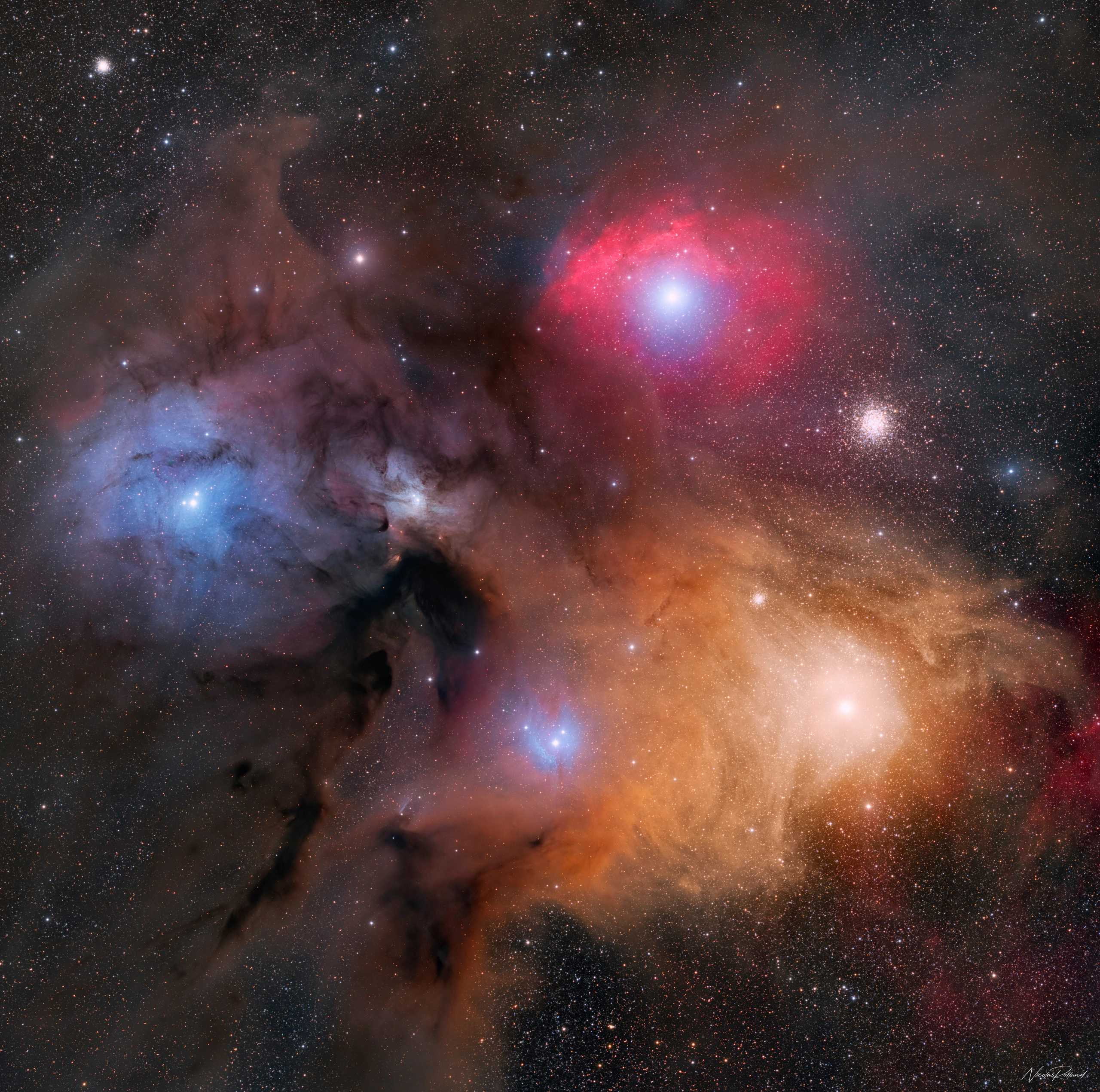
Processed by Nicolas Rolland, Paris. 23.4 hours gathered at Heaven's Mirror Observatory, Yass, Australia.
Three kinds of nebula share this field, and a fourth thing separates them: dust dense enough to show up as nothing at all.
Three nebulae and a boundary
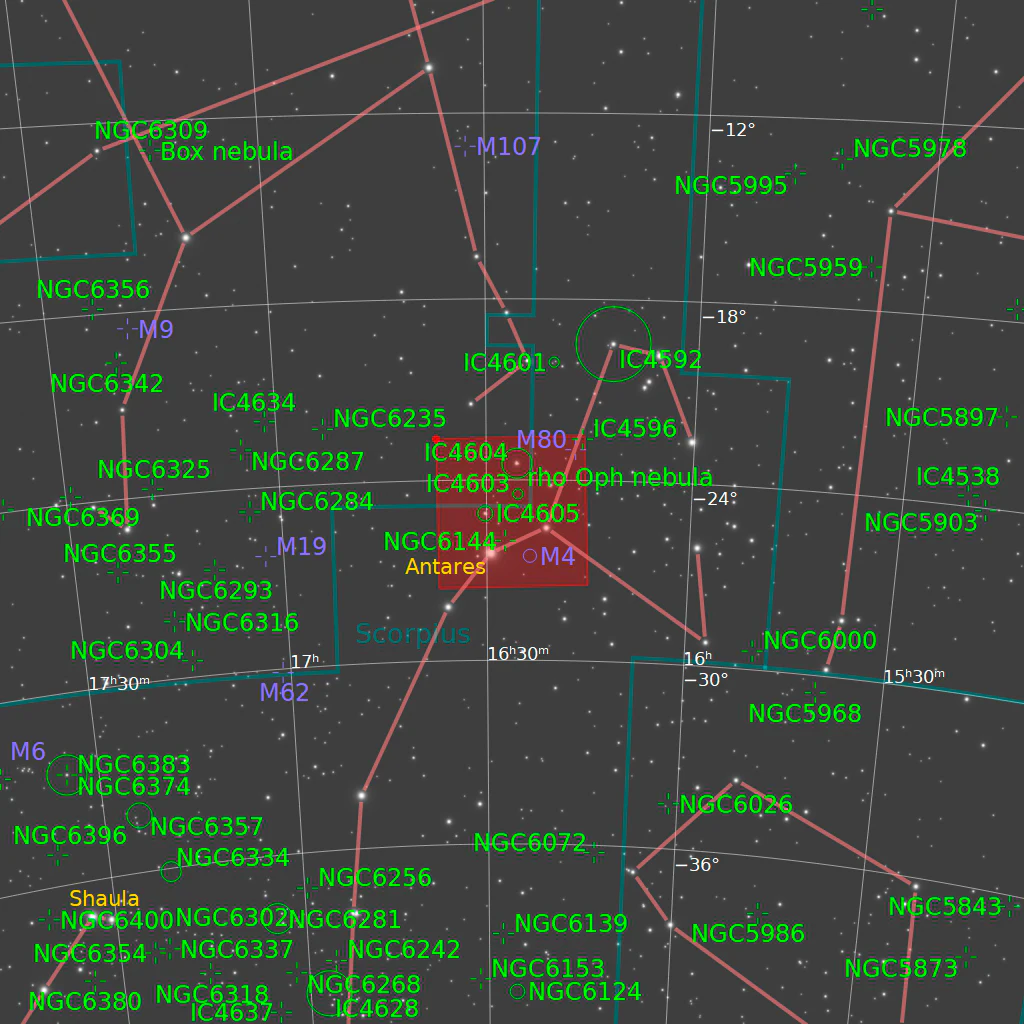
The blue nebulosity around Rho Ophiuchi is IC 4604, and IC 4603 sits beside it around SAO 184376. The yellow glow at the other end is IC 4606, the dust around Antares itself, with IC 4605 near 22 Scorpii between them. What runs down the middle are the dark nebulae Barnard 42 and Barnard 45 — clouds thick enough to cut the field in two, separating the reflection nebulosity near Rho Ophiuchi from the warmer material near Antares.
Why the colours differ
The blue and the gold are the same process seen against different stars. Dust scatters the light it receives, and Rho Ophiuchi is a hot blue system while Antares is a red supergiant — so the same grains return blue at one end of the field and amber at the other. The dark lanes are the same dust again, only with nothing behind them to scatter.
Four hundred and sixty light-years
Radio interferometry of young stars inside the cloud, confirmed by Gaia, places the complex at about 140 parsecs — some 460 light-years, one of the nearest star-forming regions to the Sun. It sits well above the galactic plane, near the edge of the Scorpius-Centaurus OB association, and it was set going by a supernova in upper Scorpius roughly a million years ago.
Twenty-three hours, and a magnitude-one problem
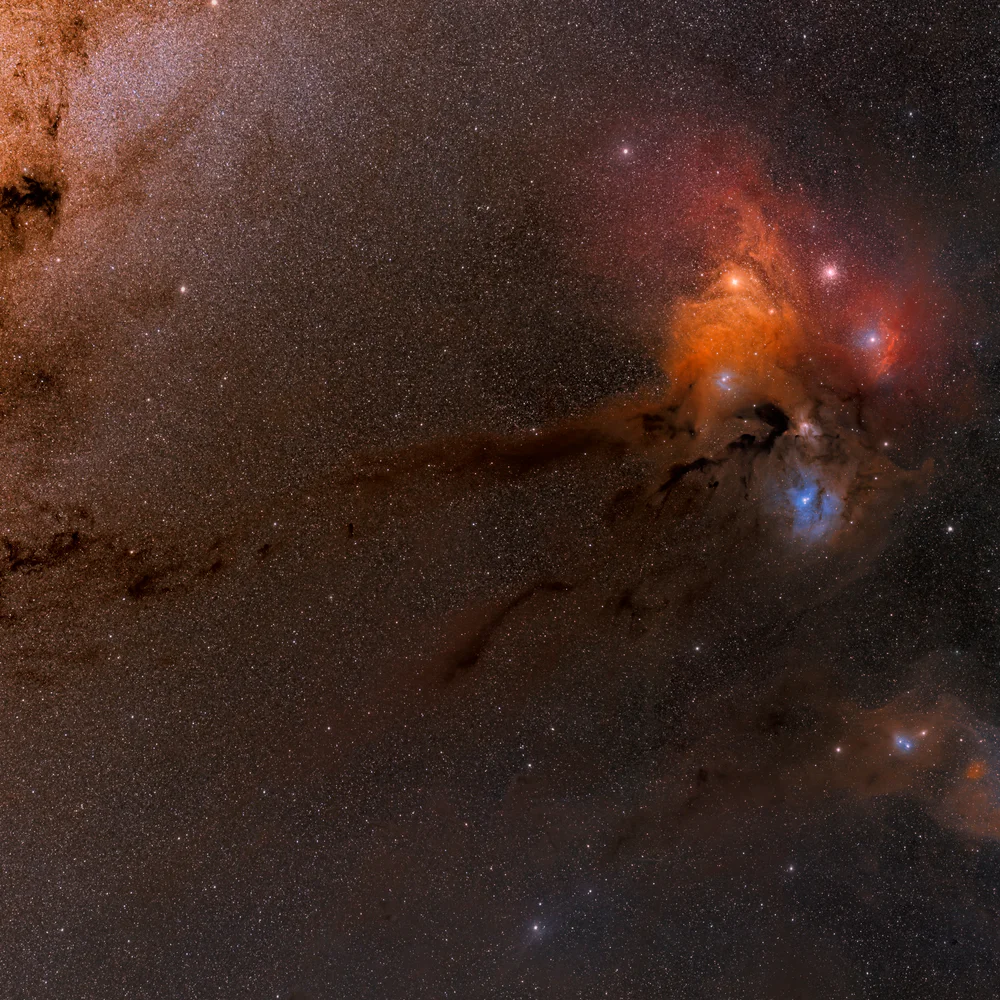
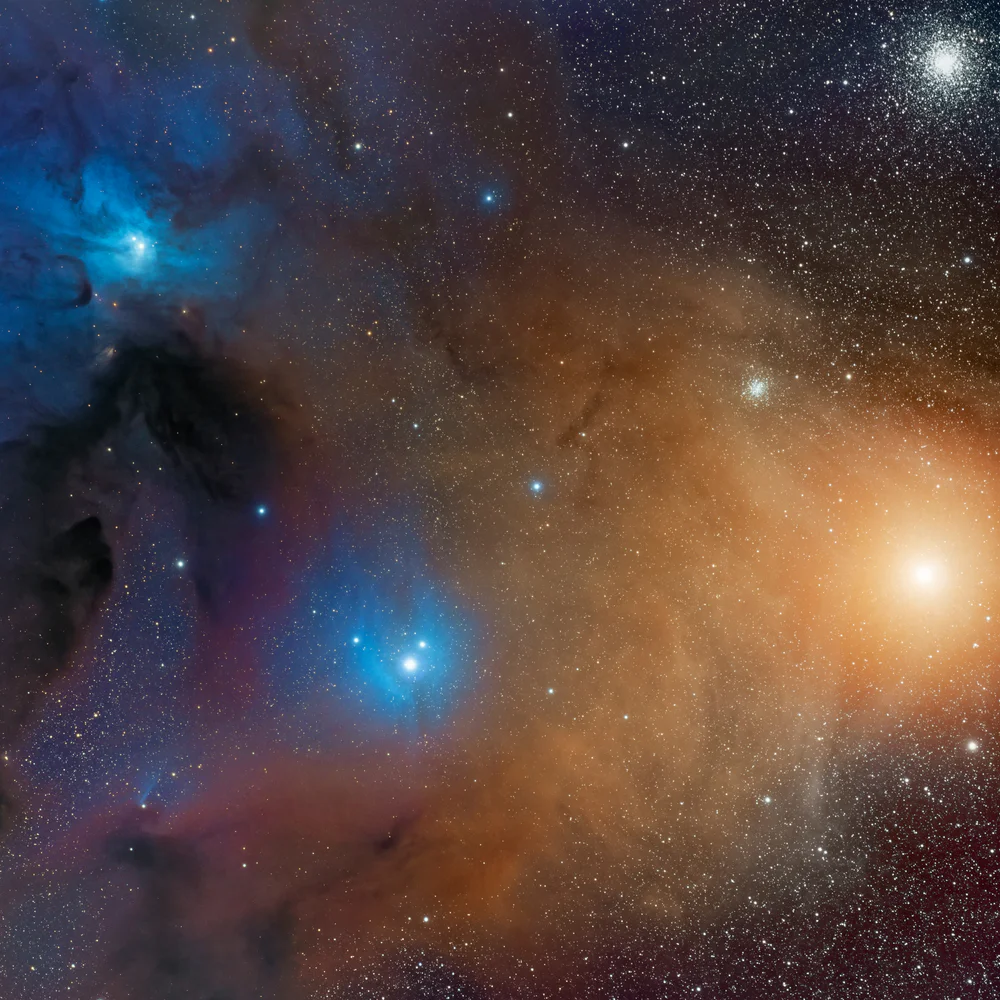
The optic was a Takahashi FSQ106 ED at f/3.6 in May 2021, and the real constraint was dynamic range. Antares is first magnitude; the nebulosity it lights is around fifth. Holding both in one five-degree frame means the star saturates long before the dust registers, so each colour channel was gathered twice — a set of five-minute frames and a set of ten-minute ones, the short set to keep Antares from burning out and the long set to reach the dust. Twenty-three hours in total, five of them luminance. What that reaches is the full run of dark lanes between the two ends of the field. What it does not reach is what lies beyond them: at five degrees the complex is already running out of frame, and holding all of it takes a three-panel mosaic. Its brightest part, the blue nebulosity around Rho Ophiuchi, fills a frame of its own at 3.8 degrees.