STAR CLUSTER
The Hyades
— Melotte 25 —
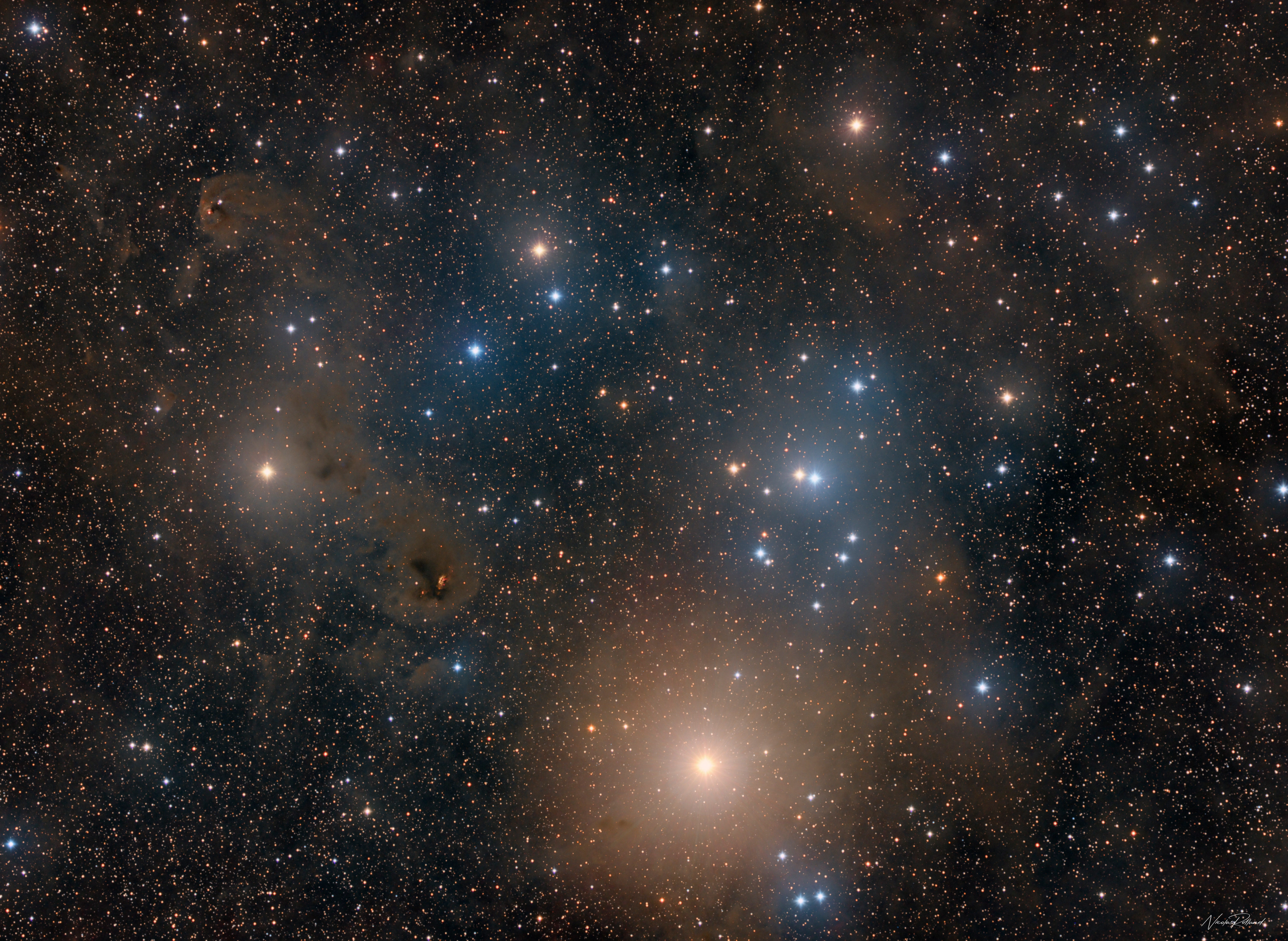
Processed by Nicolas Rolland, Paris. 12.5 hours gathered by Deep Sky West at Rowe Mesa, New Mexico, USA.
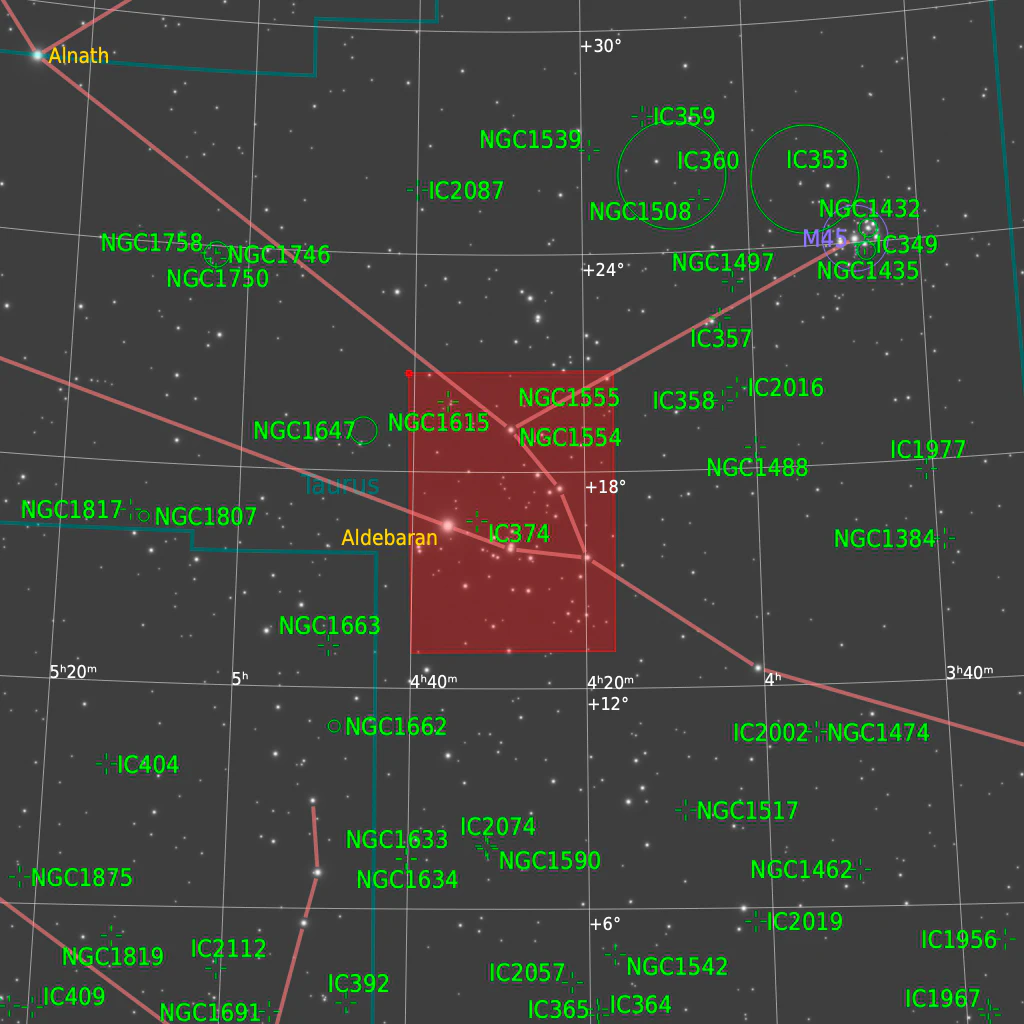
The brightest star in this V is not part of the cluster. It sits less than half as far away and happens to fall in the same direction.
Three hundred stars that left together
The Hyades form the head of Taurus, catalogued as Melotte 25, and they are the nearest open cluster to us at 147 light-years. Three to four hundred stars belong to it, and what makes them a cluster rather than a crowd is that they share an age, a birthplace, a chemical composition and a direction of travel. The dense core is about 17.6 light-years across; the tidal radius, beyond which a star is no longer held, reaches 32.
Aldebaran is not a member
The orange star at the point of the V looks like the brightest member of the cluster and is not a member at all. It lies at less than half the distance, unrelated to the group, and simply falls along the same line of sight. Nothing in an image can settle that question — it took parallax and proper motion to separate them. The picture shows a V; the V is partly a coincidence.
Metal-rich, and crowded with A stars
Within the tidal radius the Hyades hold at least 21 stars of spectral type A, around 60 of type F and around 50 of type G. The ten-parsec sphere around the Sun, a comparable volume, holds 4, 6 and 21. The cluster is also richer in heavy elements than the Sun and its neighbours, which is a clue to where and when it formed. Epsilon Tauri, one of its members, carries at least one gas giant.
A 135 mm lens, and twelve hours
The field runs 7.8 by 5.7 degrees, which is what an object this close demands: at 147 light-years the cluster covers a stretch of sky no telescope would take in. The optic here is a 135 mm lens at f/2 rather than a telescope, and the twelve and a half hours behind it went almost entirely into colour — the point of the exercise being to separate the A stars from the F and G stars by their light rather than by their catalogue entry. What the image cannot show is the third dimension. The Hyades are spread through depth as much as across the sky, and a photograph flattens exactly the thing that makes them a cluster. Deep Sky West gathered the data at Rowe Mesa.