STAR CLUSTER
The Pleiades
— Messier 45 —
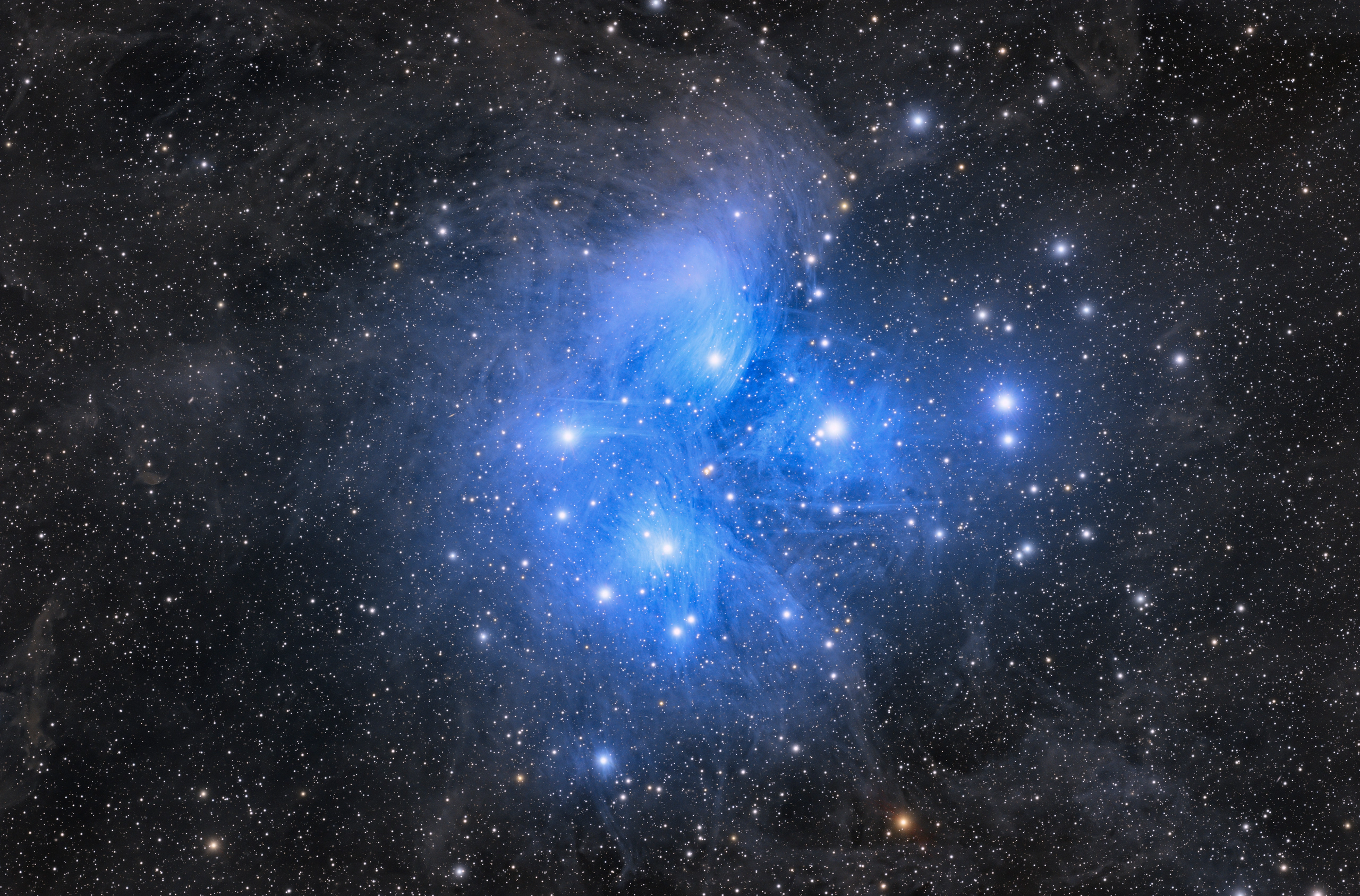
Processed by Nicolas Rolland, Paris. 6.9 hours gathered by Grand Mesa Observatory at Whitewater, Colorado, USA.
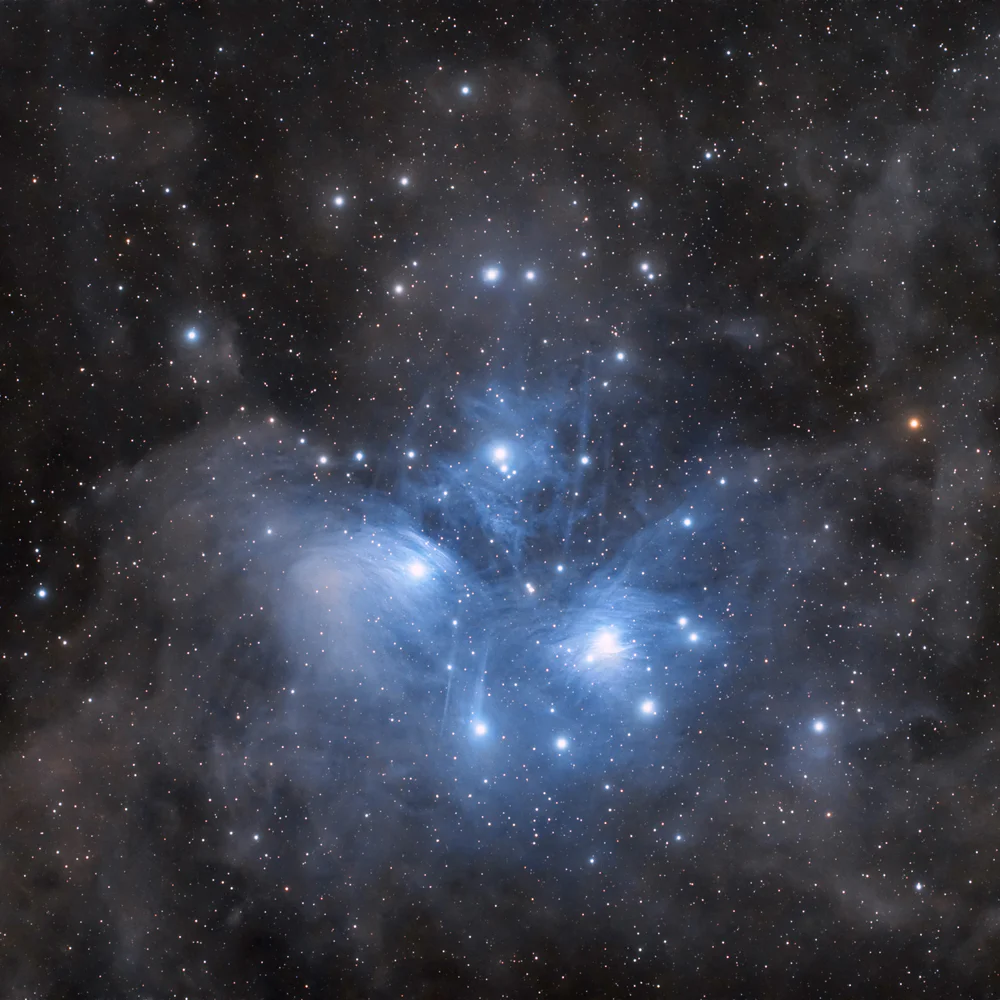
The blue haze around these stars is not theirs. They are ploughing through it, and it will be behind them in a few hundred thousand years.
Seven sisters and their parents
The name comes from Greek mythology: the seven daughters of Atlas and Pleione — Maia, Electra, Taygete, Alcyone, Celaeno, Sterope and Merope. The nine brightest stars of the cluster carry the names of the seven sisters and of their two parents. Most people see six of them with the naked eye, and the discrepancy between six visible and seven named has been remarked on for as long as the names have existed.
Why the nebulosity is blue
The haze around the brightest stars is a reflection nebula. Nothing in it is glowing: the dust returns the light that reaches it, and it returns blue preferentially because fine grains scatter short wavelengths more efficiently than long ones — the same physics that makes the daytime sky blue. The brightness of any part of it is a measure of how much dust is there, not of anything happening inside.
A coincidence, not a birthplace
For a long time this dust was taken for what remained of the cloud the cluster formed from. It is not. The Pleiades are about a hundred million years old and would have cleared their birth cloud long ago; what surrounds them now is an unrelated cloud they are currently passing through, at a relative speed of several kilometres a second. The encounter is temporary. The cluster itself has perhaps 250 million years left before its own low density lets it come apart.
Seven hours from Colorado
A Takahashi FSQ130 at f/5 with a monochrome sensor, from Whitewater in December 2020, in two-minute frames across luminance, red, green and blue. Two minutes is short, and deliberately so: Alcyone is magnitude 2.9 and the nebulosity beside it is many magnitudes fainter, so long frames would burn the stars before the dust arrived. Seven hours built from that many short frames is what holds both. What it reaches is the structure inside the reflection nebulosity — the streaks that run through it, which are the dust itself being combed by the radiation it is scattering. What it does not reach is the fainter material further out. Grand Mesa Observatory gathered the data at Whitewater.