The Great Lacerta Nebula
Sh2-126 · wide field

Processed by Nicolas Rolland, Paris. 28.3 hours gathered at IC Astronomy Observatory, Spain.
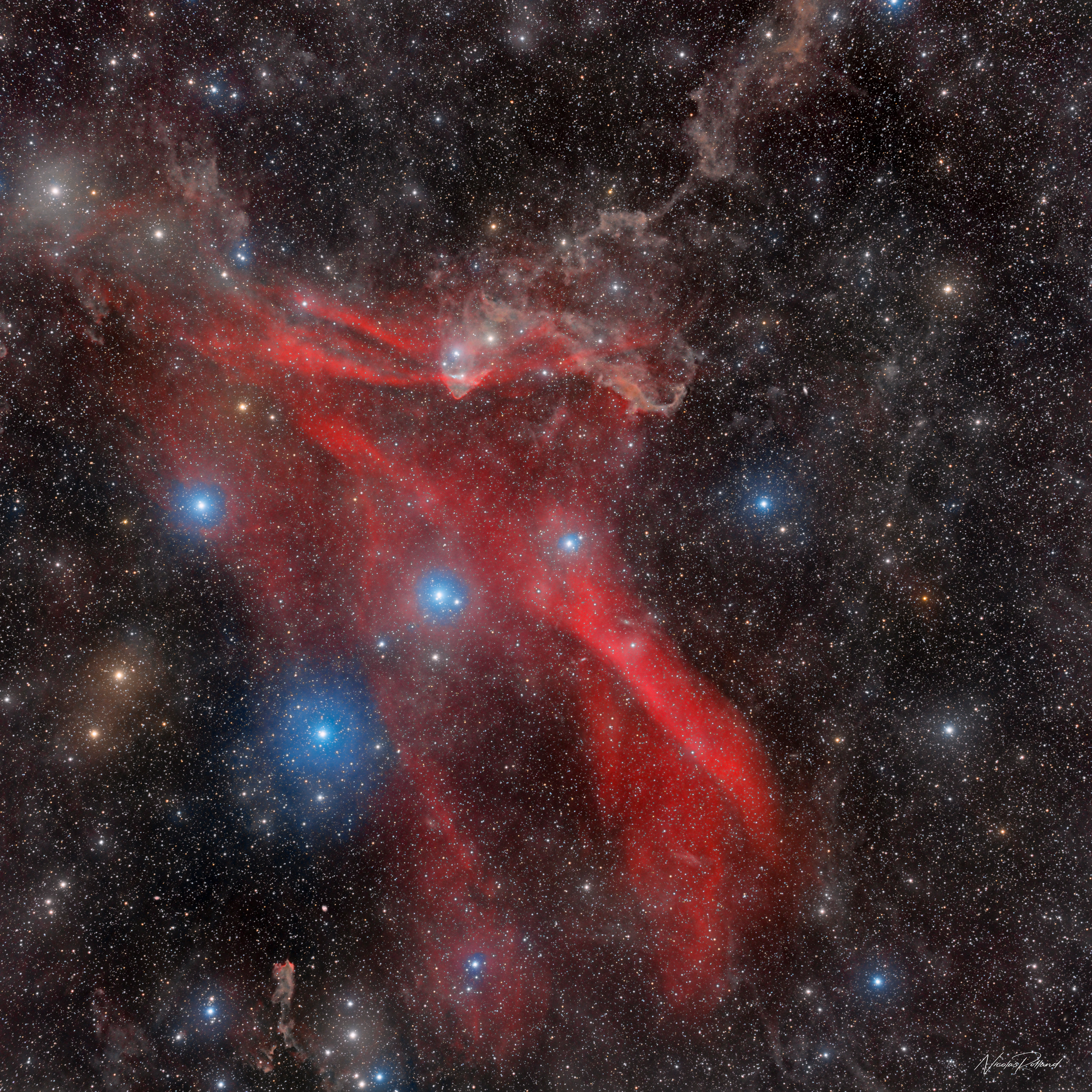
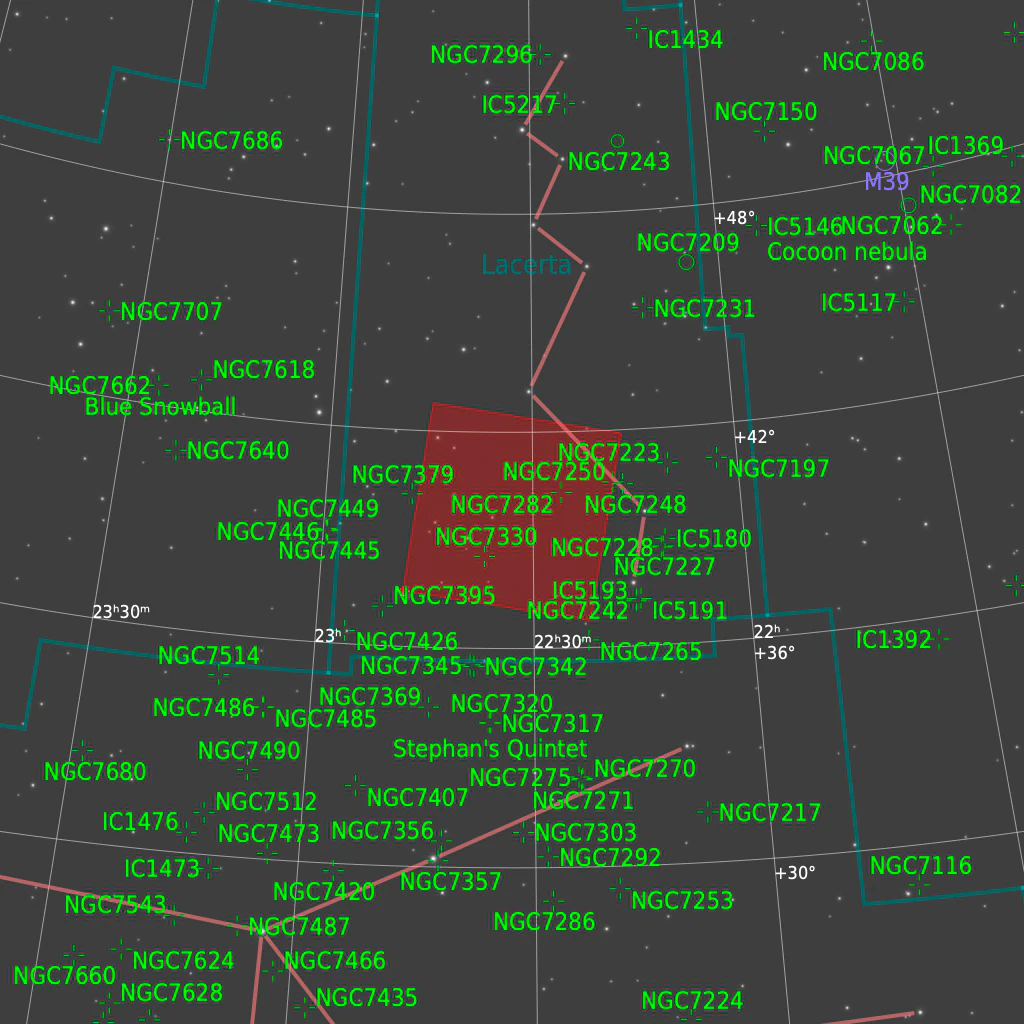
Sh2-126 is one of the largest emission nebulae in Lacerta and one of the hardest to see. This frame is 5.28 degrees on a side, wide enough to hold the whole filament in a single field — which is why it was shot through a 106 mm refractor rather than anything longer.
A five-degree filament in southern Lacerta
The nebula sits in the southern part of Lacerta, about one degree west of the star 10 Lacertae. It has the shape of a long, ragged filament rather than a compact cloud, and it is far below naked-eye reach: this is an object that exists almost entirely in photographs. Through anything other than an H-alpha filter, very little of it registers at all.
Lit by a single star
10 Lacertae is a blue variable of magnitude 4.8 and spectral type O9V, and it is what makes the nebula visible. One star ionises this entire structure — the ultraviolet light it puts out strips electrons from the hydrogen around it, and the faint red glow that a camera records is that hydrogen recombining. Take the star away and the gas is still there; there is simply nothing to reveal it.
Why this field is rarely photographed whole
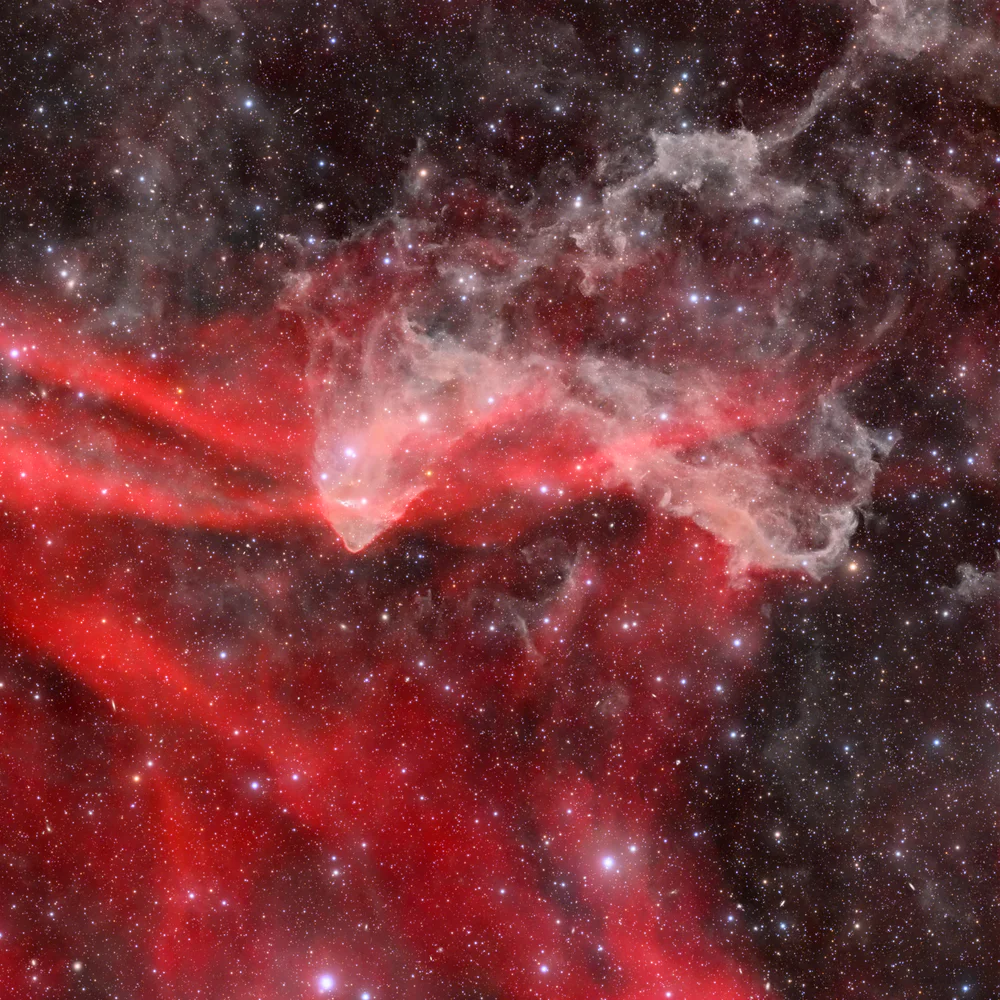
Five degrees is wider than most deep-sky setups can frame, so Sh2-126 is usually photographed in pieces or cropped to its brightest part. This version covers the region in one frame: 28.3 hours from an FSQ-106ED at f/3.6 under a Spanish sky, of which 7.3 hours went to H-alpha. The brightest knot inside the filament, LBN 437, has its own page shot at four times the depth.
Sh2-126 est l'une des plus grandes nébuleuses en émission du Lézard, et l'une des plus difficiles à voir. Ce cadrage fait 5,28 degrés de côté, assez large pour contenir le filament entier dans un seul champ — d'où le choix d'une lunette de 106 mm plutôt que d'un instrument plus long.
La nébuleuse occupe la partie sud du Lézard, à environ un degré à l'ouest de l'étoile 10 Lacertae. Elle a la forme d'un long filament déchiqueté plutôt que d'un nuage compact, et elle est très en dessous de la limite de visibilité à l'œil nu : c'est un objet qui n'existe pratiquement qu'en photographie. Avec autre chose qu'un filtre Hα, il n'en reste presque rien.
10 Lacertae est une variable bleue de magnitude 4,8 et de type spectral O9V, et c'est elle qui rend la nébuleuse visible. Une seule étoile ionise toute cette structure : son rayonnement ultraviolet arrache les électrons à l'hydrogène qui l'entoure, et la faible lueur rouge qu'enregistre le capteur est cet hydrogène qui se recombine. Retire l'étoile, le gaz est toujours là — il n'y a simplement plus rien pour le révéler.
Cinq degrés, c'est plus large que ce que cadrent la plupart des montages de ciel profond ; Sh2-126 est donc le plus souvent photographiée par morceaux, ou recadrée sur sa partie la plus brillante. Cette version couvre la région d'un seul tenant : 28,3 heures avec une FSQ-106ED à f/3,6 sous un ciel espagnol, dont 7,3 heures de Hα. Le nœud le plus lumineux du filament, LBN 437, a sa propre page, photographiée quatre fois plus profond.
TECHNICAL DATA
ACQUISITION DETAILS
OPTICS Takahashi FSQ-106ED @ F/3.6
CAMERA FLI PL 16803
MOUNT Paramount MX+
FILTERS Ha, L, R, G, B
LOCATION IC Astronomy Observatory, Oria, Almería, Spain
DATE July 2022
EXPOSURES 28.3 hours (L 24 x 600 sec, R 34 x 600 sec, G 34 x 600 sec, B 34 x 600 sec, Ha 44 x 600 sec)
PROCESSING SOFTWARE Pixinsight, CCDstack, Photoshop
COPYRIGHTS Nicolas Rolland & Telescope.Live

TARGET DETAILS
RA 22h 33m 02.1s
DEC +39° 47' 15.2"
SIZE 5.28 x 5.28 deg
ORIENTATION Up is 8.83 degrees E of N
CONSTELLATION Lacerta