STAR CLUSTER
A Globular You Can See Through
— Messier 55 —
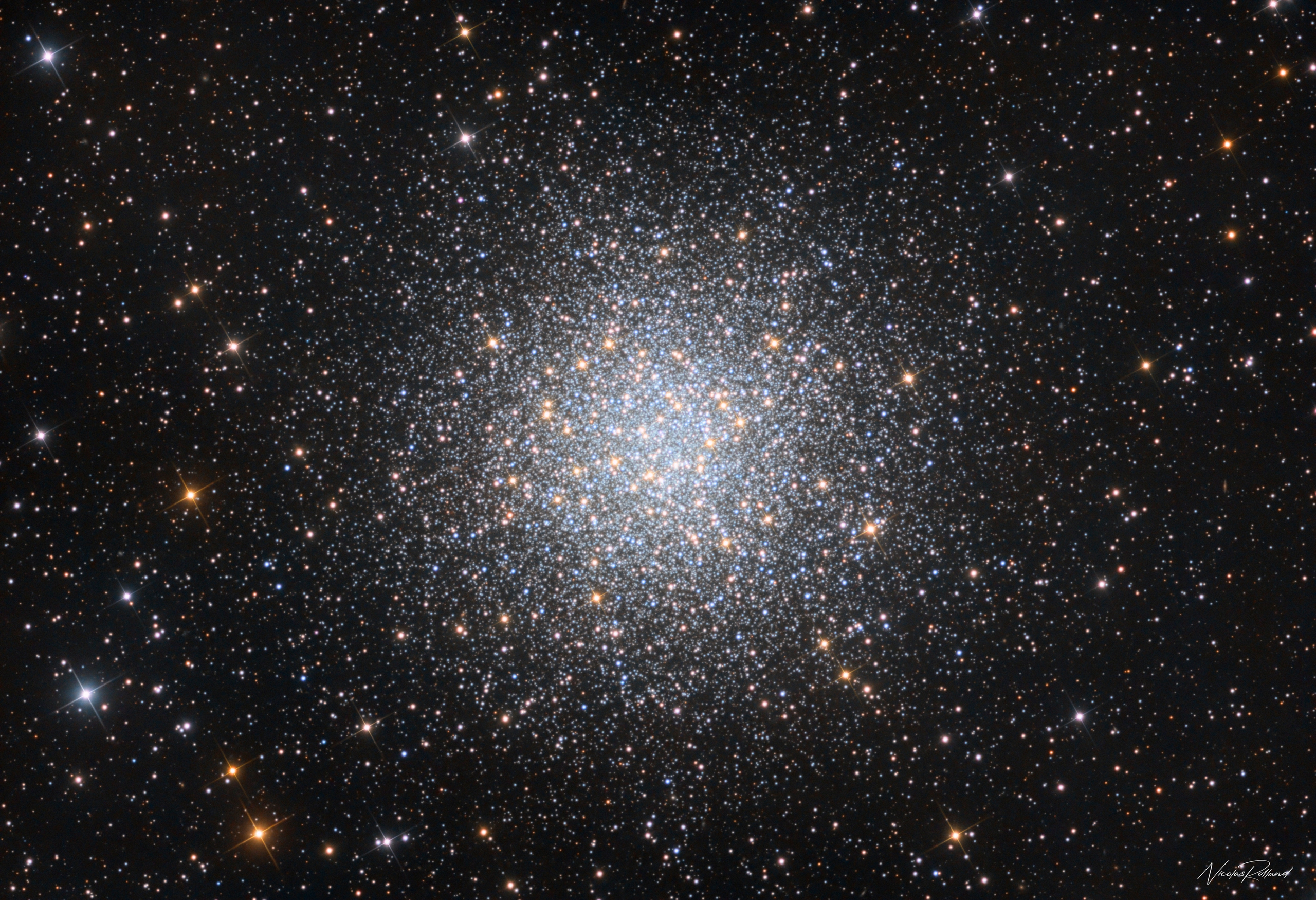
Processed by Nicolas Rolland, Paris. 3.8 hours gathered by Martin Pugh at El Sauce Observatory, Rio Hurtado, Chile.
A hundred thousand stars, and room to see between them.
Fourteen years between two catalogues
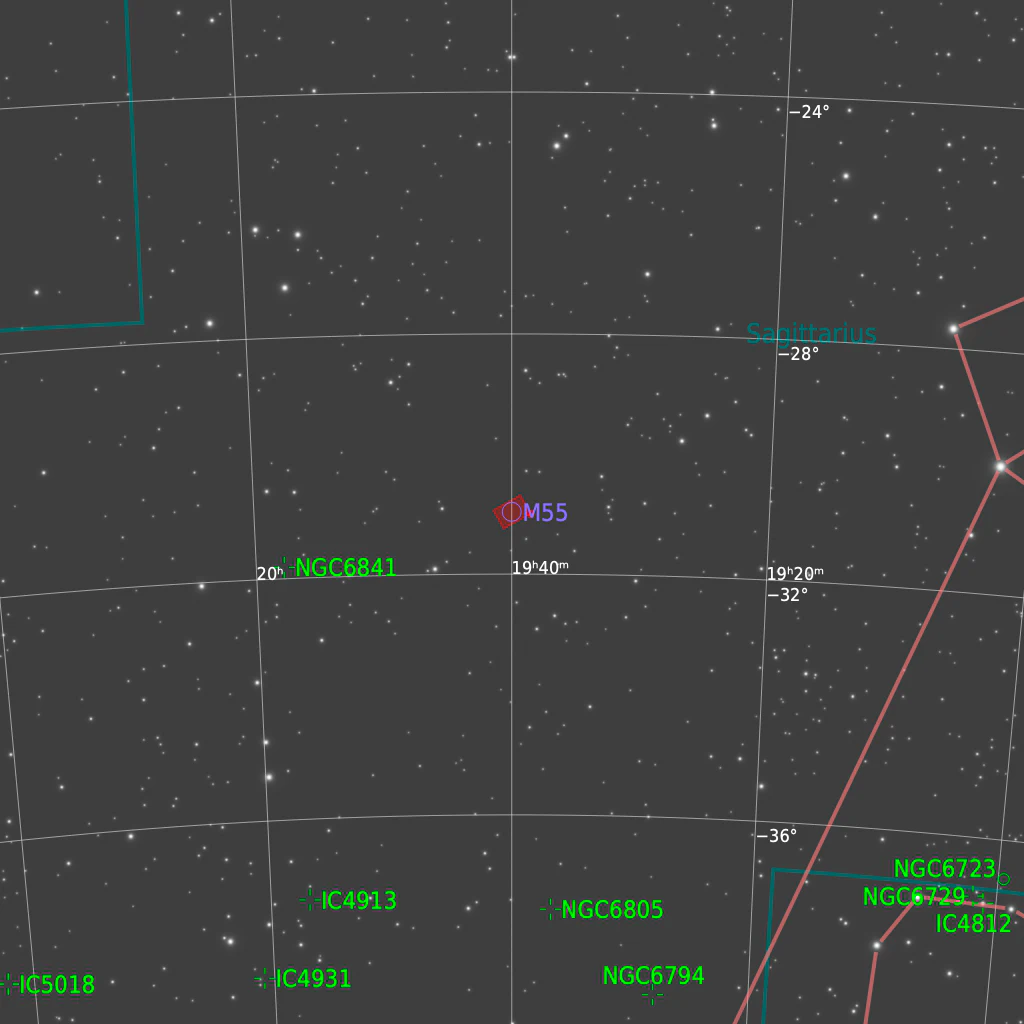
Lacaille catalogued this cluster from the Cape in 1752. Messier went looking for it in 1764, came back with nothing, and only added it to his list in 1778. The trouble was never the cluster, which shines at magnitude 6.3. It was the latitude: at a declination of −31 degrees, Messier 55 scrapes along the southern horizon from Paris, seen through the thickest air the sky has to offer.
A hundred light-years, a hundred thousand suns
It lies 17,300 light-years away in Sagittarius and measures around a hundred light-years across, which makes it one of the nearest globular clusters to us. Its combined output is something like a hundred thousand times that of the Sun. Fifty-five variable stars have been identified in the central region so far. The whole cluster is moving away from us at 169 kilometres a second.
A core you can see through
What sets it apart from most globulars is a centre that barely behaves like one. Cluster cores are usually packed past the point any telescope can separate them: the middle collapses into a single glare and individual stars only reappear towards the edges. Messier 55 has no such glare. It ranks among the most diffuse globulars known, and its stars stay countable all the way in — a hundred thousand of them, spread thin enough to leave gaps onto the field behind.
Fifty minutes of luminance, three hours of colour
A CDK17 at f/6.8 with adaptive optics ahead of the sensor, from Rio Hurtado in May 2022. Three hours and fifty minutes in total, and luminance is the smallest share of it: fifty minutes, against an hour each in red, green and blue. On a cluster this bright the useful measurement is colour, since its stars run from ancient reds to the blue stragglers that have no business being there, and that spread is what sorts them by age and by mass. The adaptive optics count for more here than the total does. Two stars a few arcseconds apart near the centre either stay separate or merge into one, depending on how steady the image is held between guide corrections. Martin Pugh gathered the data at El Sauce.