NEBULAE
The Flaming Skull Nebula
— Sh2-68 —
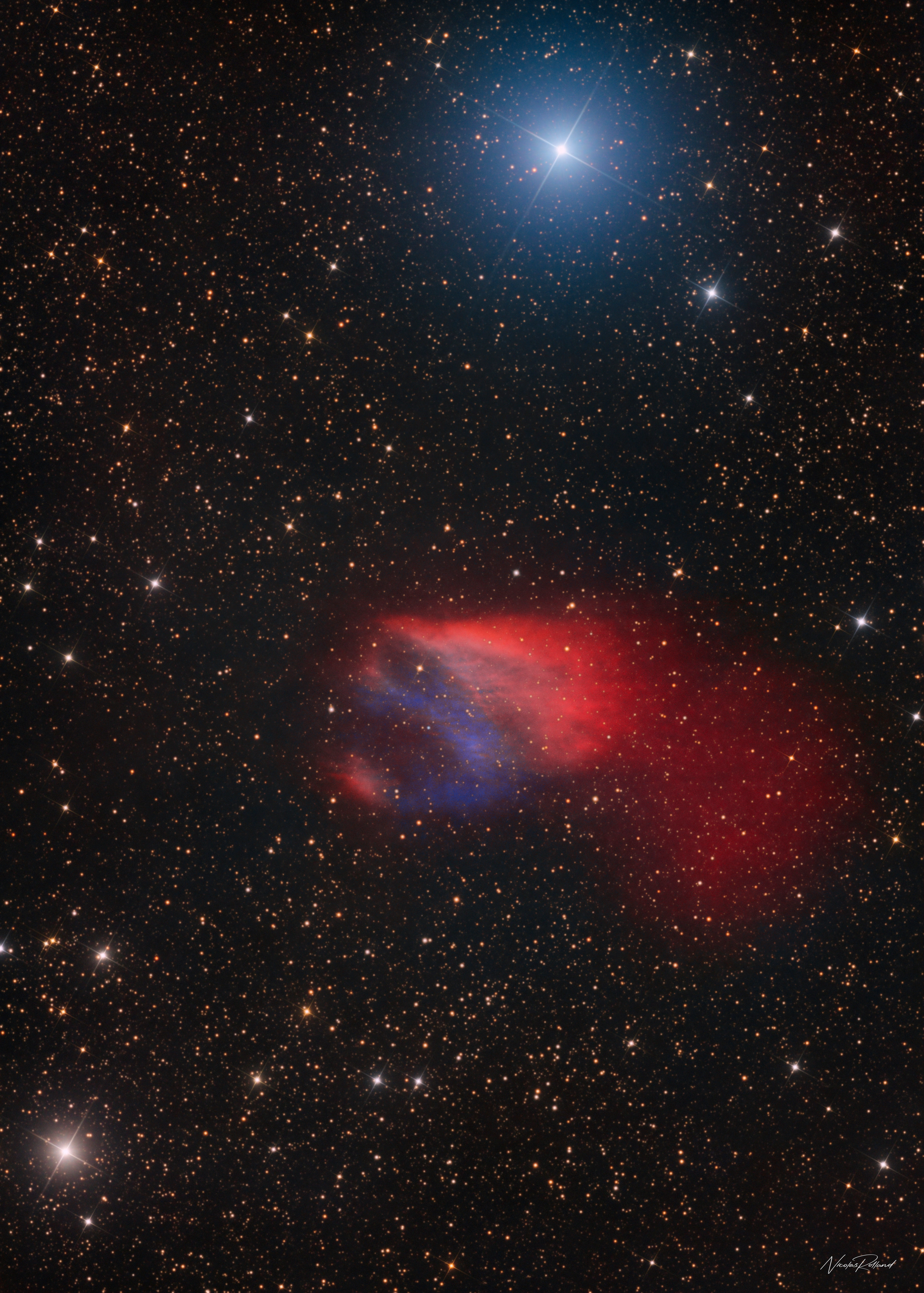
Processed by Nicolas Rolland, Paris. 51.5 hours gathered by Martin Pugh at El Sauce Observatory, Rio Hurtado, Chile.
This shell has been expanding for forty-five thousand years, and it is losing its shape to whatever it is expanding into.
Forty-five thousand years of expansion
Sh2-68 sits in the northern part of Serpens, about four degrees north-northeast of eta Serpentis, and spans some eight arcminutes. It is a planetary nebula near the end of its visible life: the shell a sun-like star shed as it collapsed into a white dwarf, thinning out for around forty-five thousand years. Most planetary nebulae look tidy. This one does not.
A shape drawn by resistance
The irregularity is not decorative. As the shell expands it runs into the interstellar medium around it, and the boundary between the two is unstable — a Rayleigh-Taylor instability, the same effect that makes a heavy fluid pushing into a light one break up into fingers and lobes rather than staying flat. What the image shows is that boundary caught mid-collapse. Along with Sh2-174, this nebula is one of the standard test cases for how planetary nebulae and the interstellar medium interact.
A star that may not belong to it
The white dwarf that produced the shell does not sit at its centre; it is visibly offset. Its distance is put between 120 and 270 parsecs, while the nebula is put between 200 and 500. Those two ranges barely overlap. Either the measurements will converge with better data, or the star and the shell are not at the same distance at all — and this object is a good deal stranger than it looks.
Fifty-one hours, mostly narrowband
The CDK17 was working at f/6.8 with adaptive optics ahead of the sensor, from Rio Hurtado in August 2022. Fifty-one and a half hours went to this field, and thirty-six of them are narrowband: twenty-five in H-alpha, eleven and a half in OIII. That ratio is the whole answer to a nebula this far gone — the shell has thinned to the point where broadband luminance returns almost nothing, and only the emission lines still carry a signal above the sky. The remaining fifteen hours in luminance and colour do a different job: they give the field its real star colours, which narrowband cannot. Martin Pugh gathered the data at El Sauce.