STAR CLUSTER

The Coma Star Cluster

— MELOTTE 111 —
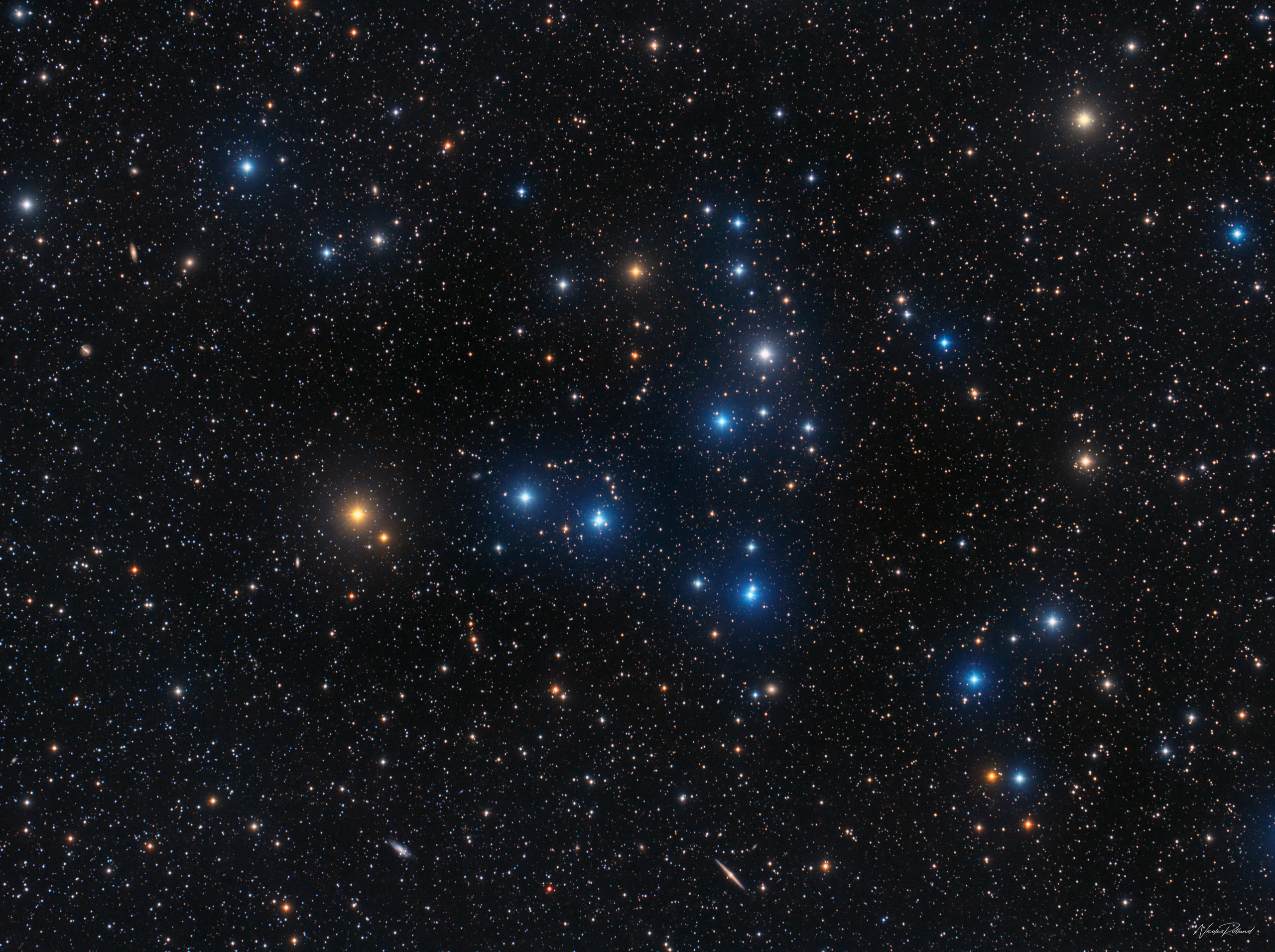
The Coma Star Cluster, Melotte 111, a naked-eye open cluster spread across Coma Berenices, in 5 hours of LRGB

Processed by Nicolas Rolland, Paris. 5 hours gathered by Deep Sky West at Rowe Mesa, New Mexico, USA.

The Coma Star Cluster in Coma Berenices, catalogued as Melotte 111, is a large open cluster and one of the closest to us. Ptolemy recorded it around AD 138, which makes it one of the oldest astronomical objects still known by a catalogue number rather than a name.

Too obvious to be catalogued

Conspicuous as it is, the cluster appears in neither the Messier nor the NGC catalogues. Both were built to list objects that could be mistaken for comets, and this one is far too large and too loose to be mistaken for anything. P. J. Melotte included it in his 1915 catalogue as number 111, and its true nature as an open cluster was only proven in 1938, when R. J. Trumpler identified 37 stars as genuine members.

Forty stars moving together

The cluster is scattered across 4.5 degrees and contains about 40 stars between magnitude 4.35 and 10.5, identified as members by their common proper motion — they are a cluster because they move together, not because they look grouped. No fainter members have been found. It is neither approaching us nor receding: it moves tangentially, at 0.02 arcseconds per year.

Two hundred and eighty-eight light-years

The distance was refined by the Hipparcos satellite and now stands at 288 light-years, which makes this one of the three nearest open clusters — only the Ursa Major Cluster and the Hyades are closer. The cluster is 400 million years old and its hottest member is spectral type A0. Being this close is exactly what makes it difficult to photograph: proximity is what spreads it across 4.5 degrees in the first place.

Five hours, and a camera lens

The cluster is 4.5 degrees across, and that single number decides everything about how it has to be photographed. No telescope frames 4.5 degrees. So this one was shot with a Rokinon 135 mm at f/2 on a QSI 583 at Deep Sky West, Rowe Mesa, New Mexico — a camera lens rather than a telescope, chosen for the field and not because it was what stood there. It covers 7.61 by 5.68 degrees, which leaves the cluster room on all sides, and that margin is the whole point: a cluster this loose only reads as a cluster when you can see where it stops. Five hours were enough at f/2. This image is not after depth, it is after field.

Version française
L'amas de la Chevelure de Bérénice, catalogué Melotte 111, est un grand amas ouvert et l'un des plus proches de nous. Ptolémée l'a consigné vers 138 apr. J.-C., ce qui en fait l'un des plus anciens objets astronomiques connus encore désignés par un numéro de catalogue plutôt que par un nom.
 
Aussi visible soit-il, l'amas ne figure ni au catalogue Messier ni au NGC. L'un comme l'autre ont été bâtis pour recenser les objets qu'on pouvait confondre avec des comètes, et celui-ci est bien trop vaste et trop lâche pour qu'on le confonde avec quoi que ce soit. P. J. Melotte l'a inscrit dans son catalogue de 1915 sous le numéro 111, et sa véritable nature d'amas ouvert n'a été démontrée qu'en 1938, quand R. J. Trumpler y a identifié 37 étoiles réellement membres.
 
L'amas s'étend sur 4,5 degrés et compte une quarantaine d'étoiles de magnitude 4,35 à 10,5, reconnues comme membres par leur mouvement propre commun — c'est un amas parce que ses étoiles se déplacent ensemble, pas parce qu'elles paraissent groupées. Aucun membre plus faible n'y a été trouvé à ce jour. Melotte 111 ne s'approche ni ne s'éloigne du Soleil : il se déplace tangentiellement, à 0,02 seconde d'arc par an.
 
Sa distance a été affinée par le satellite Hipparcos et s'établit désormais à 288 années-lumière, ce qui en fait l'un des trois amas ouverts les plus proches — seuls l'amas de la Grande Ourse et les Hyades le sont davantage. Il est âgé de 400 millions d'années et son étoile la plus chaude est de type spectral A0. Cette proximité est précisément ce qui le rend difficile à photographier : c'est elle qui l'étale sur 4,5 degrés.
 
L'amas s'étend sur 4,5 degrés, et ce seul chiffre décide de toute la manière de le photographier. Aucun télescope ne cadre 4,5 degrés. Celui-ci a donc été pris avec un Rokinon 135 mm à f/2 sur une QSI 583, à Deep Sky West, sur Rowe Mesa, au Nouveau-Mexique — un objectif photo plutôt qu'un télescope, choisi pour le champ et non parce qu'il se trouvait là. Il couvre 7,61 × 5,68 degrés, ce qui laisse de la marge à l'amas de tous les côtés, et cette marge est précisément l'objectif : un amas aussi lâche ne se lit comme un amas que si l'on voit où il s'arrête. Cinq heures ont suffi à f/2. Cette image ne cherche pas la profondeur, elle cherche le champ.

Technical data
OpticsRokinon 135 @ f/2.0
CameraQSI 583 WSG5
MountAstro-Physics Mach1 GTO
FiltersL, R, G, B
LocationDeep Sky West at Rowe Mesa, New Mexico, USA
DateMay 2020
Exposures5 hours L 14 × 300 sec · R 14 × 300 sec · G 17 × 300 sec · B 15 × 300 sec
Distance~288 ly
SoftwarePixinsight, CCDstack, Photoshop
CopyrightsNicolas Rolland & Deep Sky West
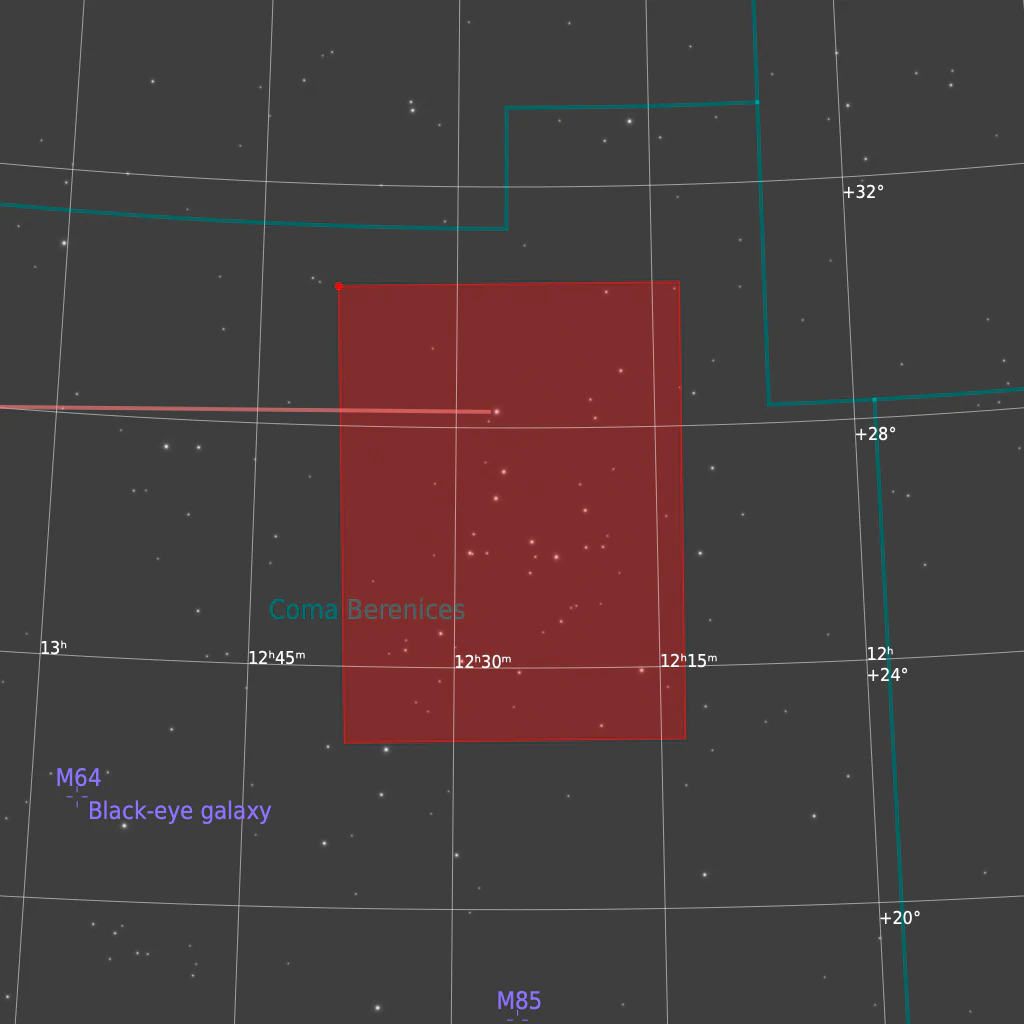
Finding chart The Coma Star Cluster — finding chart
RA12h 25m 47.2s Dec+26° 35′ 57.4″ Size7.61 × 5.68 deg Orientationup is 89.2° E of N ConstellationComa Berenices