NEBULAE
The Gecko Nebula
— LBN 437 —
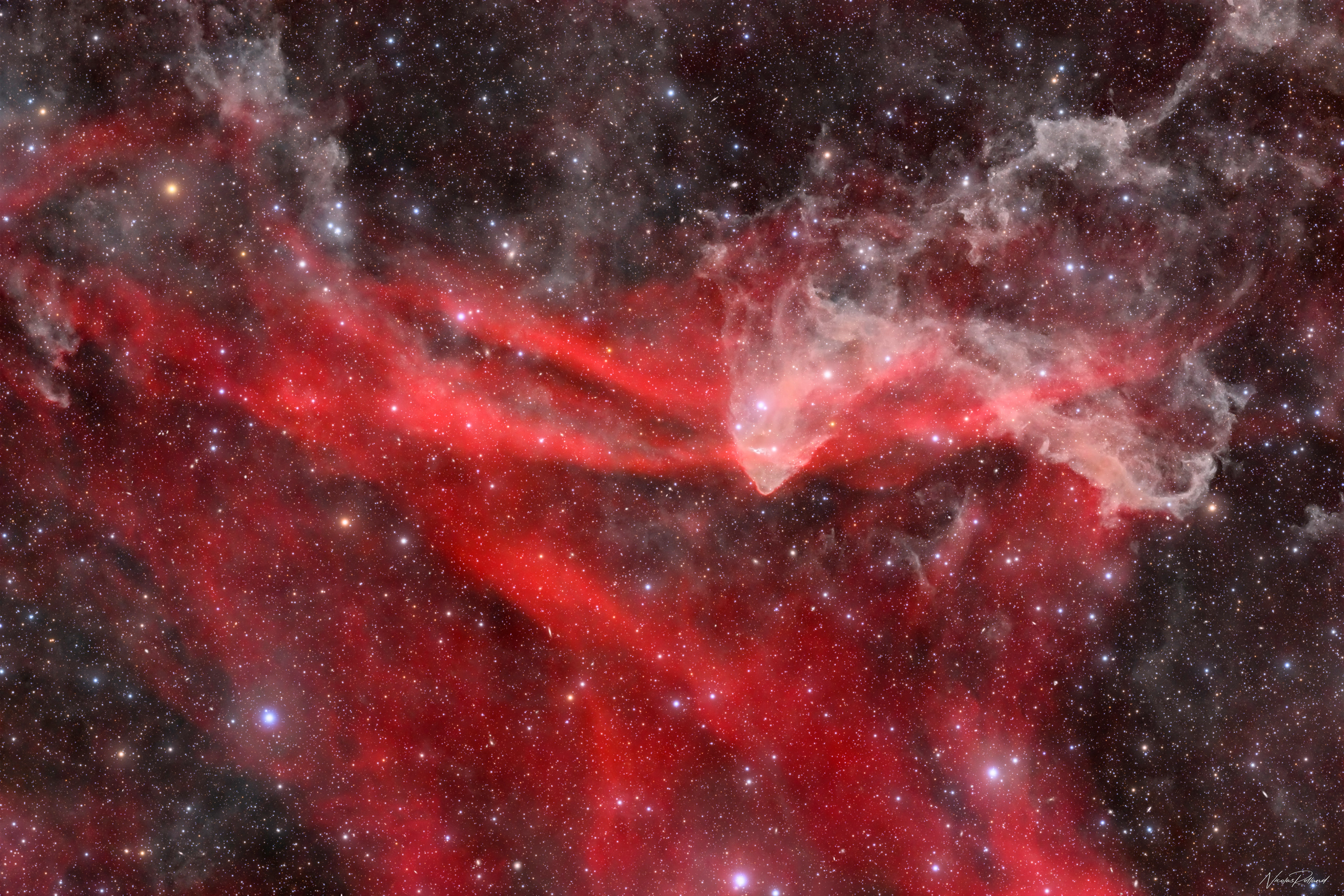
Processed by Nicolas Rolland, Paris. 53.1 hours gathered by Christophe Marsaud at Saintes, France.
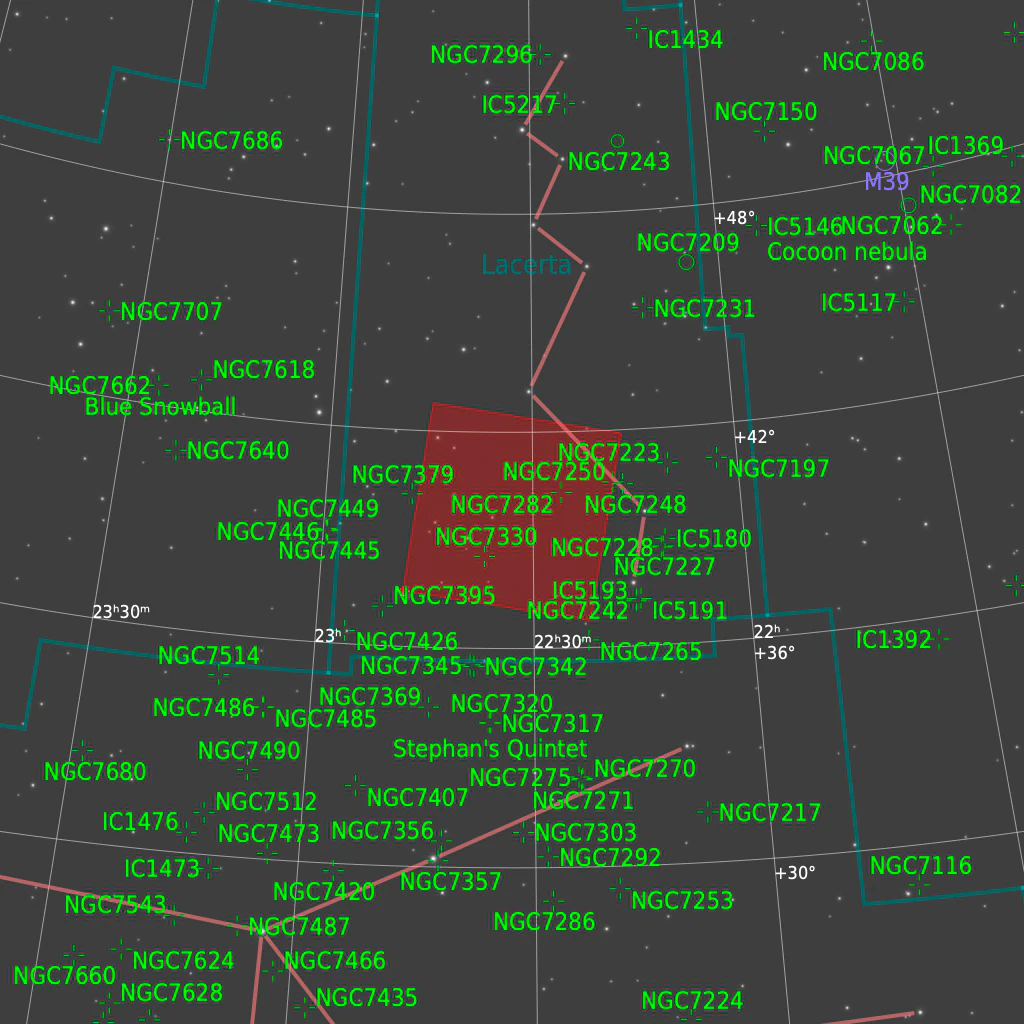
LBN 437 is the brightest thing in a field where almost nothing is bright. It sits inside the faint hydrogen filament of Sh2-126, in the southern part of Lacerta, and it owes its nickname to its outline: a small, sprawling shape that reads as a lizard against the dust.
A bright knot inside a faint filament
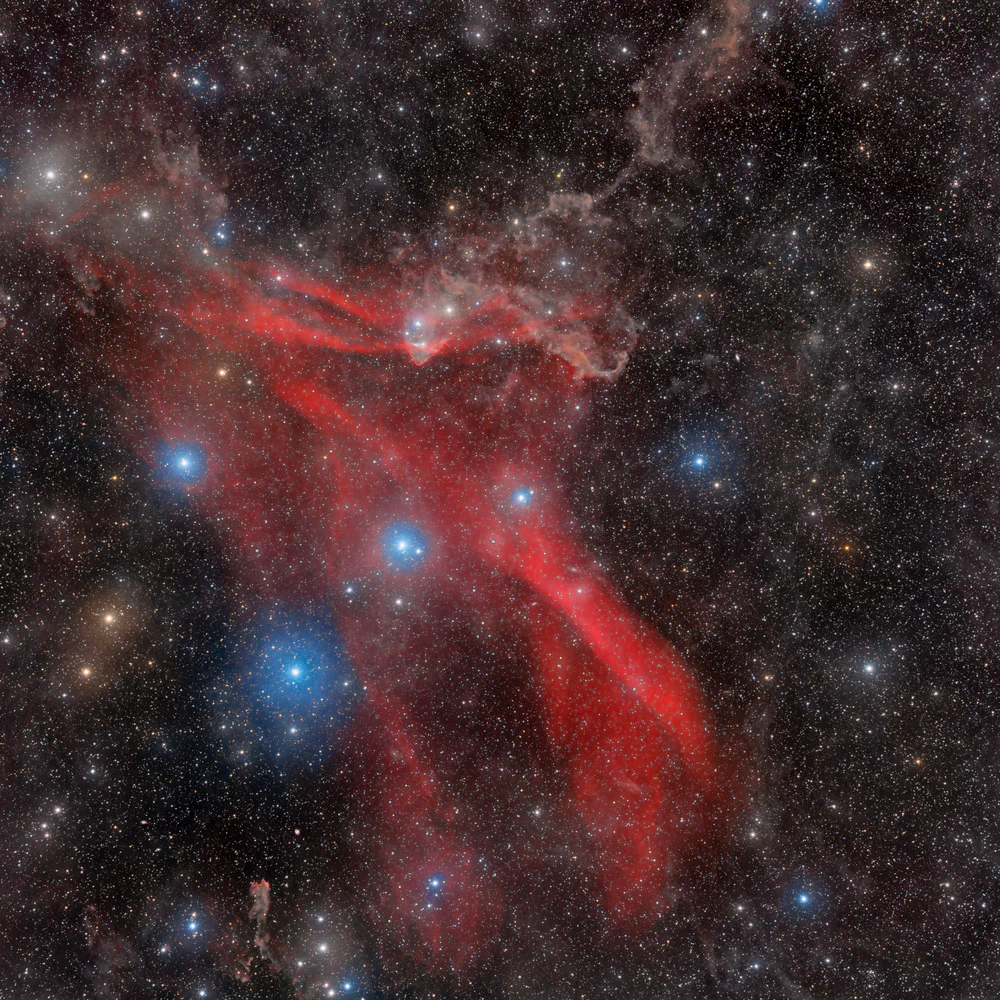
Sh2-126 covers more than five degrees of sky and is barely there at all — an emission region so faint that it is essentially invisible without an H-alpha filter. LBN 437 is the exception inside it. It is compact by comparison, it holds its own structure, and it is the one part of this field that survives a shorter exposure. This frame is 3.31 by 2.21 degrees, roughly a quarter of the area covered by the wide-field version of the same region.
Young stars behind the dust
The brightest part of LBN 437 is associated with young, hot stars. What the eye reads as a bright edge is dust and gas catching the light of stars that formed inside the cloud, and the darker lanes running through it are the same material seen against that glow rather than in front of it. The nebula is both lit and obscured by the cloud it belongs to.
Thirty-six hours of H-alpha
Of the 53.1 hours behind this image, 36 are H-alpha alone — 216 exposures of ten minutes, gathered by Christophe Marsaud from Saintes with an Askar FRA400 at f/5.6. That is what a target this faint costs from a site with an ordinary sky: the luminance and colour layers add up to seventeen hours, and the hydrogen layer takes twice as long as all the rest put together. The signal is not hiding behind the dust here — there is simply very little of it.
Sh2-126 s'étend sur plus de cinq degrés et tient à peine debout — une région en émission si faible qu'elle est pratiquement invisible sans filtre Hα. LBN 437 y fait exception. Elle est compacte en comparaison, elle a sa propre structure, et c'est la seule partie du champ qui survive à une pose courte. Ce cadrage couvre 3,31 × 2,21 degrés, soit environ le quart de la surface de la version grand champ de la même région.
La partie la plus brillante de LBN 437 est associée à de jeunes étoiles chaudes. Ce que l'œil lit comme un bord lumineux, ce sont des poussières et du gaz qui accrochent la lumière d'étoiles formées à l'intérieur du nuage ; les voies sombres qui la traversent sont la même matière, vue cette fois devant cette lueur. La nébuleuse est à la fois éclairée et obscurcie par le nuage dont elle fait partie.
Sur les 53,1 heures de cette image, 36 sont du Hα seul — 216 poses de dix minutes, acquises par Christophe Marsaud depuis Saintes avec un Askar FRA400 à f/5,6. C'est ce que coûte une cible aussi faible sous un ciel ordinaire : les couches de luminance et de couleur totalisent dix-sept heures, et la couche hydrogène demande à elle seule deux fois plus que tout le reste. Le signal ne se cache pas derrière la poussière ici — il y en a simplement très peu.