GALAXY
The Galaxy with Four Arms
— MESSIER 106 —
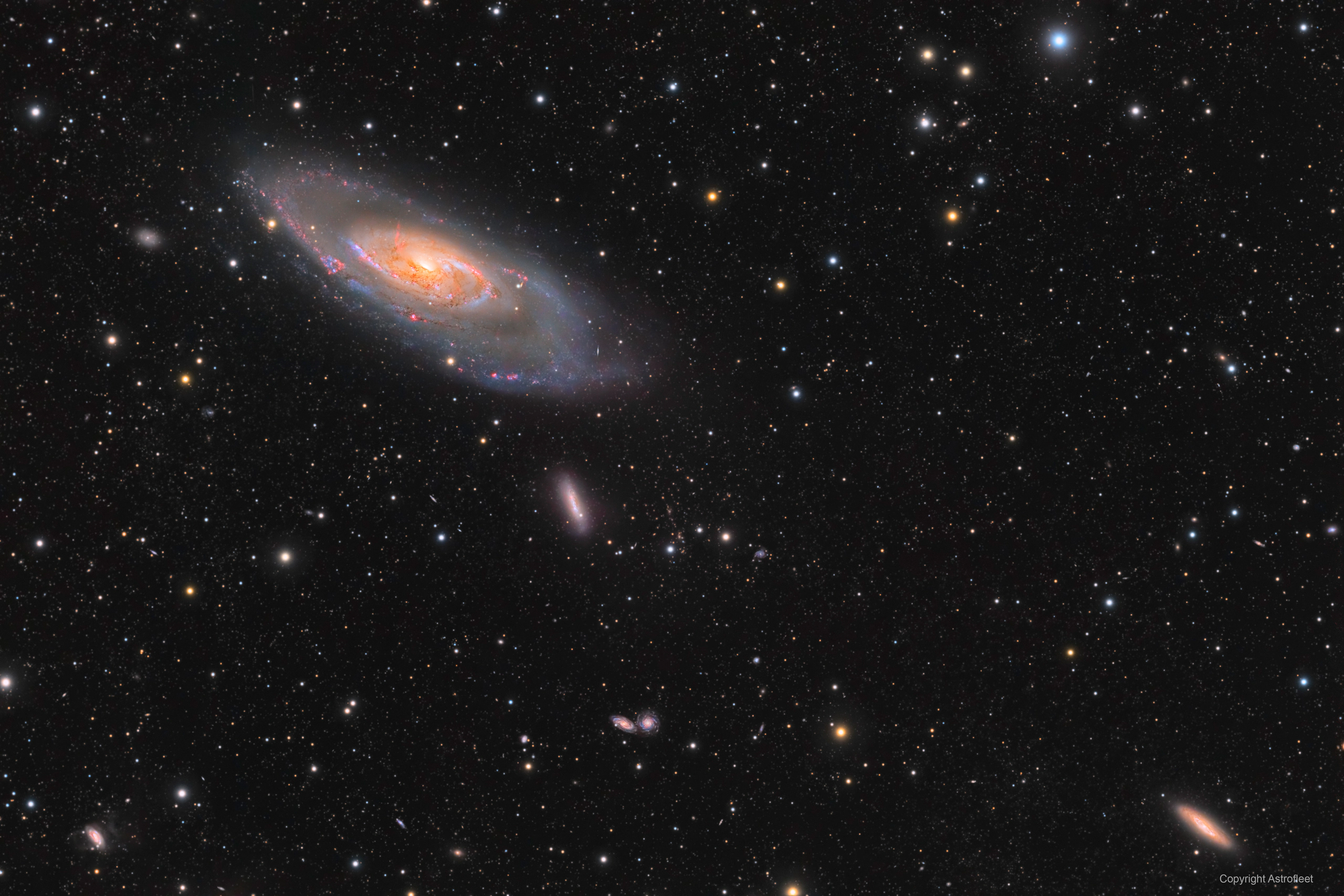
Processed by Nicolas Rolland, Paris, as part of the Astrofleet Team. 58.8 hours gathered with our own setup at PixelSkies, Castilléjar, Spain.
This galaxy has four spiral arms. Two of them contain no stars.
A spiral in Canes Venatici
Messier 106 is an intermediate spiral in Canes Venatici, between 22 and 25 million light-years away — barred, but weakly enough that the classification hedges. Pierre Méchain found it in 1781, and Charles Messier added it to his catalogue of nebulae and clusters. Dust lanes trace a spiral pattern that can be followed all the way into the bright central core, and the arms end in blue knots: young clusters dominated by hot massive stars with lifetimes of a few million years. The yellowish remnant of an older arm is visible too, its colour saying that its most massive stars stopped shining long ago.
Two arms with nothing in them
Then there are the other two. They were found in H-alpha in 1961 and have been called the anomalous arms ever since, because nothing about them behaves like a spiral arm: they hold no star clusters, no dust lanes, and no stars at all. What they hold is hot gas. The black hole at the centre of Messier 106 drives jets out into the disc, and the jets shock the gas they pass through, which then glows in hydrogen and in radio. The arms are the wake of something that came from the middle, not structure the galaxy built.
The galaxy that weighs black holes
That black hole is known better than most, and the reason is a ring of water molecules orbiting inside it. The molecules act as natural masers — microwave lasers — bright enough and compact enough to be tracked individually by radio interferometry. Following them around their orbits gives the mass of what they are orbiting by geometry alone, with no model in between: about forty million solar masses. The same measurement gives the distance to the galaxy directly, one of the most precise ever obtained outside our own, and it is one of the anchors the whole extragalactic distance scale is calibrated against. Carl Seyfert had picked up the unusual emission lines in 1943, and the galaxy has been a radio source since the 1950s; the masers explained what was underneath.
Thirty-four hours of hydrogen
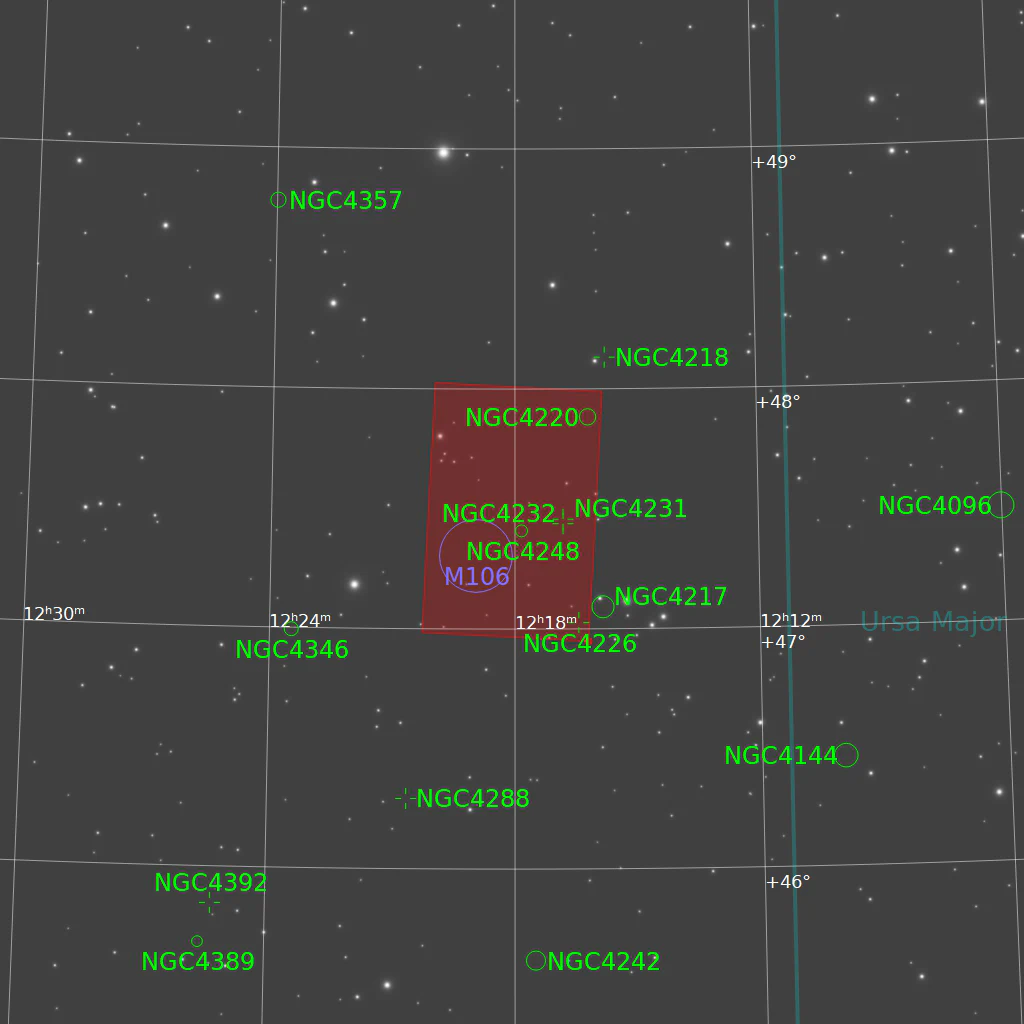
A TS-Optics CF-APO of 155 millimetres at f/8 with a monochrome sensor, from Castilléjar in March 2023, fifty-nine hours in all — and thirty-four of them are H-alpha, in ten-minute frames. That ratio is the whole answer to this subject. The anomalous arms emit almost nothing in broadband: they are not stars, and a luminance frame records the galaxy without them. Twenty-two hours of luminance in three-minute frames carry the disc, the dust and the star clusters; the H-alpha carries what the black hole did. The field runs 62 by 42 arcminutes for a galaxy about a fifth that size, which leaves room for the faint outer halo — and that is where fifty-nine hours runs out. Gathered with the Astrofleet team's own setup at PixelSkies.