NEBULAE

The Wizard Nebula, wide field

— NGC 7380 —
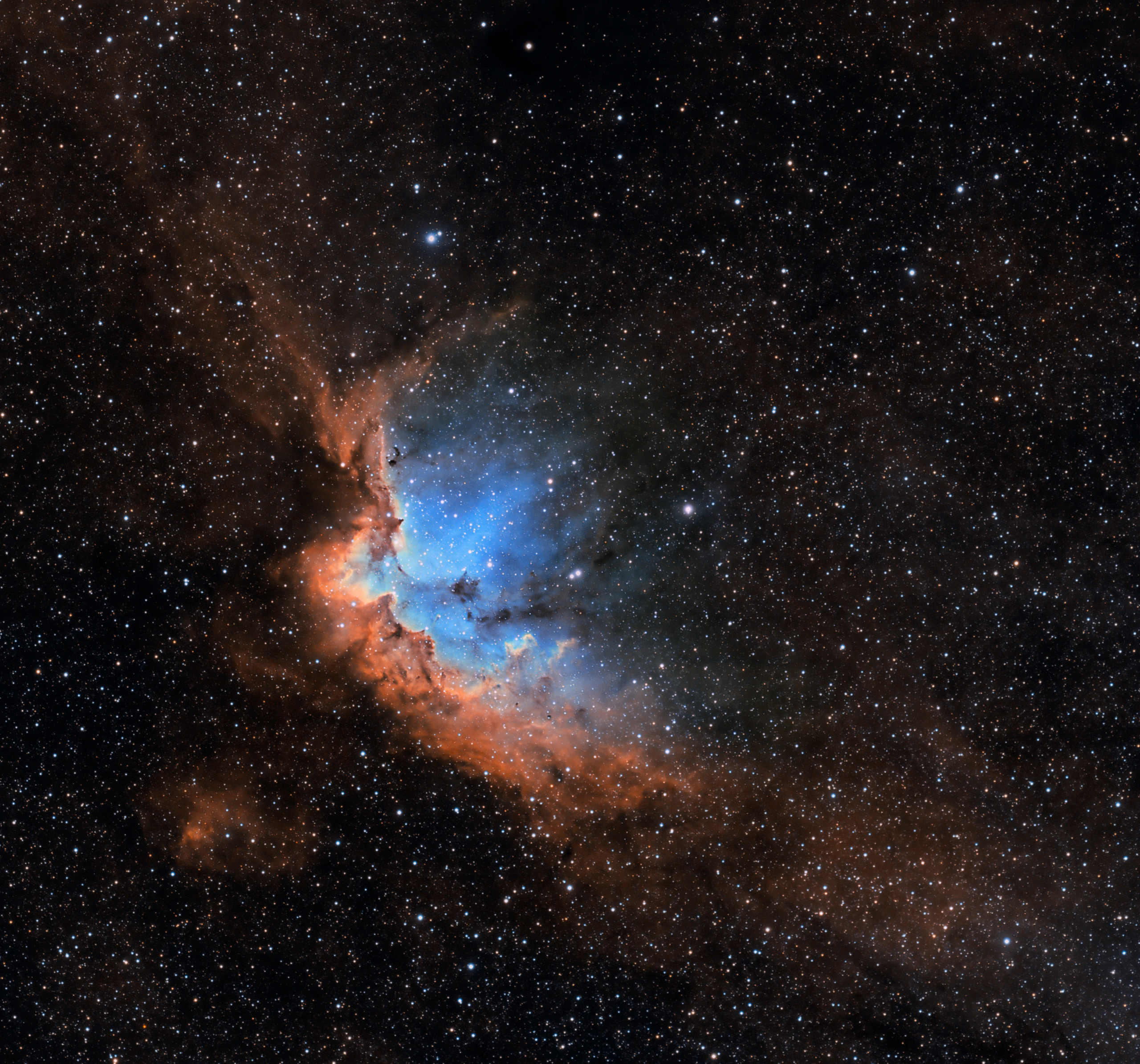
The Wizard Nebula NGC 7380 in Cepheus, pillars of dust lit from within by a young star cluster, in 11.6 hours of SHO with RGB stars.

Processed by Nicolas Rolland, Paris. 11.6 hours gathered by Grand Mesa Observatory at Whitewater, Colorado, USA.

This is the same nebula as the seventy-hour version, seen from further back. The frame runs 1.39 by 1.30 degrees, roughly two and a half times the area, and it holds the whole of NGC 7380 with room around it — the cluster, the nebula it lit, and the field it sits in.

A nebula wrapped around a young cluster

Caroline Herschel found the open cluster in 1787, and the nebula around it entered the Sharpless catalogue in 1959 as Sh2-142. It lies about 8,500 light-years away in Cepheus. The cluster spans some 20 light-years and is between 4 and 11 million years old, which is young enough that the gas it formed from is still there — what the frame shows is a cluster in the act of clearing its own nursery.

DH Cephei does the ionising

The pair of massive O-type stars at the cluster's centre, catalogued together as DH Cephei, is the primary ionising source for the whole HII region. At this focal length their effect is easier to read than in a tight crop: the nebula is visibly brighter and more structured close to them, and thins out towards the edges of the field where the ultraviolet no longer reaches with the same force.

Mapped nebula, real stars

The nebula is rendered in the Hubble palette — SII to red, Ha to green, OIII to blue — so its colours are assigned rather than observed. The stars are not. Red, green and blue filters were shot alongside the narrowband set and used for the stars alone, which means every point of light in this frame carries its true colour while everything around it carries a mapped one. It is a small distinction and it changes how the image reads: the star field stays honest, and the nebula stays legible.

Version française
C'est la même nébuleuse que la version de soixante-dix heures, vue de plus loin. Le champ fait 1,39 × 1,30 degré, environ deux fois et demie la surface, et il contient NGC 7380 en entier avec de la marge autour : l'amas, la nébuleuse qu'il éclaire, et le champ dans lequel il se trouve.
 
Caroline Herschel a découvert l'amas ouvert en 1787, et la nébuleuse qui l'entoure est entrée au catalogue Sharpless en 1959 sous le numéro Sh2-142. L'ensemble se situe à environ 8 500 années-lumière, dans Céphée. L'amas s'étend sur une vingtaine d'années-lumière et son âge est estimé entre 4 et 11 millions d'années : assez jeune pour que le gaz dont il est né soit encore là. Ce que montre le champ, c'est un amas en train de déblayer sa propre pouponnière.
 
La paire d'étoiles massives de type O qui occupe le centre de l'amas, cataloguée sous le nom de DH Cephei, est la principale source d'ionisation de toute la région HII. À cette focale, son effet se lit mieux que sur un cadrage serré : la nébuleuse est visiblement plus brillante et plus structurée à proximité, et s'amincit vers les bords du champ, là où l'ultraviolet n'arrive plus avec la même force.
 
La nébuleuse est rendue en palette Hubble — le SII sur le rouge, le Ha sur le vert, le OIII sur le bleu — ses couleurs sont donc attribuées et non observées. Les étoiles, elles, ne le sont pas. Des filtres rouge, vert et bleu ont été posés en plus du jeu à bande étroite et servent uniquement aux étoiles : chaque point lumineux de ce champ porte sa vraie couleur, tout ce qui l'entoure porte une couleur assignée. La distinction est petite et elle change la lecture de l'image — le champ d'étoiles reste honnête, la nébuleuse reste lisible.

Technical data
OpticsTakahashi FSQ130 f/5
CameraQHY600M
MountParamount ME
FiltersHa, OIII, SII, R, G, B
PaletteSHO SII → red · Ha → green · OIII → blue
LocationGrand Mesa Observatory at Whitewater, Colorado, USA
DateOctober 2020
Exposures11.6 hours Ha 17 × 600 sec · OIII 17 × 600 sec · SII 19 × 600 sec · R 13 × 300 sec · G 12 × 300 sec · B 8 × 300 sec
SoftwarePixinsight, CCDstack, Photoshop
CopyrightsNicolas Rolland & Grand Mesa Observatory
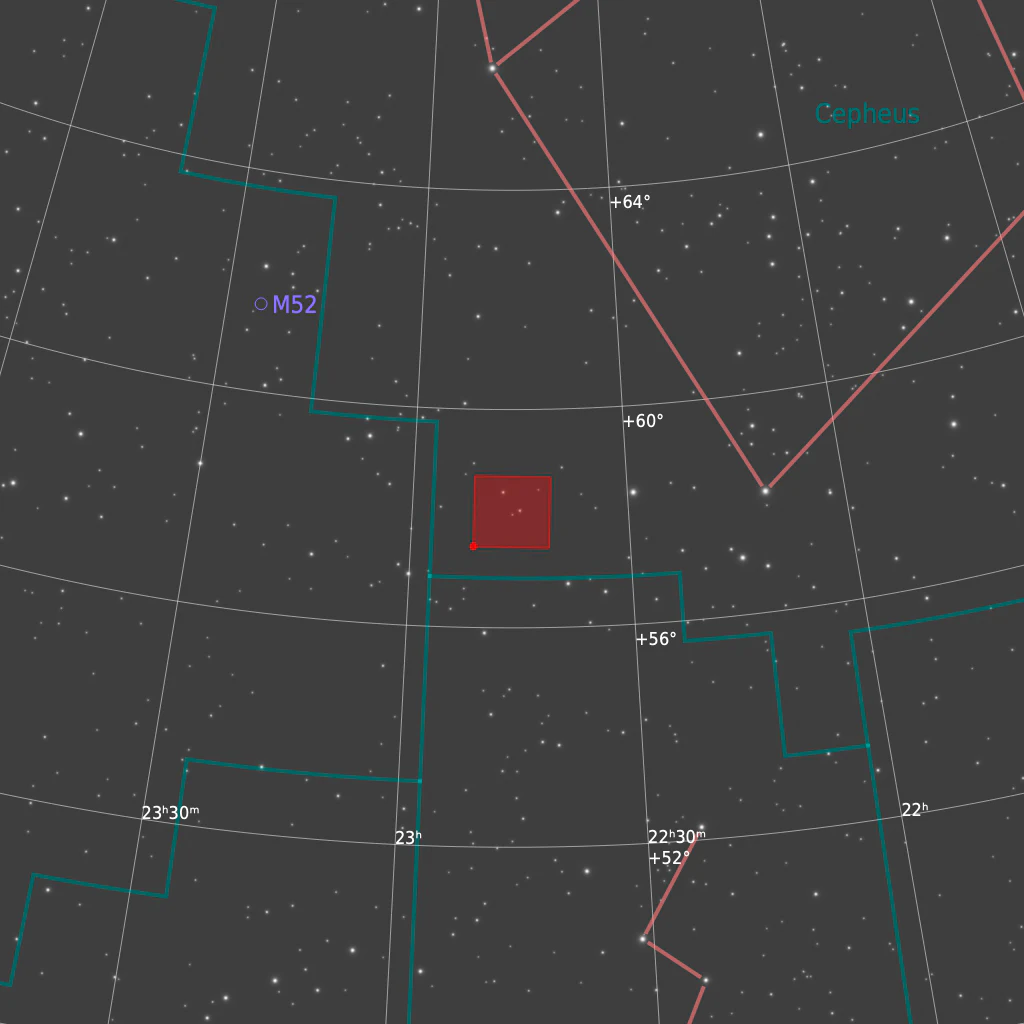
Finding chart The Wizard Nebula, wide field — finding chart
RA22h 46m 09.3s Dec+58° 07′ 22.6″ Size1.39 × 1.3 deg Orientationup is 1.91° E of N ConstellationCepheus