NEBULAE
The Continent and the Bird
— NGC 7000 & IC 5070 —
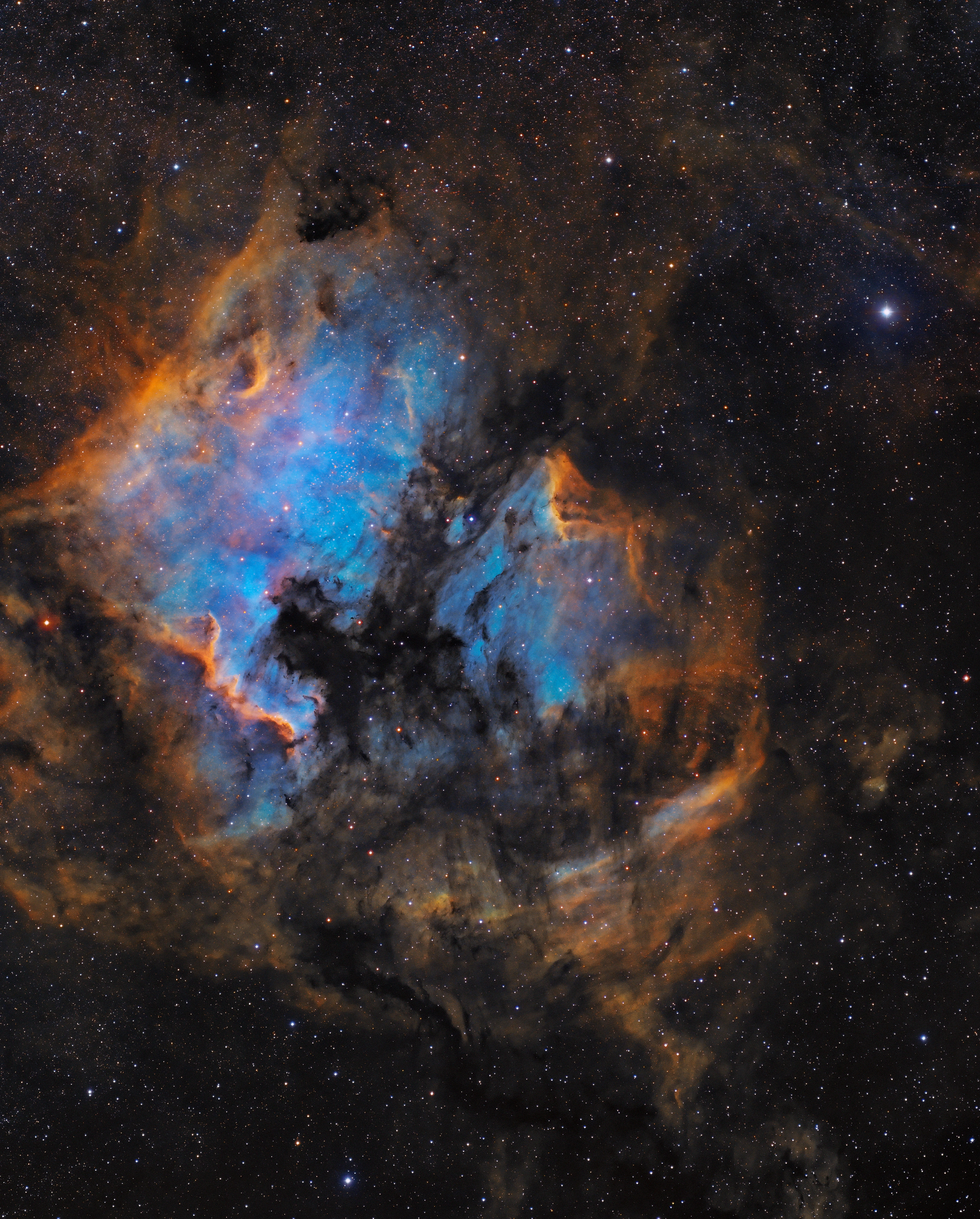
Processed by Nicolas Rolland, Paris. 21 hours gathered by Grand Mesa Observatory at Whitewater, Colorado, USA.
The coastline of this continent is not an edge. It is a strip of dust lying in front of the gas.
A continent made by an absence
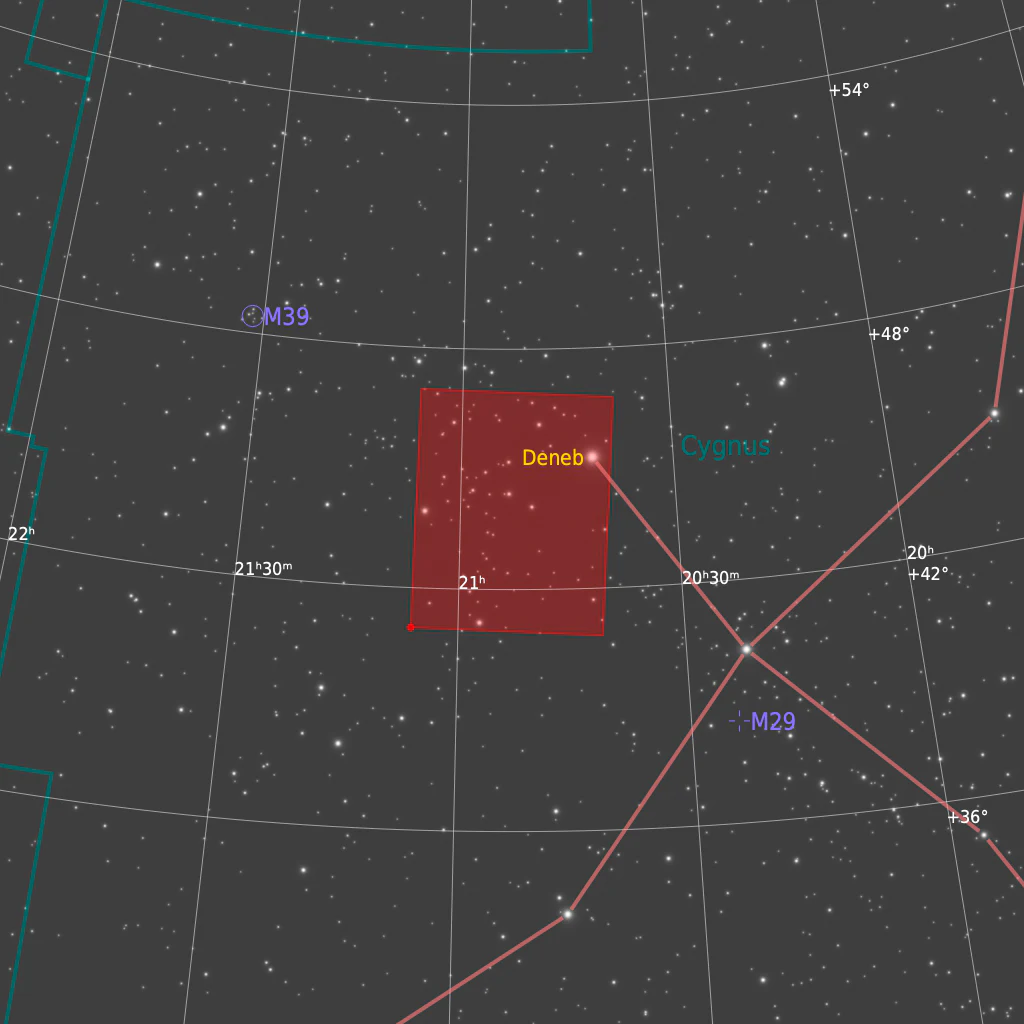
NGC 7000 is an emission nebula in Cygnus, also catalogued Caldwell 20, about 2,600 light-years away and spread across several degrees of sky. Its shape is the reason for the name, and the shape is not the nebula's own: the coastline, the Gulf of Mexico, the eastern seaboard are all drawn by a lane of dark dust lying between us and the glowing hydrogen, blocking it in some places and not in others. What looks like the edge of a continent is a gap in something else.
One cloud, two names
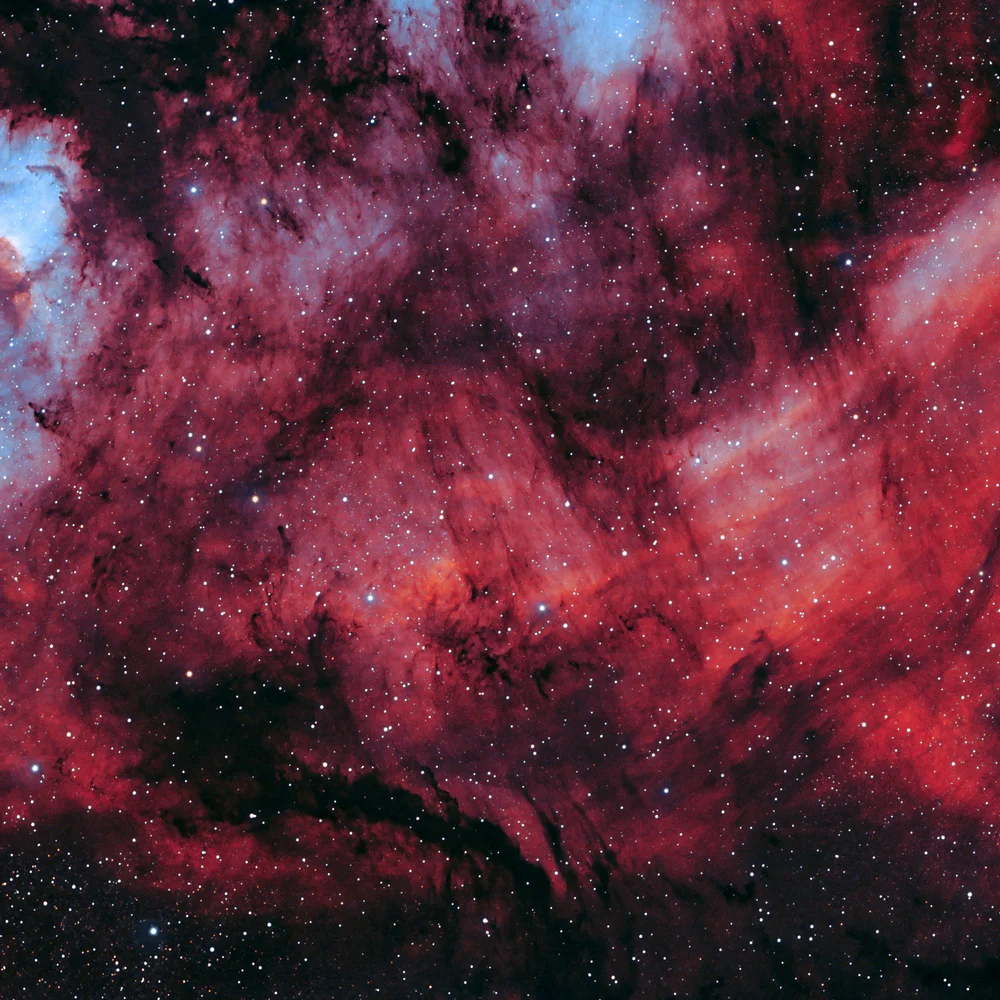
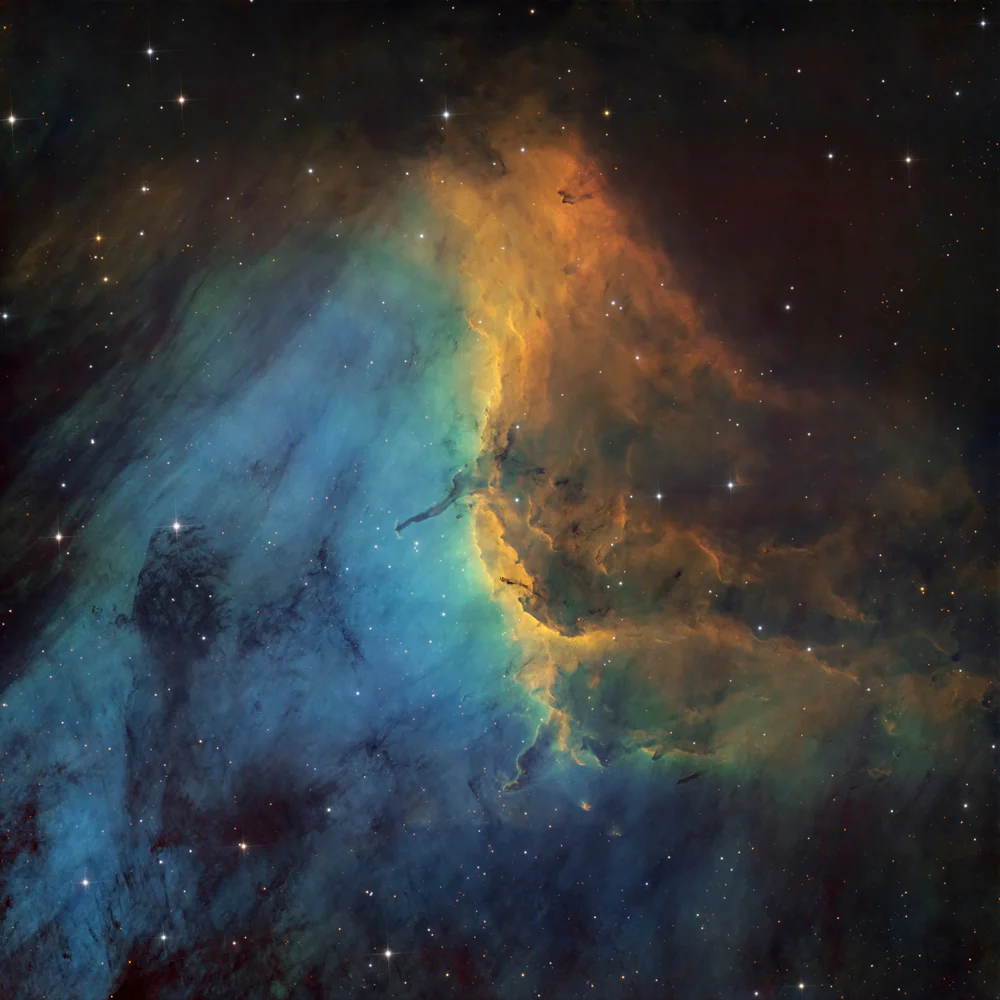
The same dark lane makes the Pelican. IC 5070 sits on the other side of it, and the two nebulae have been catalogued separately since the nineteenth century because from here they look like separate objects. They are not. Gas runs continuously from one to the other behind the dust, and the two silhouettes are two views of one cloud interrupted by the same obstacle. IC 5068, the fainter patch further along, belongs to it as well.
The star nobody can see
Something has to be ionising all of this, and for a long time the credit went to Deneb, which lies in the same direction and is one of the most luminous stars in the sky. It is also much too far away. The source was identified in 2005: a hot O-type star buried inside the dust lane itself, catalogued 2MASS J20555125+4352246, invisible at optical wavelengths and sitting almost exactly between the two nebulae it lights. The Cygnus Wall — the ridge running along the Mexico and Central America side — is where its radiation is currently eating into the cloud, and where most of the new stars in this field are forming.
Twenty-one hours at 250 millimetres
A William Optics RedCat 51 at f/4.9 with a monochrome sensor, from Whitewater in June 2020 — a focal length of 250 millimetres, which is what it takes to hold nearly six degrees of sky in one frame. Twenty-one hours went in, eighteen of them narrowband in fifteen-minute frames and three in luminance and colour at five minutes each. The narrowband does the nebula and the three hours of broadband do the stars, which is why their colours here are real while the gas is a mapping. At 250 millimetres the field comes easily and the detail does not: the Cygnus Wall is a ridge a few arcminutes wide in a frame six degrees across, and what this image gives of it is its outline. Grand Mesa Observatory gathered the data at Whitewater.
Hubble palette (SHO): SII in the red channel, H-alpha in green, OIII in blue. The nebula's colours are a mapping of three emission lines, not a record of what the eye would see. The star colours are real, taken from the separate RGB frames.