NEBULAE
The Nebula Beside the Pelican
— IC 5068 —
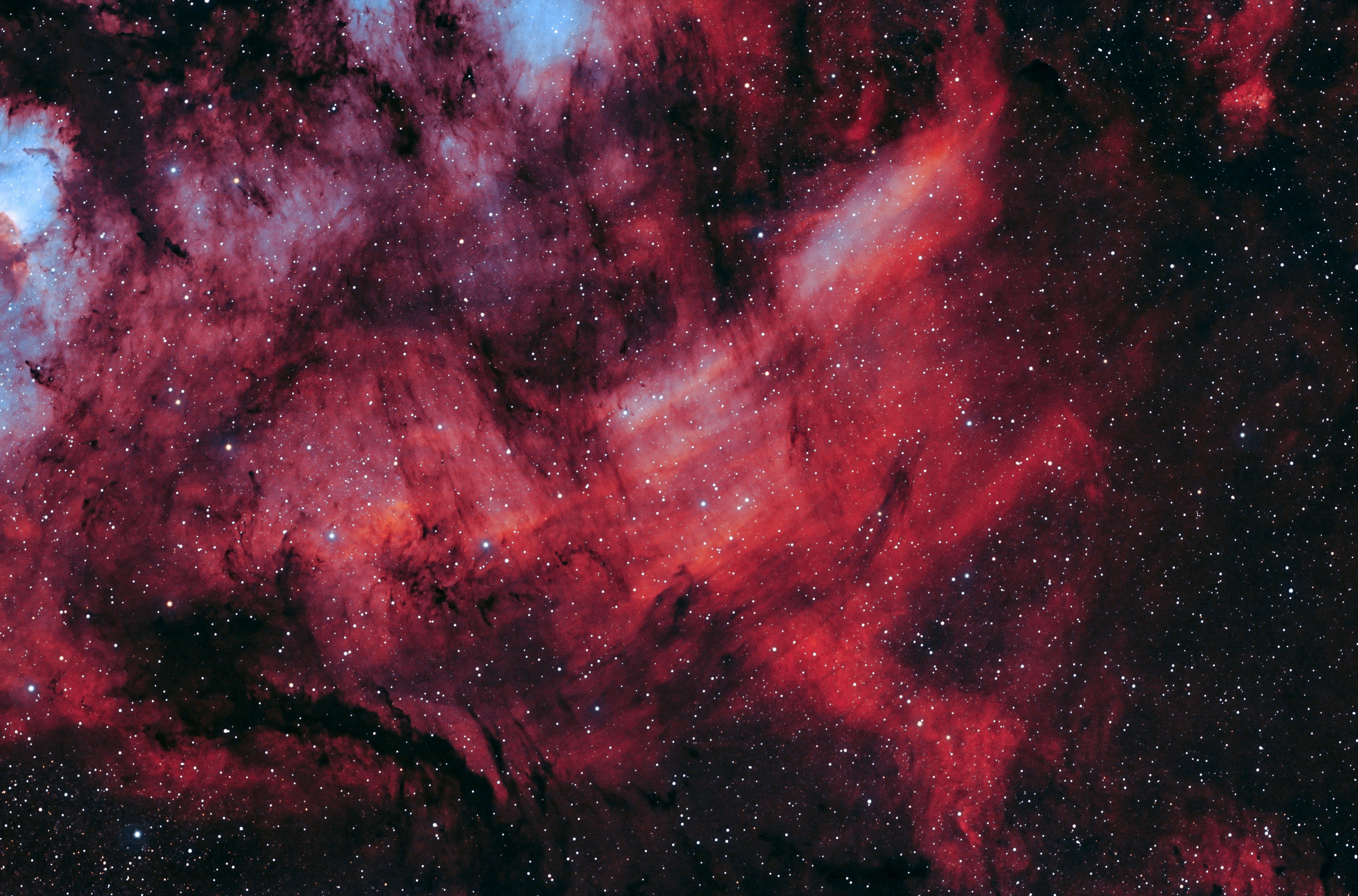
Processed by Nicolas Rolland, Paris. 6.7 hours gathered by Grand Mesa Observatory at Whitewater, Colorado, USA.
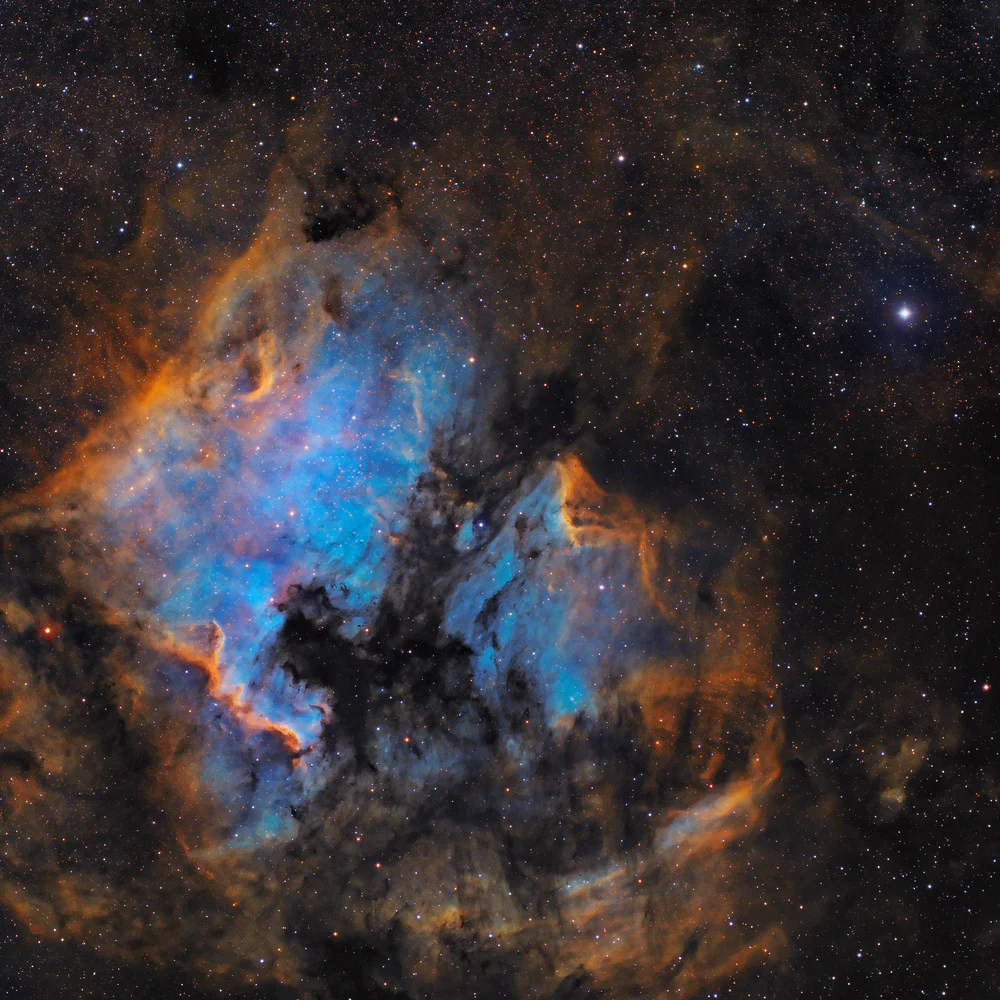
Most people who photograph this part of Cygnus crop this nebula out of the frame on their way to the two next door.
Cordoned off by dust
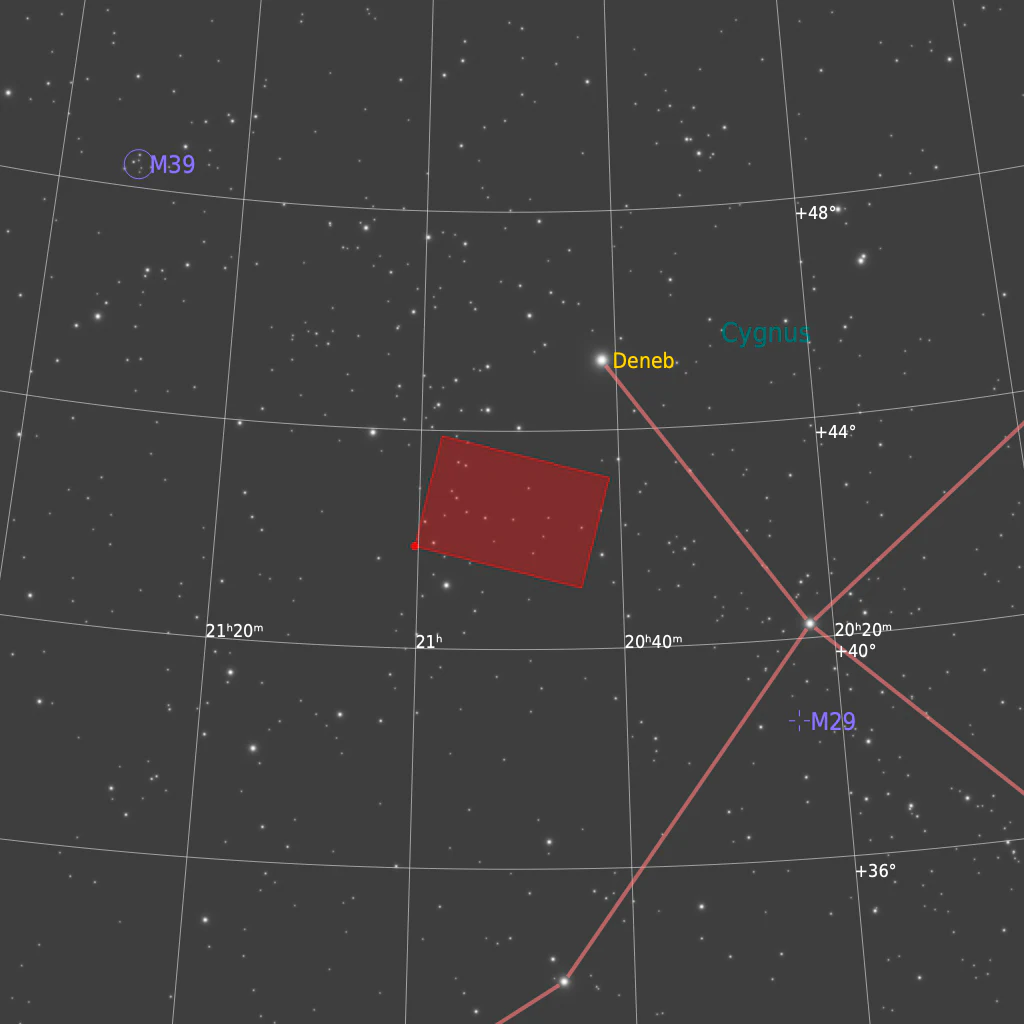
IC 5068 is a faint emission nebula in Cygnus, sitting close on the sky to the North America and Pelican nebulae and to Deneb. What defines it is not its own shape but its boundary: streaks of dark cloud run between the hydrogen regions and cut the nebula off from its better-known neighbours. Those lanes are why it reads as a separate object at all — the gas on either side of them belongs to the same complex.
Faint by comparison, not in absolute terms
At magnitude 7.3 and 1,600 light-years away, IC 5068 is not a difficult target on its own terms. It is faint relative to what surrounds it, which is a different problem: the North America nebula is brighter, the Pelican is more distinctive, and Deneb is one of the brightest stars in the sky. An object gets overlooked for its neighbours as easily as for its own dimness.
Hydrogen in red, oxygen in green and blue
This is an HOO rendering: H-alpha in the red channel, OIII in green and blue. The colours of the nebula are therefore not its true colours — narrowband filters isolate two emission lines and discard everything else, which is what makes faint gas visible against a bright sky. The star colours are real, taken from separate RGB frames and put back in afterwards.
Six hours and forty minutes
The optic was a Takahashi FSQ130 at f/5 from Whitewater in June 2020, with a colour sensor behind it. That combination costs something: on a colour sensor only a quarter of the pixels see red and half see green, so narrowband light through it is used at a fraction of its efficiency compared with a monochrome chip. Two and a half hours of H-alpha and one and three quarters of OIII is not a great deal to begin with, and less of it lands than the numbers suggest. What comes through is the hydrogen and the dark lanes across it, over a field of 3.1 by 2.1 degrees. What does not is the fainter oxygen: OIII is weak here, and one and three quarter hours reaches the strongest of it and stops.