GALAXY
Barnard's Galaxy
— NGC 6822 —
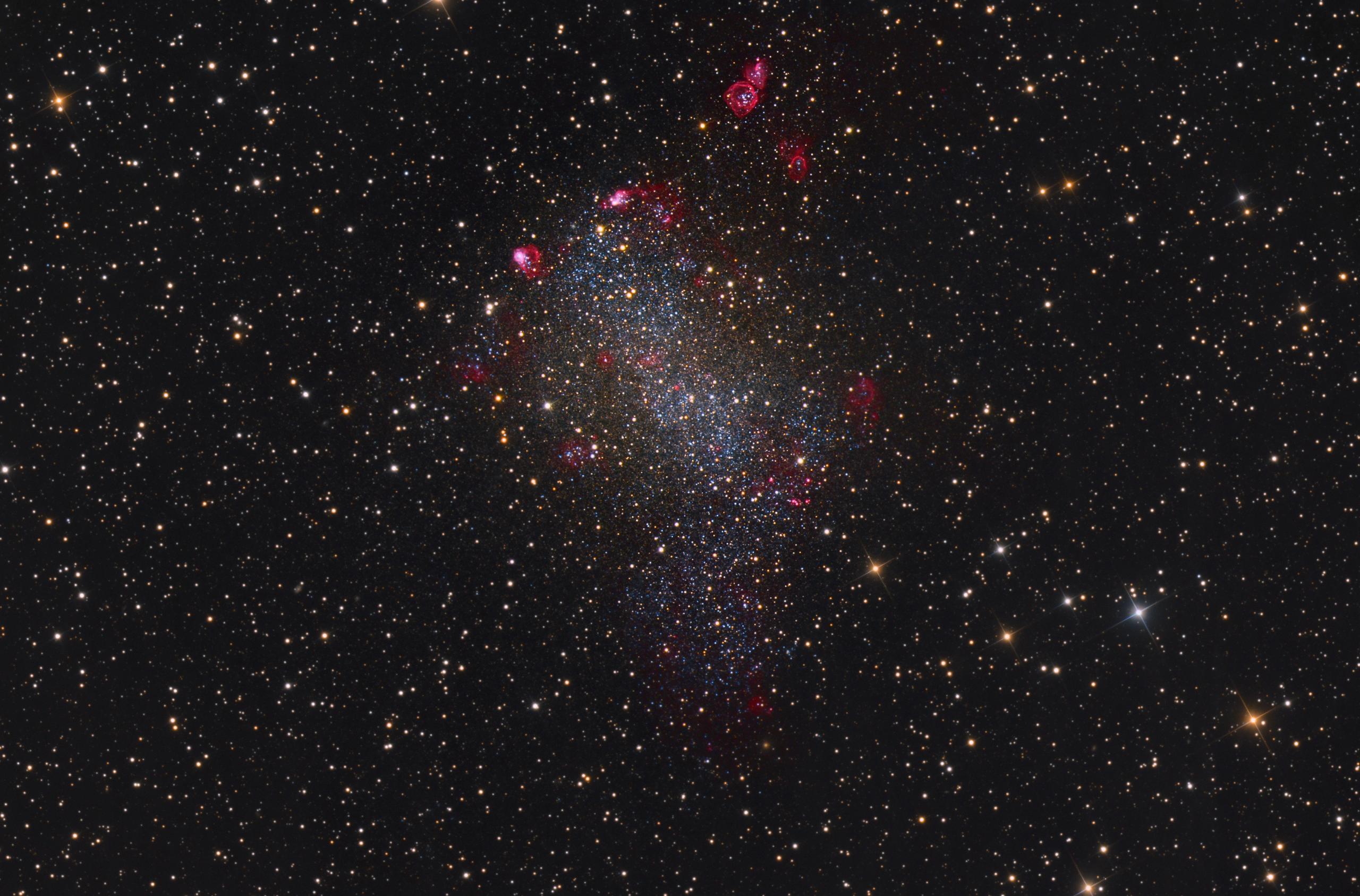
Processed by Nicolas Rolland, Paris. 32.5 hours gathered by Martin Pugh at El Sauce Observatory, Rio Hurtado, Chile.
This galaxy has been making massive star clusters for its entire life, which is not how our own has done it.
A dwarf in the Local Group
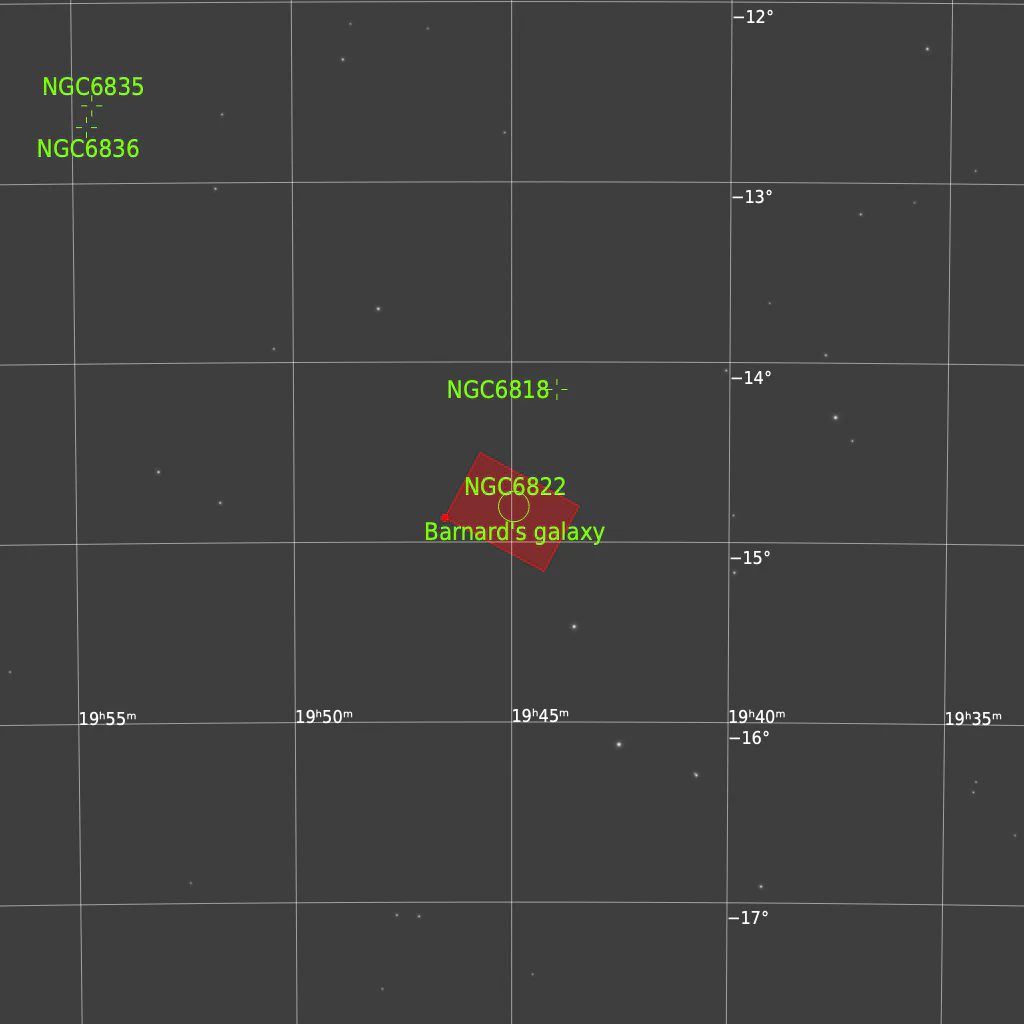
Barnard's Galaxy is a dwarf irregular in Sagittarius, about 1.6 million light-years away, and one of the closest galaxies to our own. It belongs to the Local Group and resembles the Small Magellanic Cloud in structure and composition. E.E. Barnard found it in 1884 with a six-inch refractor.
The galaxy that fixed the distance scale
In 1925 Edwin Hubble identified eleven Cepheid variables in it. Cepheids pulse at a rate that depends on their intrinsic brightness, which makes them distance markers: measure the period, you know the true luminosity, compare it to the apparent one and you have the distance. Hubble got more than 700,000 light-years — short of the modern figure, but enough to place the galaxy outside the Milky Way. NGC 6822 was the first galaxy beyond the Magellanic Clouds whose distance was measured accurately.
A hundred and fifty places making stars
More than 150 HII regions are catalogued here — pockets of hydrogen ionised by young stars inside them, and the reason the galaxy is speckled with pink. The largest active one is Hubble-X: a nearly circular cloud about 110 light-years across, holding a central cluster of several thousand stars less than four million years old, with a bluish arm of loosely grouped young stars trailing out of it. In the 1920s Hubble also found three star clusters here and took them all for ancient globulars. Space-telescope images showed otherwise: Hubble VII is nearly as old as the Universe, Hubble VIII around 1.8 billion years, and Hubble VI as young as 100 million. Unlike the Milky Way, which made its big globulars early and stopped, this galaxy has never stopped.
Thirty-two hours, a third of them in H-alpha
The CDK17 was working at f/6.8 with adaptive optics ahead of the sensor, from Rio Hurtado in August 2020. Thirty-two and a half hours went to the field, and eleven and a half of those are H-alpha alone — more than a third of the total on a single filter. That is what the subject demands: without it the galaxy is a faint smear of resolved stars, and the 150 HII regions that make it interesting do not separate from them. At 1.6 million light-years a cloud 110 light-years across covers about fourteen arcseconds, which is reachable. The star clusters are not: Hubble VI, VII and VIII are a few arcseconds each, and telling their ages apart took an instrument above the atmosphere. Martin Pugh gathered the data at El Sauce.