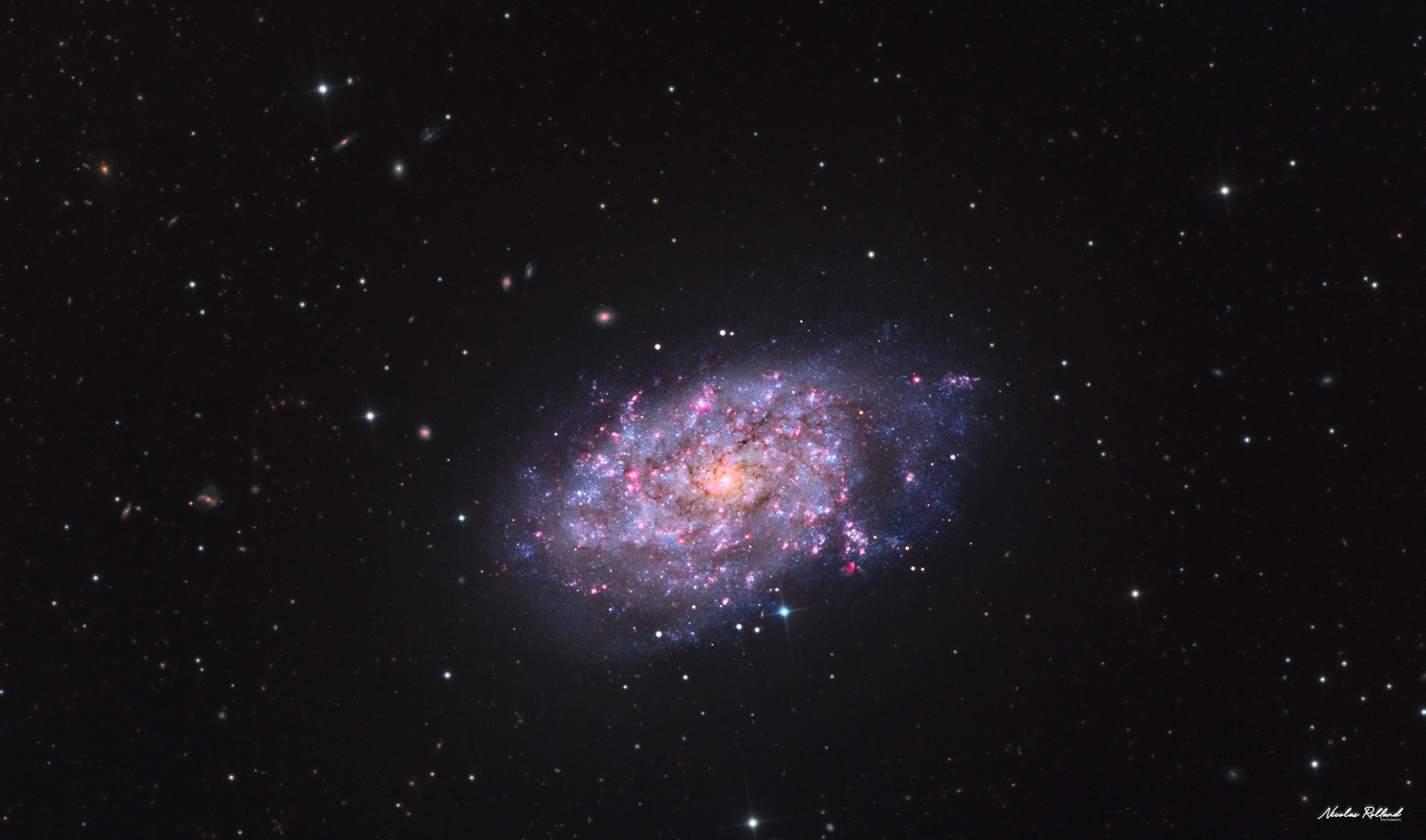
The Flocculent Spiral
NGC 7793
Processed by Nicolas Rolland, Paris. 28 hours gathered by Martin Pugh at El Sauce Observatory, Rio Hurtado, Chile.
There is an object in this galaxy that pulls matter off a supergiant faster than anything of its size should be able to.
A spiral with no pattern to its arms
NGC 7793 lies about 12.7 million light-years away in Sculptor, one of the brightest members of the Sculptor Group — the nearest galaxy group to our own. James Dunlop found it in 1826. It is flocculent: instead of two or four arms sweeping out from the core, the star-forming regions break into patches that never resolve into a pattern. Nothing organises the disc, and it goes on forming stars anyway.
A supernova caught before the fact
On 25 March 2008 a supernova appeared in this galaxy, SN 2008bk, reaching magnitude 12.5 and becoming the second brightest of that year. What makes it unusual is not the explosion but what came before it: the progenitor, a red supergiant, had been photographed 547 days earlier. Very few supernovae have a portrait of the star that produced them, and this is one of the closest.
P13, and what it turned out to be
The brightest X-ray source in the galaxy, catalogued P13, was taken for a black hole of under fifteen solar masses for more than a decade. In 2016 coherent pulsations were found in it, at 0.42 seconds — and black holes do not pulse. P13 is a neutron star of about 1.4 solar masses, orbiting a B9Ia supergiant of eighteen to twenty-three in sixty-four days, and pulling matter off it at a rate that should not be possible for something that small. Elsewhere in the same galaxy sits S26, a nebula inflated by jets from a different compact source.
Twenty-eight hours from Rio Hurtado
The CDK17 was working at f/6.8 with adaptive optics ahead of the sensor, from Rio Hurtado in October 2020. Twenty-eight hours went to this field: seven in luminance, fifteen split across red, green and blue, and six in H-alpha. The six hours of H-alpha are what separate the star-forming patches from the general glow of the disc — on a flocculent spiral that matters more than usual, because there is no arm structure to guide the eye and the patches are the only structure there is. What the image does not show is any of the objects above. P13 and S26 are X-ray and radio sources; at visible wavelengths this is a galaxy with a patchy disc, and everything interesting about it was found somewhere else in the spectrum. Martin Pugh gathered the data at El Sauce.
Il y a dans cette galaxie un objet qui arrache de la matière à une supergéante plus vite que rien de sa taille ne devrait pouvoir le faire.
NGC 7793 se trouve à environ 12,7 millions d'années-lumière, dans le Sculpteur, et compte parmi les membres les plus brillants du groupe du Sculpteur — le groupe de galaxies le plus proche du nôtre. James Dunlop l'a découverte en 1826. Elle est cotonneuse : au lieu de deux ou quatre bras s'échappant du noyau, les régions de formation d'étoiles s'y fragmentent en plaques qui ne dessinent jamais de motif. Rien n'organise ce disque, et il continue de fabriquer des étoiles.
Le 25 mars 2008, une supernova est apparue dans cette galaxie, SN 2008bk, atteignant la magnitude 12,5 et devenant la deuxième plus brillante de l'année. Ce qui la rend singulière n'est pas l'explosion mais ce qui l'a précédée : son progéniteur, une supergéante rouge, avait été photographié 547 jours plus tôt. Très peu de supernovae disposent d'un portrait de l'étoile qui les a produites, et celle-ci est l'une des plus proches.
La source X la plus brillante de la galaxie, cataloguée P13, a passé plus de dix ans pour un trou noir de moins de quinze masses solaires. En 2016, on y a détecté des pulsations cohérentes à 0,42 seconde — et un trou noir ne pulse pas. P13 est une étoile à neutrons d'environ 1,4 masse solaire, en orbite de soixante-quatre jours autour d'une supergéante B9Ia de dix-huit à vingt-trois masses solaires, à qui elle arrache de la matière à un rythme qui ne devrait pas être possible pour un objet aussi petit. Ailleurs dans la même galaxie se tient S26, une nébuleuse gonflée par les jets d'une autre source compacte.
Le CDK17 travaillait à f/6,8, avec une optique adaptative devant le capteur, depuis Rio Hurtado en octobre 2020. Vingt-huit heures ont été consacrées à ce champ : sept en luminance, quinze réparties entre rouge, vert et bleu, et six en H-alpha. Ce sont ces six heures de H-alpha qui séparent les plaques de formation stellaire de la lueur générale du disque — sur une spirale cotonneuse, cela compte plus qu'ailleurs, puisqu'aucune structure de bras ne guide l'œil et que ces plaques sont la seule structure disponible. Ce que l'image ne montre pas, c'est aucun des objets ci-dessus. P13 et S26 sont des sources X et radio ; en lumière visible, il s'agit d'une galaxie au disque grumeleux, et tout ce qu'elle a d'intéressant a été trouvé ailleurs dans le spectre. Martin Pugh a rassemblé les données à El Sauce.
TECHNICAL DATA
ACQUISITION DETAILS
OPTICS Planewave CDK17 @ F/6.8
CAMERA SBIG STXL-11002 (AOX)
MOUNT Paramount ME
FILTERS Ha, L, R, G, B
LOCATION El Sauce Observatory, Rio Hurtado, Chile
DATE October 2020
EXPOSURES 28 hours (L 21 x 1200 sec, R 15 x 1200 sec, G 15 x 1200 sec, B 15 x 1200 sec, Ha 12 x 1800 sec)
PROCESSING SOFTWARE Pixinsight, CCDstack, Photoshop
COPYRIGHTS Nicolas Rolland & Martin Pugh

TARGET DETAILS
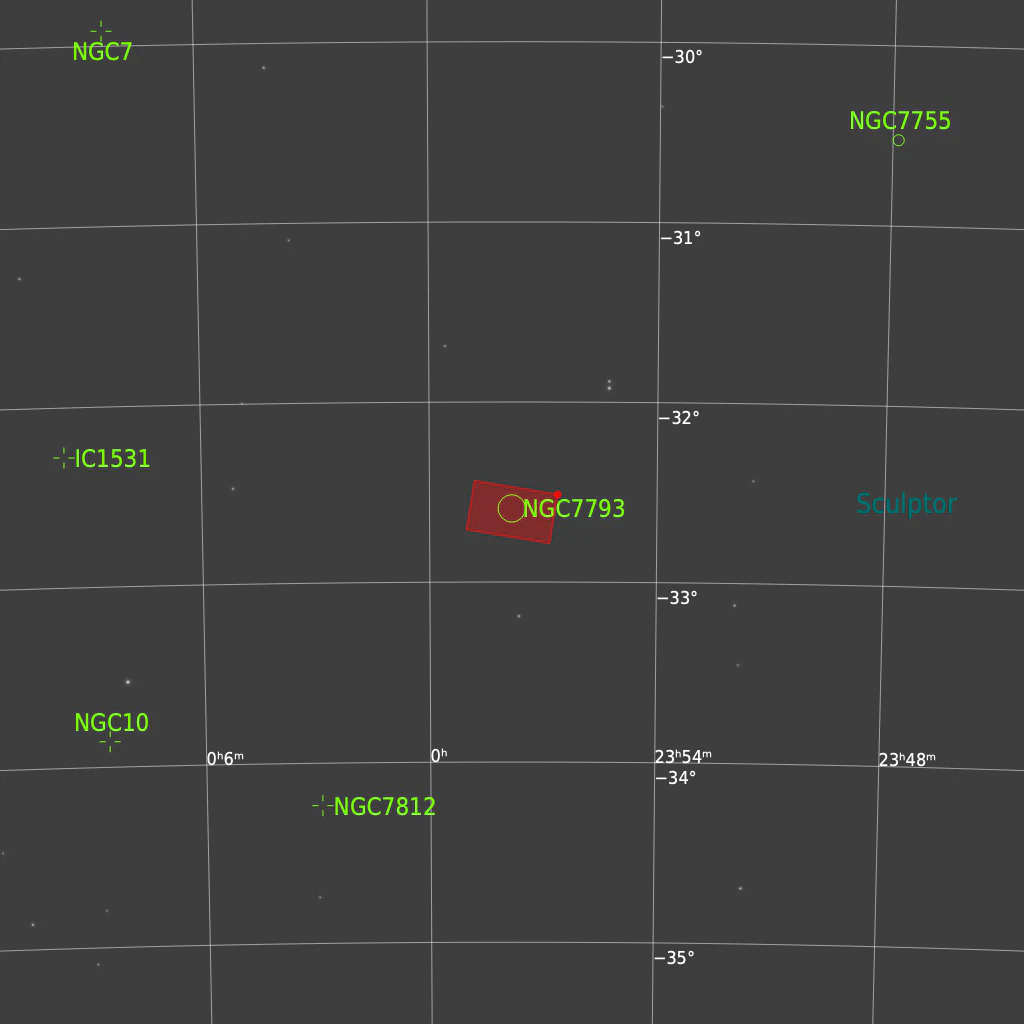
RA 23h 57m 49.4s
DEC -32° 36' 39.4"
SIZE 28.1 x 16.5 arcmin
ORIENTATION Up is 190 degrees E of N
CONSTELLATION Sculptor
DISTANCE 12 million ly
MAGNITUDE 9,15