GALAXY
NGC 5078 & Friends
— NGC 5078, NGC 5101 & IC 879 —
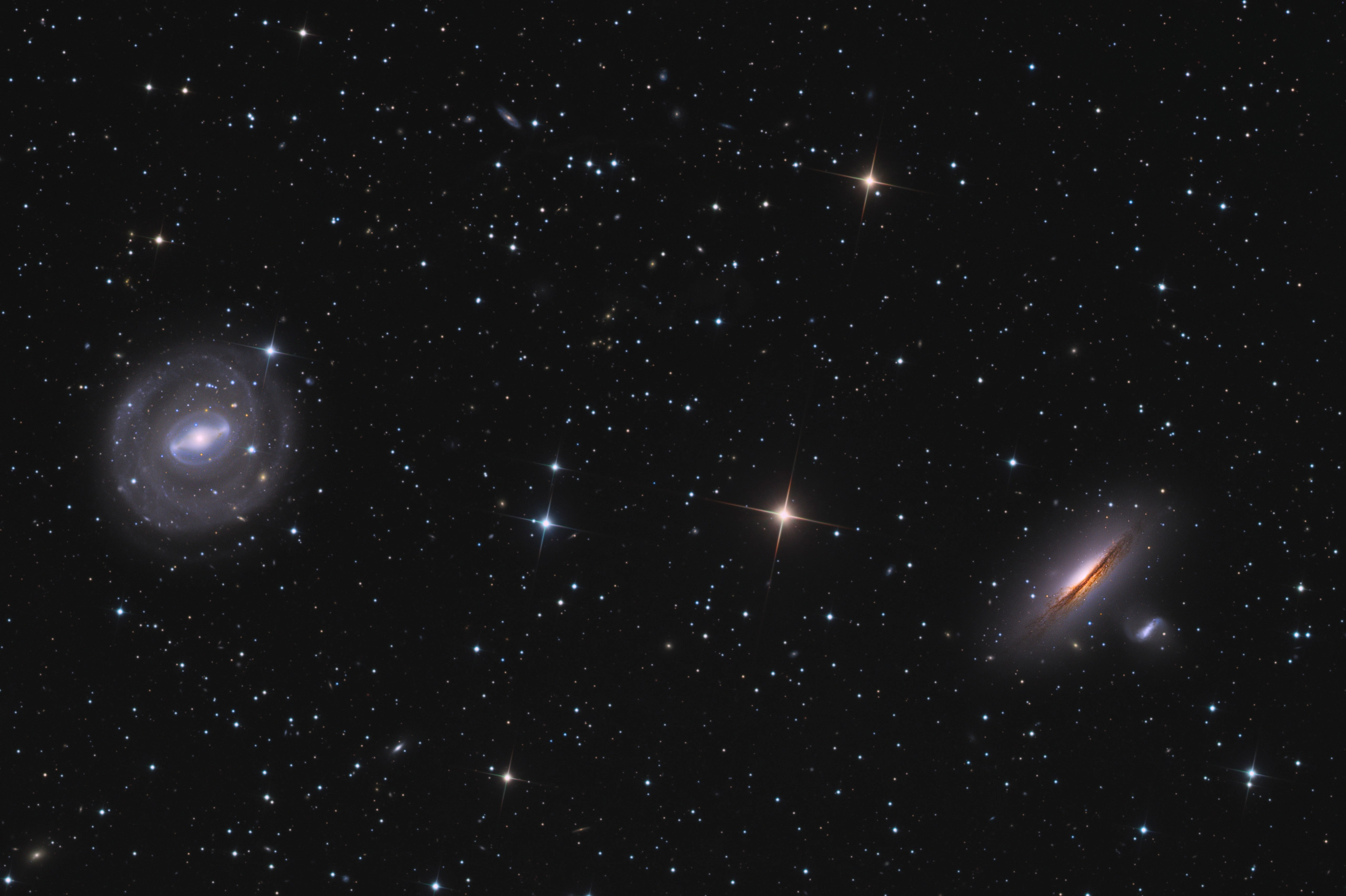
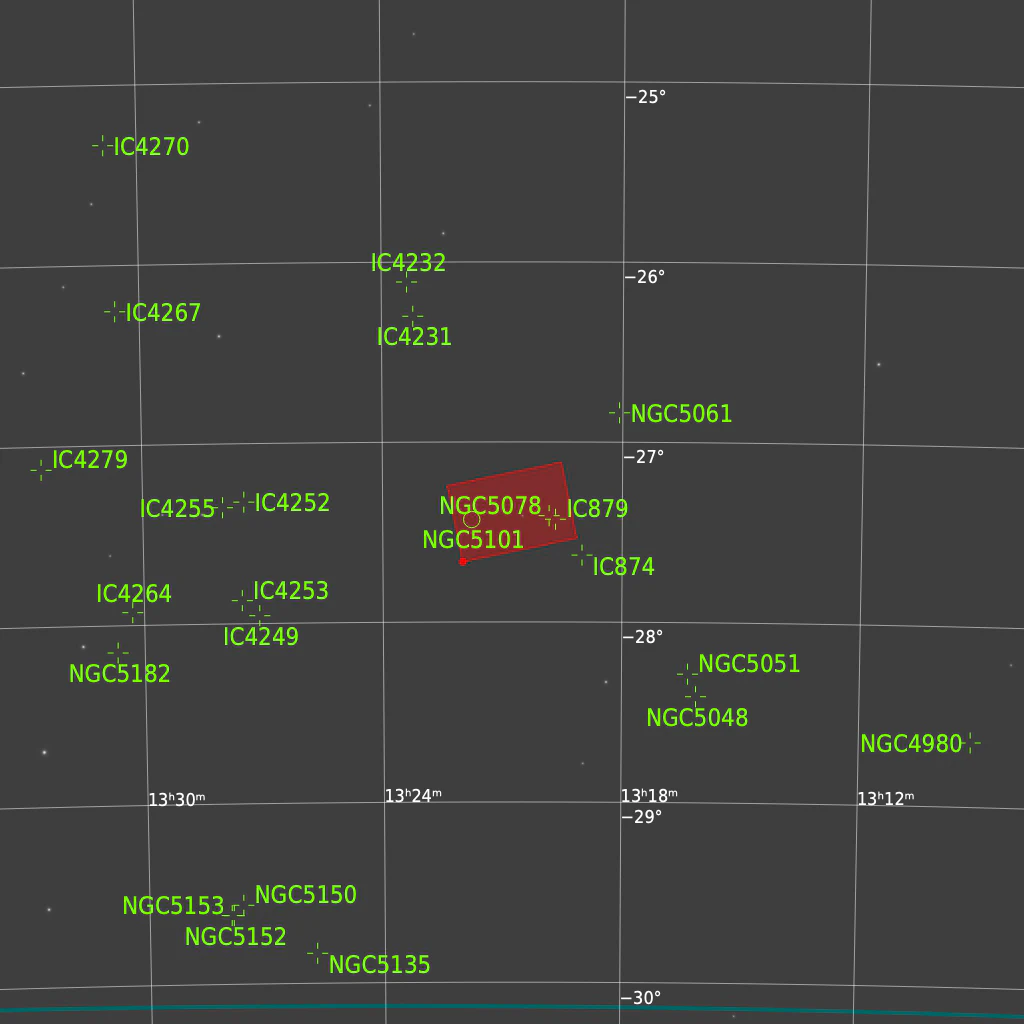
Processed by Nicolas Rolland, Paris. 26.3 hours gathered by Martin Pugh at El Sauce Observatory, Rio Hurtado, Chile.
Three galaxies share this field. Two of them are close enough to matter to each other.
A spiral in the NGC 5061 group
NGC 5078 lies about 94 million light-years away in Hydra, a spiral some 127,000 light-years across seen at a steep angle. Its dust lane runs almost the full width of the disc, dark against the light of the bulge behind it. It belongs to the loose group that carries the name of NGC 5061 — and so do the two other galaxies in this frame, which is why all three sit at much the same distance from us.
The warp left by IC 879
That dust lane is bent, and the cause sits immediately beside it. IC 879 is the small galaxy just off the disc, drawn out into an S by the same encounter that warped its larger neighbour. At the distance the two are thought to share, they pass within roughly 61,000 light-years of each other — closer than the Large Magellanic Cloud comes to the Milky Way. Neither has finished settling, and the deformation in both is the clock: it will take hundreds of millions of years to smooth out.
NGC 5101, thirteen times further
The lenticular galaxy at the other end of the frame is also a member of the group, and also at much the same distance. It sits about 800,000 light-years from NGC 5078, which is a third of the gap between the Milky Way and Andromeda — close, by the standards of galaxies. And nothing about it shows. No warp, no tail, no disturbance on either side. Gravity falls off with the square of distance, and thirteen times further is enough to turn a neighbour that deforms a disc into one that shares a group with it and leaves no mark at all.
Twenty-six hours, and three of hydrogen
A Planewave CDK17 at f/6.8 with an adaptive optics unit ahead of the sensor, from Rio Hurtado in May 2020 — twenty-six hours in all, of which seven are luminance alone. Those seven carry the dust lane and the S of IC 879, and the adaptive optics are what make them usable: pulling a faint warp away from a bright bulge a few arcminutes off depends on the star image staying still between guide corrections, which is a different problem from accumulating signal. The three hours of H-alpha, spread over six frames, do less than they might. They place the star-forming regions along the disc without mapping them, and mapping them would have taken as much again. Martin Pugh gathered the data at El Sauce.