NEBULAE
The Butterfly Nebula
— NGC 6302 —
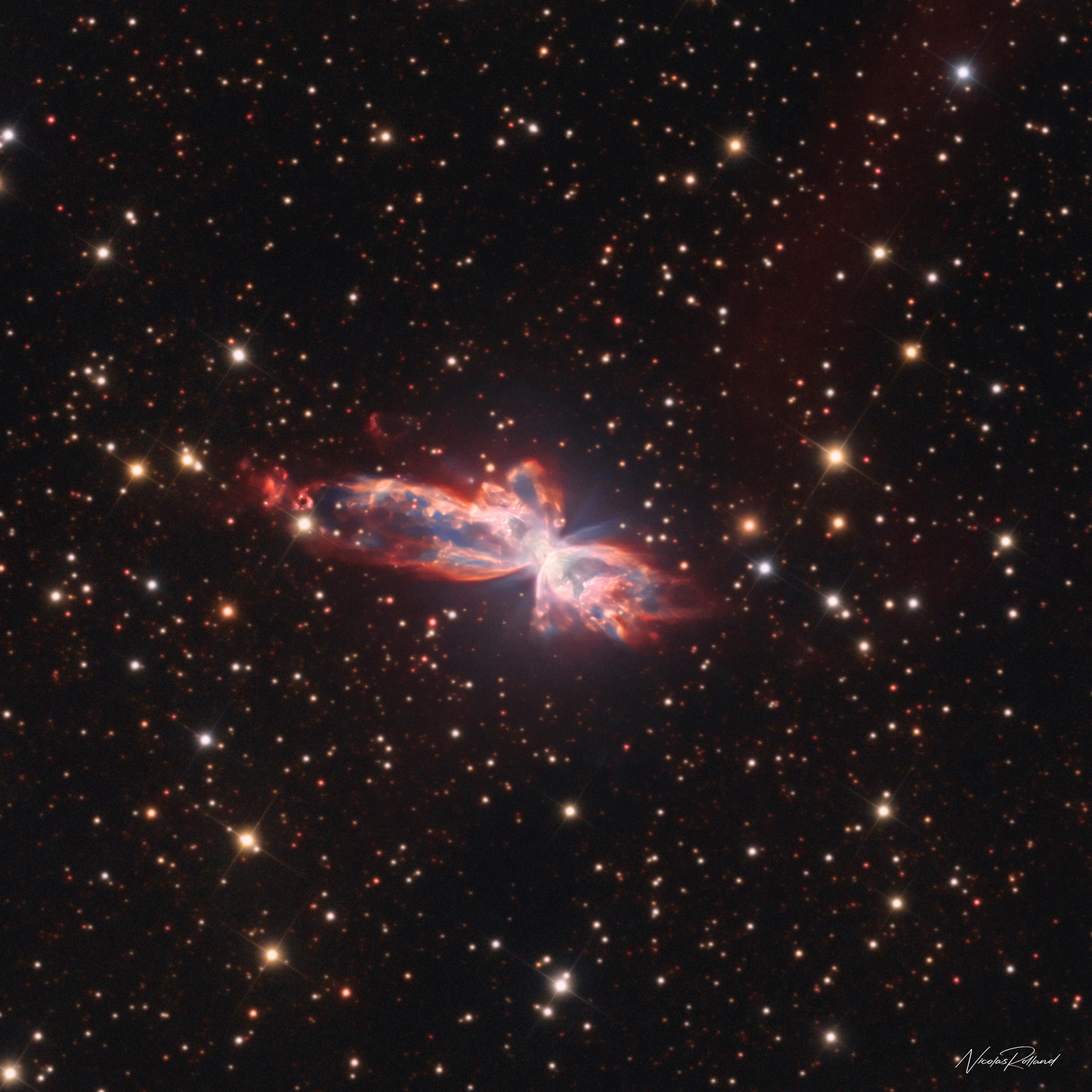
Processed by Nicolas Rolland, Paris. 16.5 hours gathered by Martin Pugh at El Sauce Observatory, Rio Hurtado, Chile.
The two wings are gas thrown clear of a dying star. The dark band across the middle is the dust that gave them that shape.
A bipolar nebula in Scorpius
The Butterfly Nebula (NGC 6302), in the constellation Scorpius, is a bipolar planetary nebula. It entered the New General Catalogue in 1888. The earliest known study of the nebula is by Edward Emerson Barnard, who drew and described it in 1907.
A quarter of a million degrees, hidden from view
NGC 6302 lies about 3,400 light-years away. Its spectrum shows that its central star is exceptionally hot (one of the hottest known stars in our galaxy), with an estimated surface temperature of almost 250,000 °C. This star that was once roughly five times the mass of the Sun, shines brightly in ultraviolet light but it is hidden from direct view by dense equatorial torus of dust.
The nebula has a complex structure, with a prominent lobe to the northwest extending some 3 arcminutes from the central star. That lobe is thought to have formed in an eruptive event around 1,900 years ago.
Every filter, on purpose
The dark line that runs through the center of the nebula has been shown to have an unusual composition, showing evidence for crystalline silicates, crystalline water ice and quartz.