NEBULAE
The Pelican Nebula
— IC 5070, wide field —
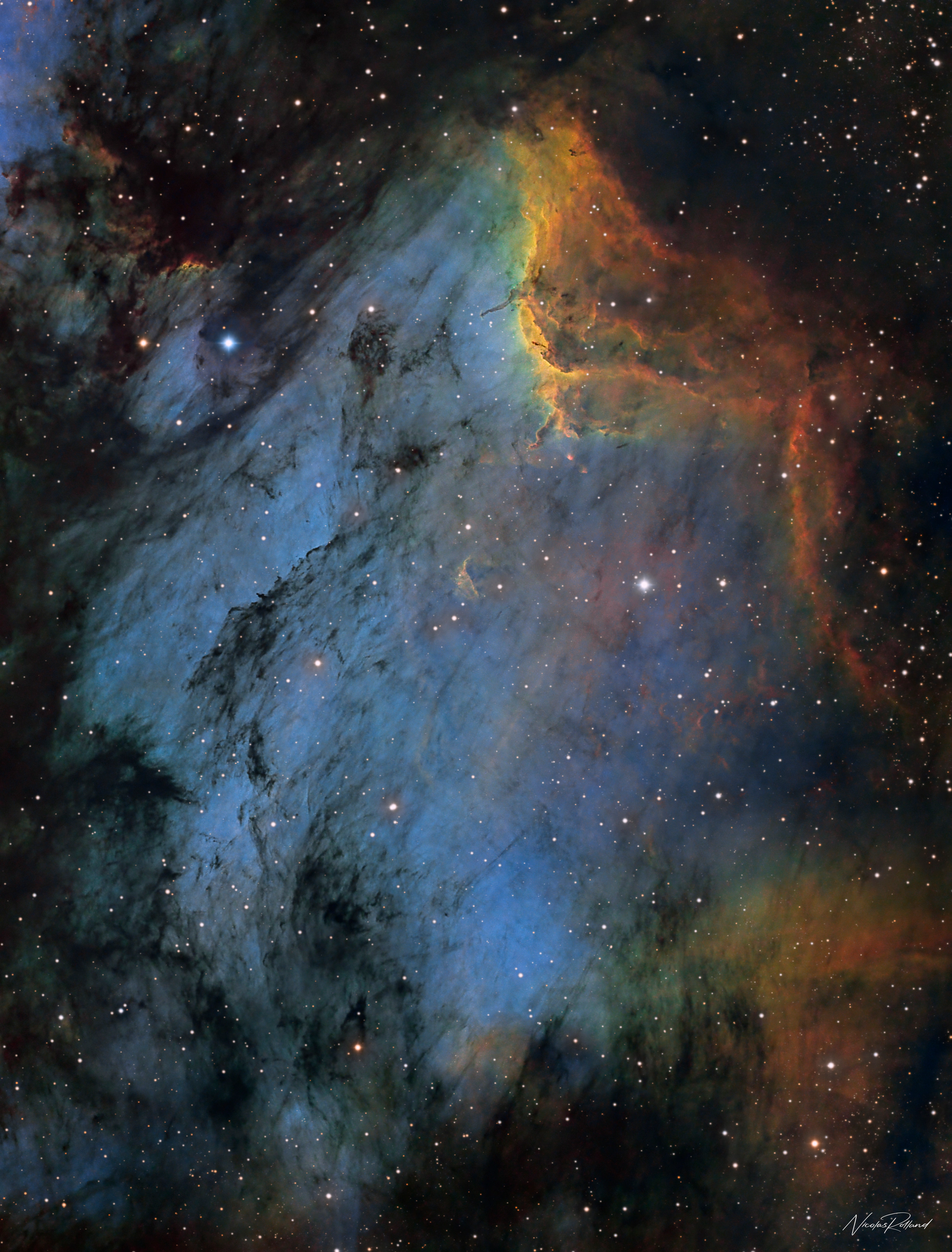
Processed by Nicolas Rolland, Paris. 29 hours gathered by Deep Sky West at Rowe Mesa, New Mexico, USA.
The bird's profile in this nebula is a coincidence of dust, and it is being erased. In a few million years there will be nothing to recognise.
A shape made of what is missing
IC 5070 is a large emission nebula in Cygnus, about 1,800 light-years away, and part of the same cloud of gas and dust as the North America Nebula. The pelican's outline is not the nebula's edge — it is the boundary of a dark lane of dust running between the two, blocking the glowing gas behind it. What reads as a head and a bill is a hole in the light.
The star that does the work
The illumination was long attributed to Deneb, which lies in the same direction. It is now credited to a hot O-type star buried in the dust between the two nebulae, catalogued 2MASS J20555125+4352246 and identified in 2005 — invisible at optical wavelengths, and close enough to do what Deneb at 2,600 light-years could not.
An outline with an expiry date
The ultraviolet from that star drives an ionisation front outward through the cloud, converting cold gas into glowing gas as it advances. Dense filaments hold out longer than the material around them, which is what gives the boundary its ragged edge. The front does not stop. As it eats back into the dust lane and as the stars and gas drift, the outline will lose the shape that gave the nebula its name.
Twenty-nine hours, and nothing but three lines
A Takahashi FSQ106 at f/5 from Rowe Mesa in October 2018, twenty-nine hours across three narrowband filters in half-hour frames — twenty in H-alpha, seventeen in OIII, twenty-one in SII, and no broadband at all. That has a consequence for what this image can be said to show. The nebula is mapped from three emission lines, which is the only way to reach structure this faint from any sky; the stars in the field are mapped from those same three lines, which means their colours here are not their colours. What twenty-nine hours does reach is the full 1.3 by 1.7 degrees of the cloud, including the fainter material outside the bird. Deep Sky West gathered the data at Rowe Mesa.