NEBULAE
Cometary Globule
— CG 12 & NGC 5367 —
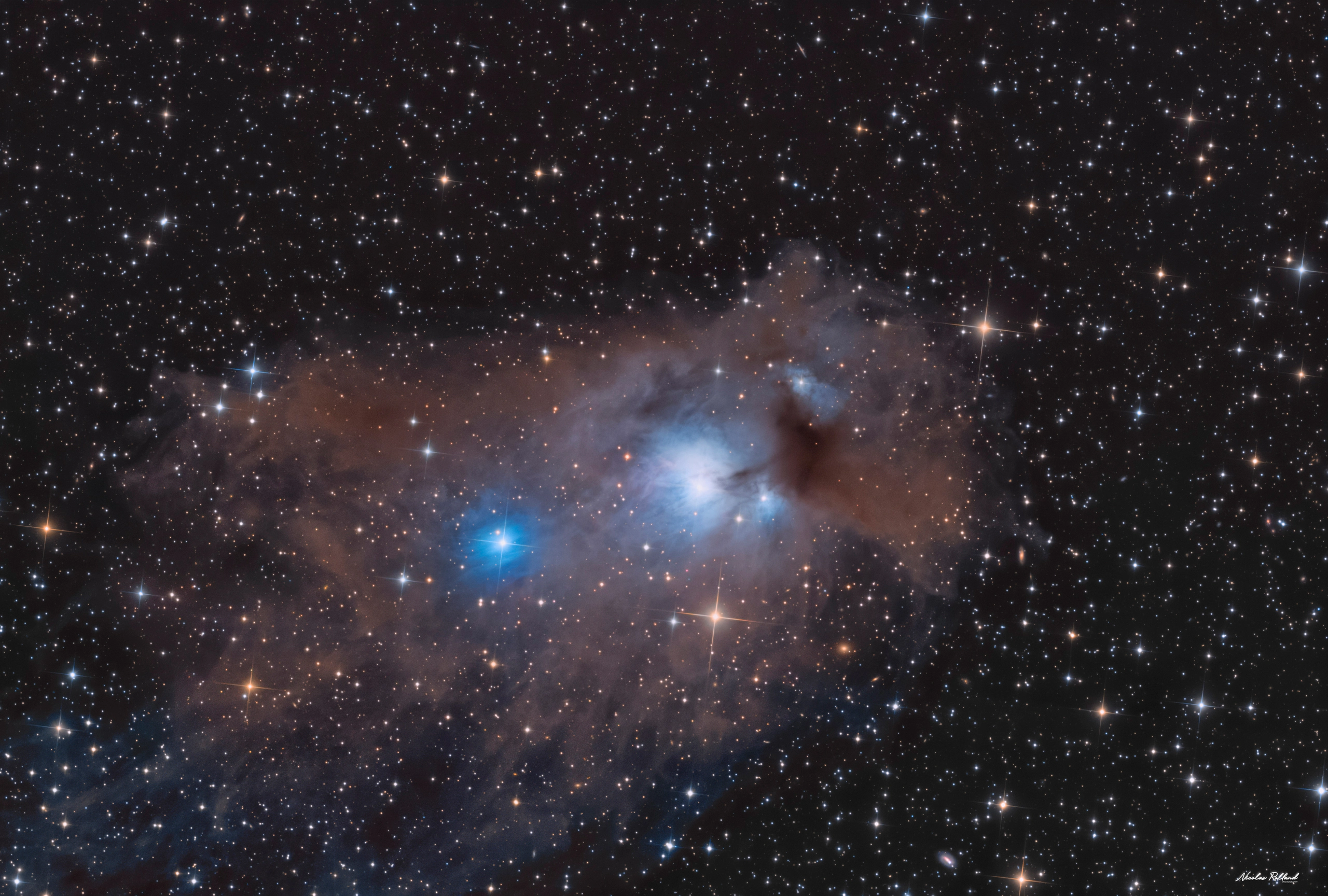
Processed by Nicolas Rolland, Paris. 23 hours gathered by Martin Pugh at El Sauce Observatory, Rio Hurtado, Chile.
This cloud is shaped like a comet and has nothing to do with one. The shape is the record of something that pushed it.
A blue nebula and the pair that lights it
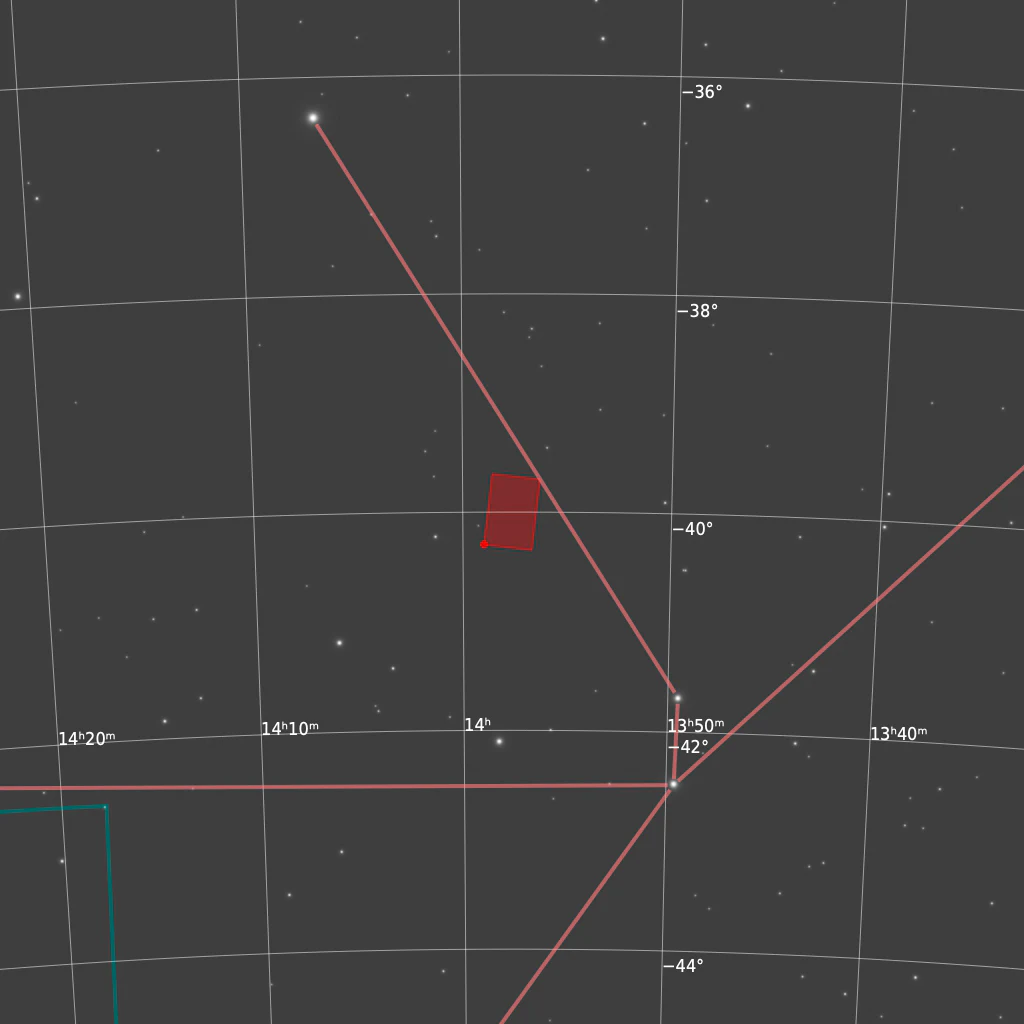
NGC 5367 is a reflection nebula in Centaurus, wrapped around the head of the cometary globule CG 12. Its colour comes from a single binary system at its centre, h4636 — two blue stars of spectral types B4 and B8, whose light the surrounding dust scatters. Nothing here is emitting; the nebula is only returning what those two stars send into it.
What a cometary globule is
Cometary globules have nothing in common with comets except an outline: a dark, dusty head and a long, faint tail. They are cold clouds of gas and dust, and the shape is not their own. Two explanations compete. Either they began as roughly spherical clouds and were deformed by the energy of a nearby supernova, or they were sculpted by the winds and radiation of massive hot stars in the neighbourhood. Both amount to the same thing: the tail points away from whatever did it.
The one that should not be there
CG 12 is the odd member of its class. Most cometary globules sit low in the galactic plane, close to the OB associations whose radiation shapes them. This one is well above the plane, far from any obvious source of the pressure that would have given it this form — and it is forming stars, which globules at that height are not supposed to be doing. The 1976 catalogue that first identified this class of object is where CG 12 enters the record; the nebula itself had been listed for much longer.
Twenty-three hours, and no filter that helps
The CDK17 was working at f/6.8 with adaptive optics ahead of the sensor, from Rio Hurtado in August 2020. Twenty-three hours across luminance, red, green and blue, in twenty-minute frames — no narrowband, and none would have helped. A reflection nebula carries no emission line to isolate it with; it scatters the same broad spectrum as the sky it competes against, so depth is the only lever there is. Seven and a half hours of luminance is what separates the bright head from the background. The tail is the harder part: it fades outward across a field of 39 by 26 arcminutes, and where it stops in this image is where twenty-three hours stops, not where the cloud does. Martin Pugh gathered the data at El Sauce.
NGC 5367 est une nébuleuse par réflexion du Centaure, enroulée autour de la tête du globule cométaire CG 12. Sa couleur vient d'un unique système binaire situé en son centre, h4636 — deux étoiles bleues de types spectraux B4 et B8, dont la poussière environnante diffuse la lumière. Rien ici n'émet : la nébuleuse ne fait que renvoyer ce que ces deux étoiles lui envoient.
Les globules cométaires n'ont de commun avec les comètes qu'une silhouette : une tête sombre et poussiéreuse, une longue queue peu brillante. Ce sont des nuages froids de gaz et de poussière, et cette forme n'est pas la leur. Deux explications s'affrontent. Ou bien ils ont commencé comme des nuages à peu près sphériques, déformés ensuite par l'énergie d'une supernova voisine, ou bien ils ont été sculptés par les vents et le rayonnement d'étoiles massives et chaudes de la région. Les deux reviennent au même : la queue pointe à l'opposé de ce qui l'a causée.
CG 12 est le membre singulier de sa classe. La plupart des globules cométaires se tiennent bas dans le plan galactique, près des associations OB dont le rayonnement les façonne. Celui-ci est nettement au-dessus du plan, loin de toute source évidente de la pression qui lui aurait donné cette forme — et il forme des étoiles, ce que des globules à cette hauteur ne sont pas censés faire. C'est le catalogue de 1976, qui a identifié cette classe d'objets, qui fait entrer CG 12 dans les registres ; la nébuleuse, elle, y figurait depuis bien plus longtemps.
Le CDK17 travaillait à f/6,8, avec une optique adaptative devant le capteur, depuis Rio Hurtado en août 2020. Vingt-trois heures réparties entre luminance, rouge, vert et bleu, en poses de vingt minutes — aucune bande étroite, et aucune n'aurait aidé. Une nébuleuse par réflexion ne porte pas de raie d'émission qui permettrait de l'isoler ; elle diffuse le même spectre large que le ciel contre lequel elle lutte, si bien que la profondeur est le seul levier disponible. Sept heures et demie de luminance, c'est ce qui sépare la tête brillante du fond de ciel. La queue est la partie difficile : elle s'efface vers l'extérieur sur un champ de 39 sur 26 minutes d'arc, et l'endroit où elle s'arrête sur cette image est celui où s'arrêtent les vingt-trois heures, pas celui où s'arrête le nuage.