NEBULAE
Hubble's Variable Nebula
— NGC 2261 —
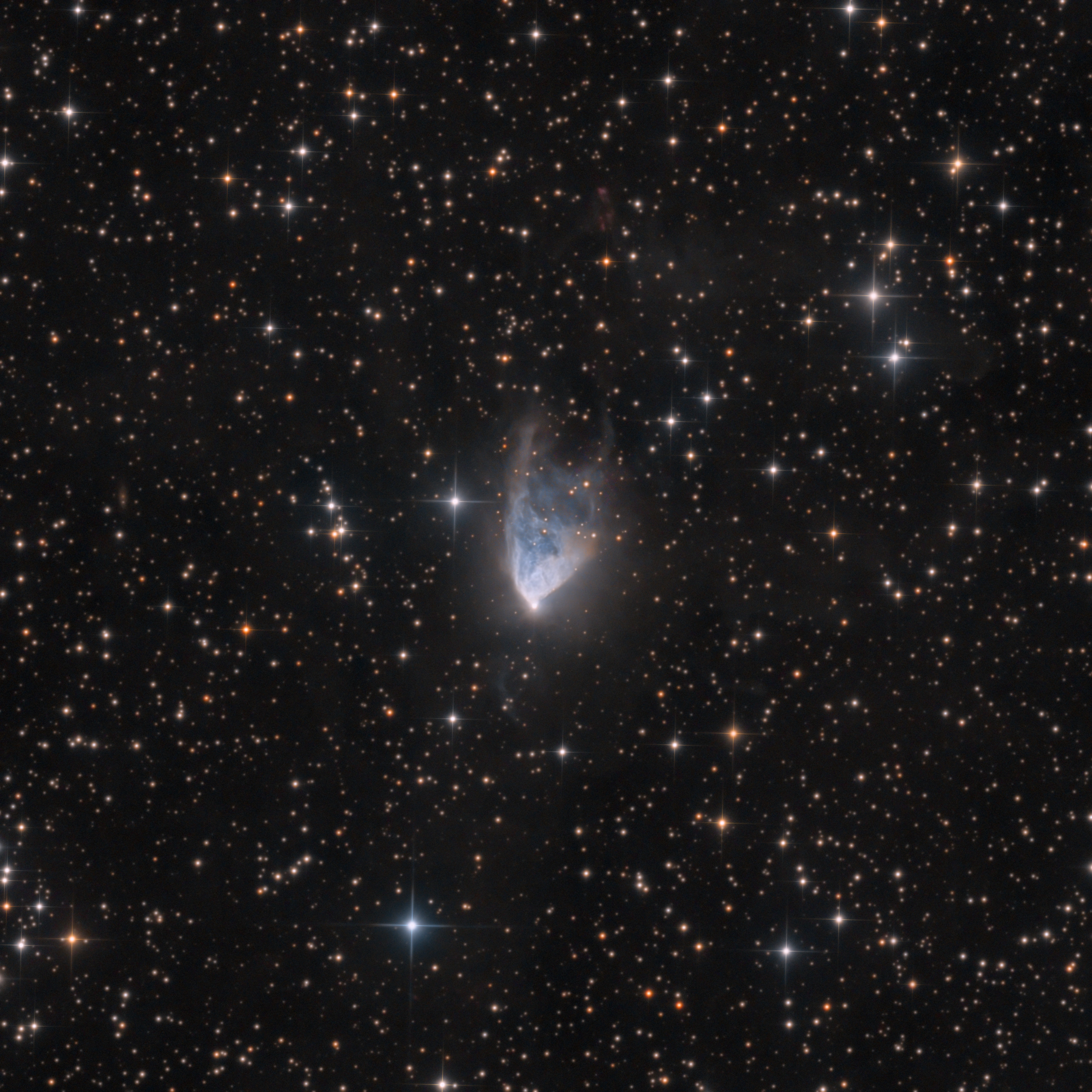
Processed by Nicolas Rolland, Paris. 19.6 hours gathered at El Sauce Observatory, Rio Hurtado, Chile.
This nebula changes shape within weeks. The data behind this image were gathered over three months, which means the thing it shows did not stay still while it was being recorded.
A fan lit by one star
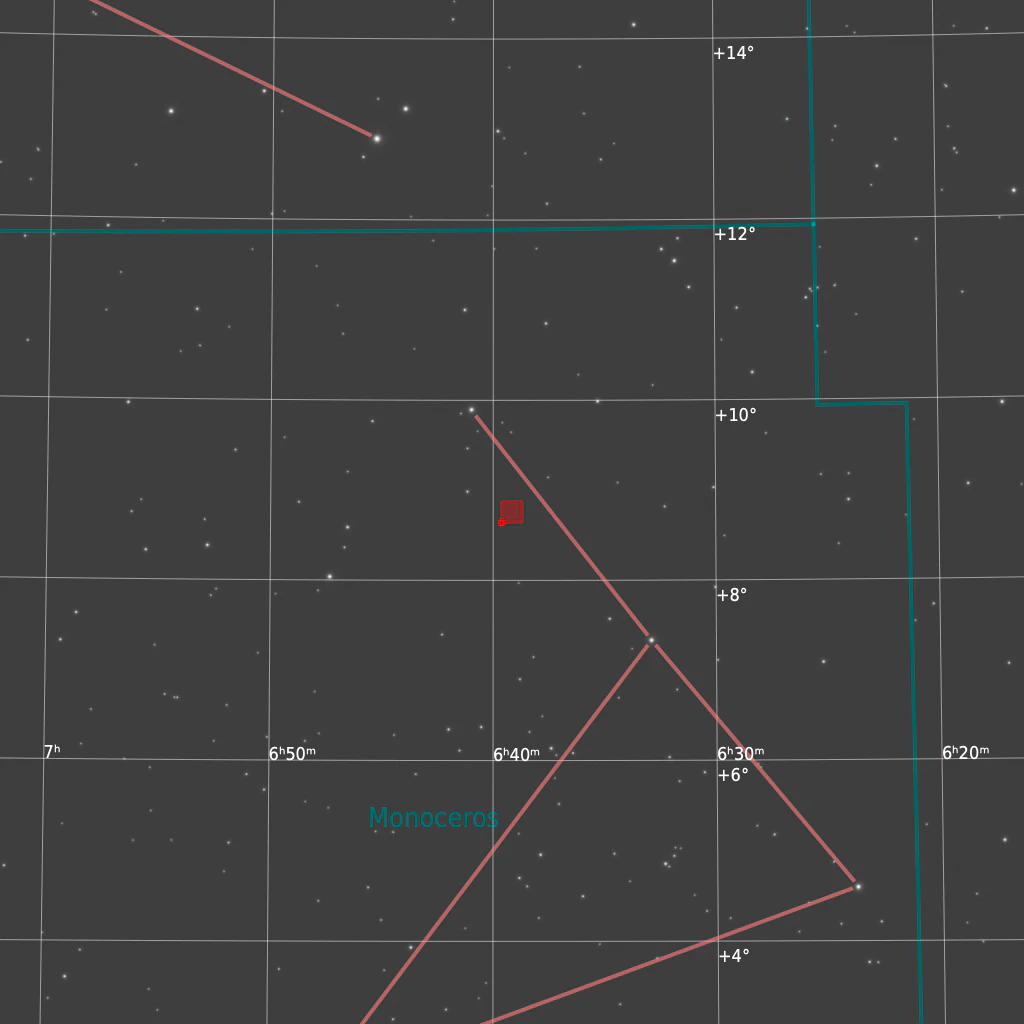
NGC 2261 is a reflection nebula in Monoceros, about 2,500 light-years away, wrapped around the variable star R Monocerotis. It measures two by four arcminutes and is thought to be an outlying part of the much larger NGC 2264 complex, only a degree away. R Monocerotis is a binary: a young B-class star of around ten solar masses with a smaller companion.
Herschel, then Hubble, then Palomar
William Herschel found it in 1783 and took it for a comet. The variability of the star was noticed in 1861, but it was not until 1916 that Edwin Hubble established that the nebula itself changes — brightening and dimming by as much as two magnitudes over months or years. The object has carried his name since. In 1949 it was the first target of the 200-inch Hale telescope at Palomar, then the largest in the world.
Shadows, not eruptions
The changes are not the star flaring. Dusty material orbits R Monocerotis close in, and as it moves it casts shadows outward across the fan — the same way a cloud crossing the sun moves a dark patch over a landscape. What varies is not how much light the star produces but which parts of the nebula receive it. The pattern of light and shade in any image of this object is a snapshot of where that material happened to be.
Three months of a changing subject
A CDK24 at f/6.5 from Rio Hurtado, with frames taken between December 2020 and February 2021 — luminance in two exposure lengths, ten minutes and five, with only a token amount of red, green and blue. The imbalance is deliberate: this is a monochrome subject, a fan of scattered light whose interest is structure rather than colour, and the two luminance lengths exist to hold the bright inner region and the faint outer fan in the same frame. The three-month span is the awkward part. Shadows measurably crossed this nebula during that period, so the image is not a moment but an average of several — the shape shown is real, and it is not the shape on any single night.