GALAXY
Centaurus A
— NGC 5128 —
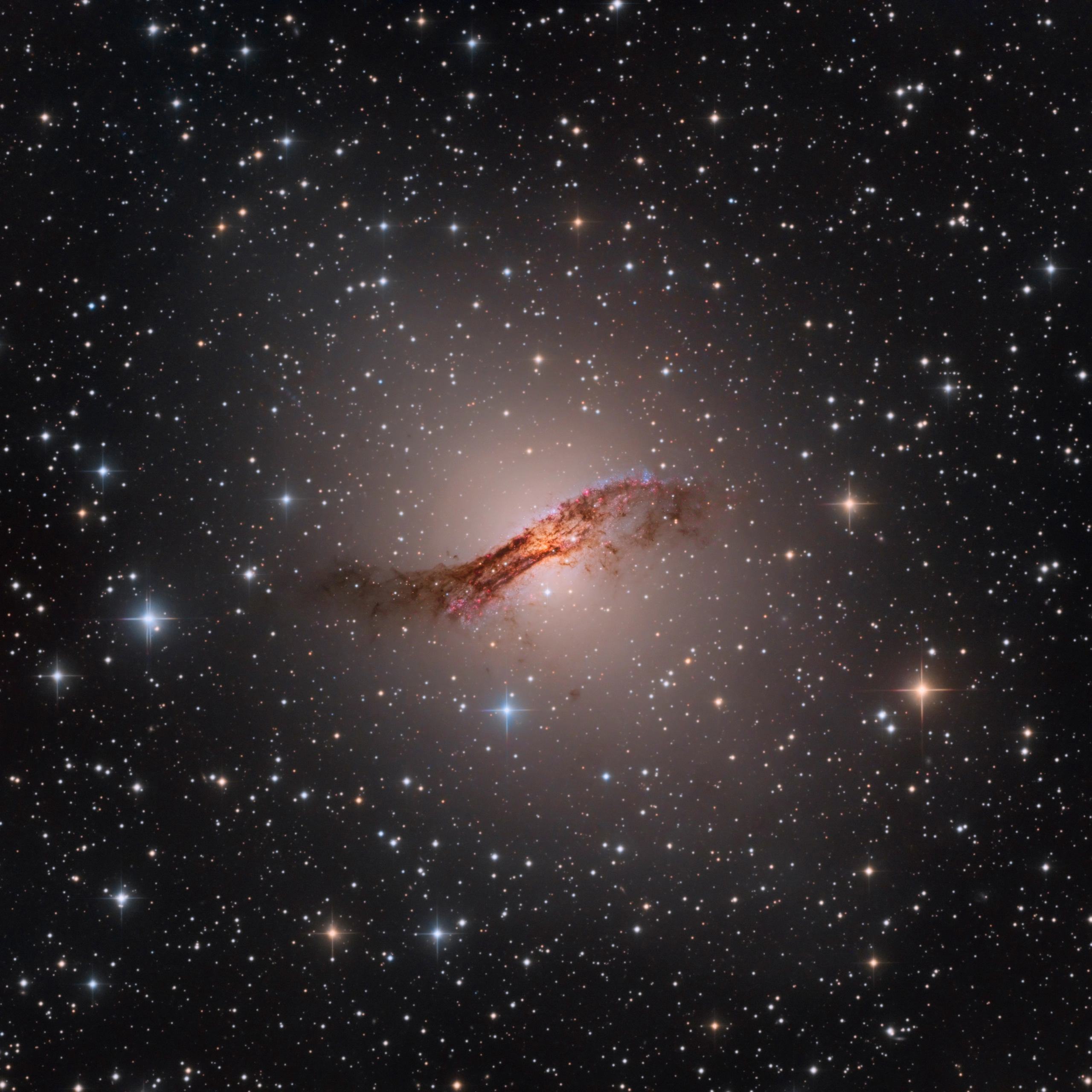
Processed by Nicolas Rolland, Paris. 2.5 hours gathered at El Sauce Observatory, Rio Hurtado, Chile.
The dark band across this galaxy is another galaxy, seen edge-on, in the middle of being absorbed.
The fifth brightest, and the nearest of its kind
Centaurus A lies about 12.4 million light-years away in Centaurus and is the fifth brightest galaxy in the sky, which puts it within reach of almost any telescope. It is also the nearest galaxy with an active nucleus — a black hole at its centre currently feeding — and that combination is rare enough to have made it one of the most studied objects outside our own galaxy. Its body is a little over 90,000 light-years across, and it is classified as lenticular: a disc galaxy without defined spiral arms.
A meal still being digested
The shape does not fit either category cleanly, and the reason is that this is not one galaxy but two. A few hundred million years ago an elliptical swallowed a smaller spiral, and the dark band is what is left of the spiral's disc, seen edge-on and still settling into place. The two populations have not mixed. The bulge is made of old red stars, the kind an elliptical carries; the lane is metal-rich, full of gas and dust, and around a hundred star-forming regions have been identified in it. One galaxy is finished making stars and the other has not stopped.
Most of it is invisible here
The black hole at the centre drives two opposing jets, and in radio they reach far beyond anything in this frame — the full extent of Centaurus A at those wavelengths covers close to twenty times the apparent width of the Moon, while the galaxy shown here is under half a degree across. That is the odd thing about photographing this object: it is the nearest active galaxy, its jets are the reason anyone knows its name, and an optical image records only the small bright piece in the middle. What the picture holds is the wreckage. What made it famous is off the edge of the frame in every direction.
Two and a half hours
A Planewave CDK24 at f/6.5 with an FLI ProLine PL9000, from Rio Hurtado in April 2021 — two and a half hours in ten-minute frames, one of luminance and half an hour each in red, green and blue. At magnitude 6.8 that is enough for the body of the galaxy and for the structure inside the dust lane, which is the part worth having at this scale. Where it stops is the outer halo. A merger of this kind leaves faint shells and streams of stars well beyond the bright disc, drifting on orbits that take hundreds of millions of years to settle, and reaching them takes tens of hours rather than two.