GALAXY
Silver Coin Galaxy
— NGC 253 —
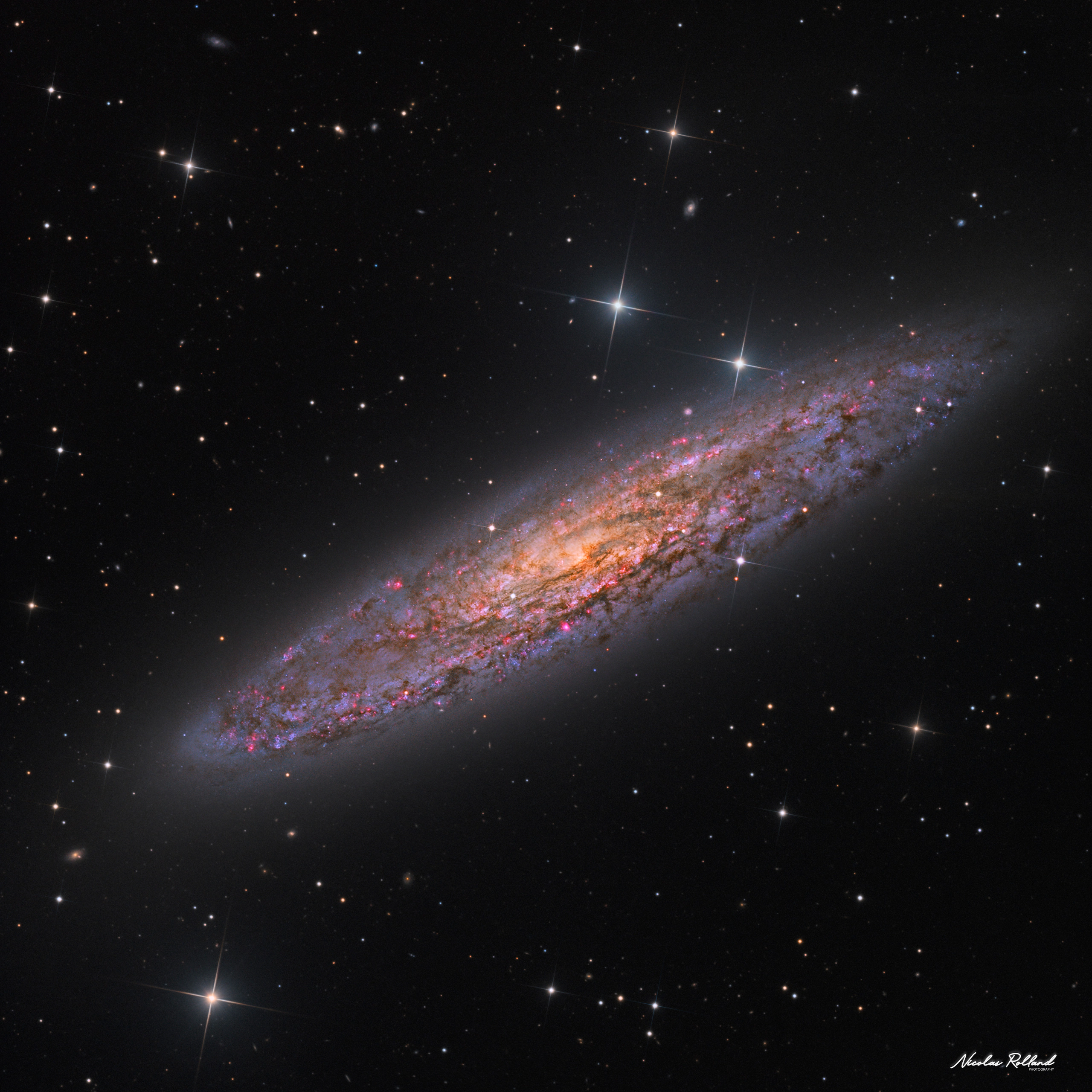
Processed by Nicolas Rolland, Paris. 25.5 hours gathered by Martin Pugh at Heaven's Mirror Observatory, Yass, Australia.
Caroline Herschel found this galaxy in 1783, while sweeping the sky for comets.
Two names, one galaxy
NGC 253 lies about 11.4 million light-years away and is the brightest member of the Sculptor Group, which may be the nearest group of galaxies to our own. It goes by two names and neither has won: most people call it the Sculptor Galaxy, after the constellation, while the RASC Observer's Handbook lists it as the Silver Coin. At magnitude 8 it is within reach of binoculars, and through a 300 mm telescope it shows as a long oval bulge with a mottled disc — the mottling being dust, seen almost edge-on.
A bar feeding the centre
It is a starburst galaxy: its nucleus is producing stars far faster than a galaxy of this size normally does. What sets M82, the other well-known starburst, alight is a close pass by a neighbour. Nothing of the sort has happened here. NGC 253 has a bar running through its centre, and a bar is an efficient way of moving gas inward — material caught along it loses angular momentum and drifts toward the middle, where it piles up and collapses. The starburst is being fed from inside the galaxy, by the galaxy's own structure.
What comes back out
A nucleus making stars at that rate cannot keep the material it is given. The most massive stars formed there live a few million years and explode, and thousands of them doing so in a small volume drive gas back out of the galaxy perpendicular to the disc. The outflow shows in H-alpha and in X-rays, and it carries away some of what the bar delivered — which is one reason a starburst does not last. It runs until the supply is spent or blown clear, and then the galaxy goes quiet.
Twenty-five hours, three and a half of them in hydrogen
A Planewave CDK17 at f/6.8 with adaptive optics ahead of the sensor, from Yass in November 2018 — twenty-five and a half hours across a field of 27 arcminutes square, which the galaxy fills along its long axis. Twenty hours went into luminance and colour at twenty minutes a frame, and three and a half into H-alpha at thirty. Those three and a half hours do a job nothing else can: the star-forming knots along the disc and the outflow above the nucleus are emission, and a broadband frame records the galaxy without them. Three and a half hours reaches the knots. The outflow is the part that stops short — it fades outward with no edge, and where it ends in this frame is a matter of exposure rather than of gas. Martin Pugh gathered the data at Heaven's Mirror.