GALAXY
Southern Pinwheel Galaxy
— Messier 83 —
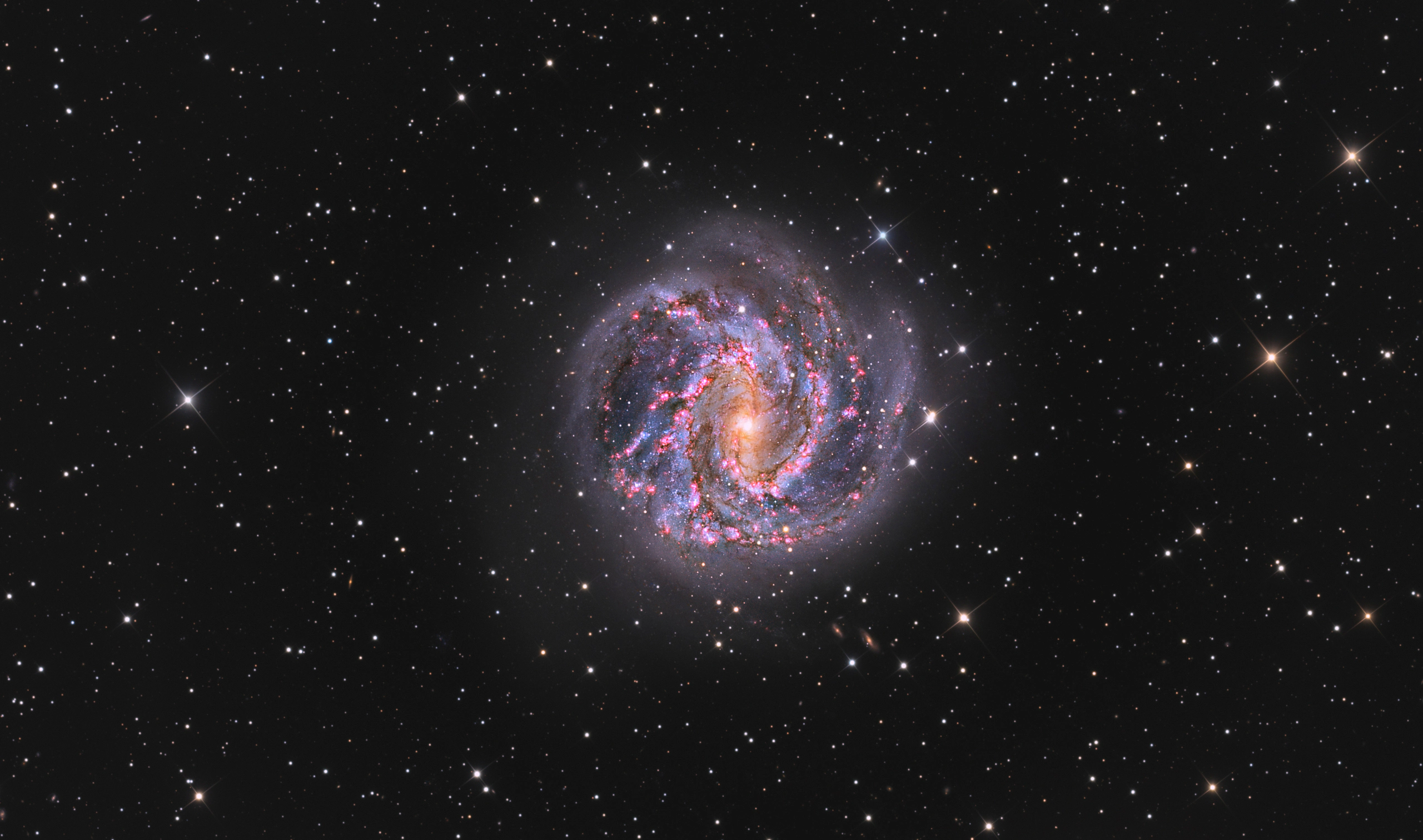
Processed by Nicolas Rolland, Paris. 25.6 hours gathered by Martin Pugh at El Sauce Observatory, Rio Hurtado, Chile.
Six supernovae went off in this galaxy between 1923 and 1983. None since.
Found from the Cape in 1752
Messier 83, also catalogued NGC 5236, is a barred spiral in Hydra, about 16 million light-years away and a little over 100,000 light-years across — close to the size of the Milky Way. Nicolas Louis de Lacaille found it from the Cape of Good Hope on 23 February 1752, the first galaxy anyone had recorded beyond the Local Group. Messier added it to his catalogue in 1781; William Lassell was the first to note that it had spiral arms. The nickname came later, from its resemblance to Messier 101 in the northern sky.
Red knots and blue knots
The face-on view is what makes this galaxy worth photographing: the arms are laid out flat, and everything in them is legible. The red knots strung along them are HII regions — clouds of hydrogen lit from inside by stars hot enough to ionise them. The blue patches beside them are the clusters those clouds have already finished making, a few million years old and not yet dispersed. Dark dust lanes follow the arms all the way in, and at the centre the colour changes: the nucleus is yellow, an older population that stopped forming stars long ago.
The same stars, at the other end
Those two things — the knots and the supernovae — are one process seen at both ends. A galaxy this active makes massive stars in quantity, and a massive star lives a few million years and then explodes. Six went off here in sixty years: SN 1923A, 1945B, 1950B, 1957D, 1968L and 1983N, which is among the highest rates recorded anywhere. Then it stopped. Forty years have passed without another, which says nothing about the galaxy and everything about how small a sample six is.
Twenty-five hours, and two of hydrogen
A Planewave CDK17 at f/6.8 with adaptive optics ahead of the sensor, from Rio Hurtado in June 2020 — twenty-five and a half hours across a field of 20 arcminutes square, which the galaxy sits inside comfortably. Twenty-three of those hours are luminance and colour at twenty minutes a frame. Two are H-alpha, in four frames of thirty minutes, and that is the thin part of this dataset: the red knots are the reason to photograph a face-on spiral, and two hours reaches the brightest of them while the fainter ones stay inside the general glow of the arms. There is a second limit underneath it. At 16 million light-years an HII region a hundred light-years across covers about 1.3 arcseconds, which is the same order as the atmosphere allows on a good night — so the knots arrive as points whether or not the exposure is doubled. Martin Pugh gathered the data at El Sauce.