GALAXY

A Grand-Design Spiral in Eridanus

— NGC 1232 —
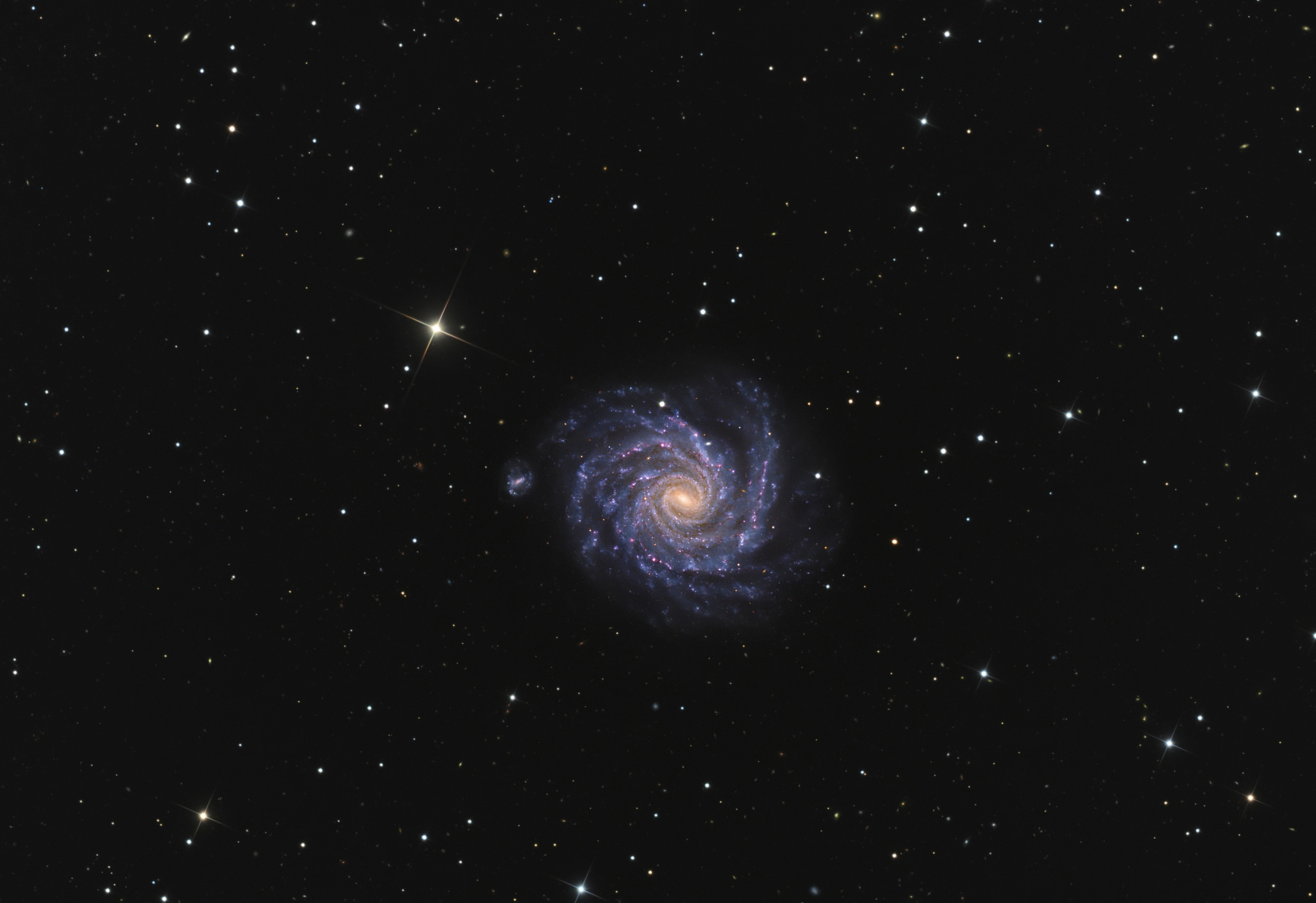
NGC 1232, a grand-design spiral in Eridanus seen face-on with its arms fully unwound

Processed by Nicolas Rolland, Paris. 26.5 hours gathered by Martin Pugh at El Sauce Observatory, Rio Hurtado, Chile.

Most of the mass in this picture is not in the picture.

Face-on, in Eridanus

NGC 1232 is an intermediate spiral in Eridanus, about 60 million light-years away, and William Herschel recorded it on 20 October 1784. It is turned almost exactly face-on to us, which is the only reason its structure can be read: the arms come out of the core and can be followed all the way to the edge of the disc without ever crossing each other. Two arms dominate and the rest branch off them, which is what earns a galaxy the label grand design — most spirals are patchier than this.

What holds it together is not what lights it

The arms are marked out by open clusters of hot blue stars, with dark lanes of dense interstellar dust running between them, and small knots of ionised hydrogen where the newest stars are still switching on. Those are the bright things, and they are not the massive things. Dim ordinary stars and interstellar gas, neither of which shows well in an image, carry enough mass between them to govern the motion of the inner galaxy. Further out even that is not enough: the speed at which the outer disc turns requires several times more matter than anything visible accounts for, and what that matter is remains unsettled.

Arms that bend the wrong way

There is one thing about this galaxy that a face-on view makes obvious: the arms do not curve smoothly. They are visibly kinked, bent out of the gentle logarithmic sweep a spiral usually follows, and a disc does not do that on its own. The usual explanation is gravitational — something passed close enough to pull on it, and the arms are still carrying the deformation. The small barred galaxy in the field, NGC 1232A, is the candidate that gets named. Whether it is the right one depends on how far away it actually is, and that is not settled.

Twenty-six hours, four and a half in hydrogen

A Planewave CDK17 at f/6.8 with adaptive optics ahead of the sensor, from Rio Hurtado in December 2019 — twenty-six and a half hours in all, seven of luminance and fifteen of colour at twenty minutes a frame, and four and a half of H-alpha at thirty. Those four and a half hours are what separate the HII knots from the general blue of the arms; without them the star-forming regions and the clusters they belong to blur into one another. The field runs 32 by 22 arcminutes and the galaxy covers about eight, which leaves most of the frame empty — deliberately, because the outer disc and whatever tidal material surrounds it extend well past the bright body, and framing tight would have cut off the part of the question this image can address. Martin Pugh gathered the data at El Sauce.

Version française
L'essentiel de la masse présente dans cette image n'y figure pas.
 
NGC 1232 est une spirale intermédiaire de l'Éridan, à environ 60 millions d'années-lumière, et William Herschel l'a relevée le 20 octobre 1784. Elle nous présente presque exactement sa face, ce qui est la seule raison pour laquelle sa structure se laisse lire : les bras sortent du noyau et se suivent jusqu'au bord du disque sans jamais se croiser. Deux d'entre eux dominent et les autres s'y greffent, ce qui vaut à une galaxie l'appellation de spirale à grand dessin — la plupart des spirales sont plus fragmentaires que celle-ci.
 
Les bras sont jalonnés d'amas ouverts d'étoiles bleues et chaudes, avec des couloirs de poussière interstellaire dense entre eux, et de petits nœuds d'hydrogène ionisé là où les étoiles les plus récentes viennent de s'allumer. Ce sont les objets brillants, et ce ne sont pas les objets massifs. Les étoiles ordinaires peu lumineuses et le gaz interstellaire, qui n'apparaissent guère sur une image, portent à eux deux assez de masse pour gouverner le mouvement de la galaxie interne. Plus loin, cela ne suffit même plus : la vitesse à laquelle tourne le disque extérieur exige plusieurs fois plus de matière que tout ce qui est visible n'en explique, et la nature de cette matière reste ouverte.
 
Une chose que la vue de face rend évidente : les bras ne s'incurvent pas régulièrement. Ils sont visiblement coudés, écartés de la spirale logarithmique douce que suit d'ordinaire un disque, et un disque ne fait pas cela tout seul. L'explication habituelle est gravitationnelle — quelque chose est passé assez près pour le tirer, et les bras en portent encore la déformation. La petite galaxie barrée du champ, NGC 1232A, est la candidate qu'on cite. Qu'elle soit la bonne dépend de la distance à laquelle elle se trouve réellement, et ce point n'est pas réglé.
 
Un Planewave CDK17 à f/6,8, optique adaptative devant le capteur, depuis Rio Hurtado, en décembre 2019 — vingt-six heures et demie en tout, dont sept de luminance et quinze de couleur en poses de vingt minutes, et quatre et demie de H-alpha en poses de trente. Ces quatre heures et demie sont ce qui sépare les nœuds HII du bleu général des bras ; sans elles, les régions de formation d'étoiles et les amas auxquels elles appartiennent se confondent. Le champ couvre 32 sur 22 minutes d'arc quand la galaxie en occupe environ huit, ce qui laisse l'essentiel du cadre vide — délibérément, car le disque extérieur et la matière de marée qui l'entoure s'étendent bien au-delà du corps brillant, et cadrer serré aurait retranché la part de la question que cette image peut aborder. Martin Pugh a rassemblé les données à El Sauce.

Technical data
OpticsPlanewave CDK17 f/6.8
CameraSBIG STXL-11002 (AOX)
MountParamount ME
FiltersHa, L, R, G, B
LocationEl Sauce Observatory, Rio Hurtado, Chile
DateDecember 2019
Exposures26.5 hours L 21 × 1200 sec · R 15 × 1200 sec · G 15 × 1200 sec · B 15 × 1200 sec · Ha 9 × 1800s
SoftwarePixinsight, Photoshop
CopyrightsNicolas Rolland & Martin Pugh
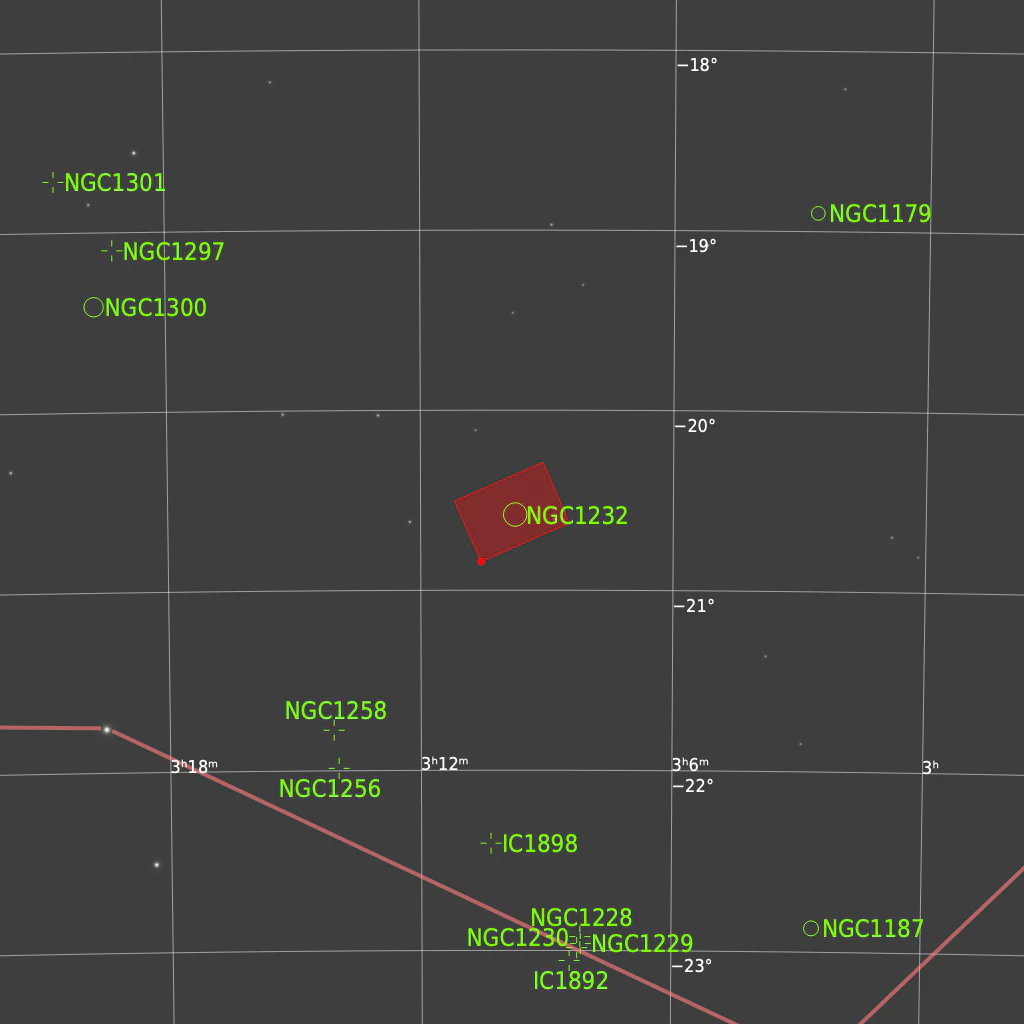
Finding chart Spiral Galaxy — finding chart
RA03h 09m 49s Dec20° 33′ 55.8″ Size32.2 × 22.1 arcmin Orientationup is 336° E of N ConstellationEridanus