STAR CLUSTER
The Jewel Box
— NGC 4755 —
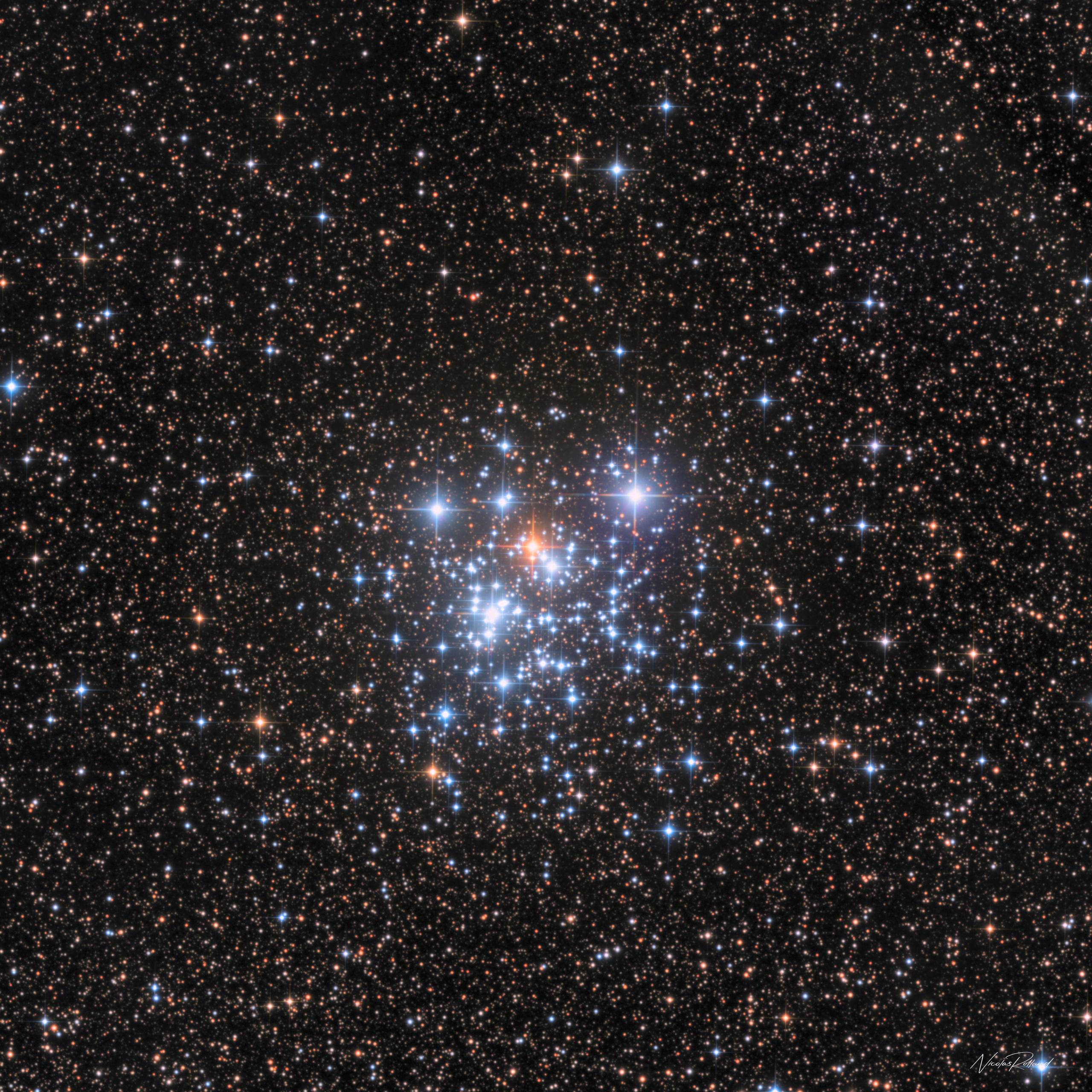
Processed by Nicolas Rolland, Paris. 10.8 hours gathered at El Sauce Observatory, Rio Hurtado, Chile.
Every star in this cluster was born at the same time. Everything different about them is a difference of mass.
A casket of coloured stones
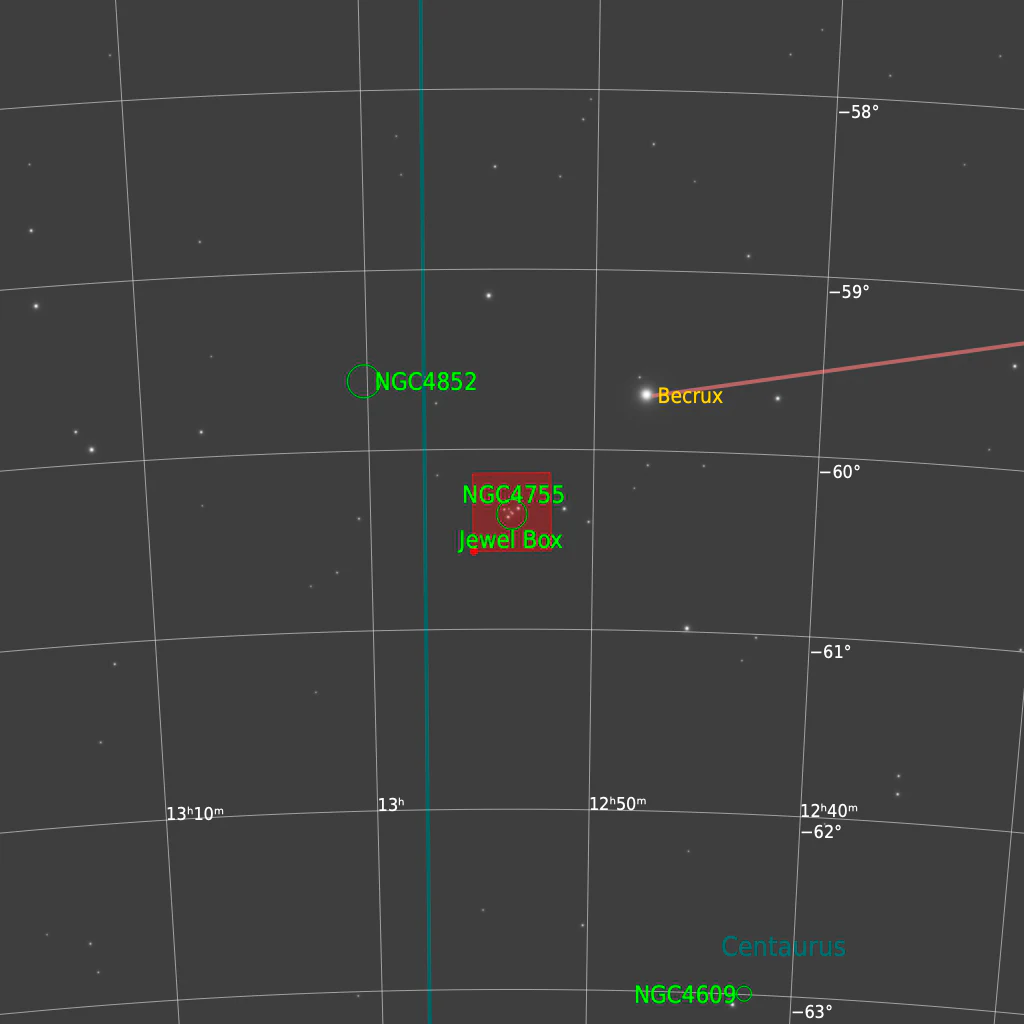
NGC 4755 sits in Crux, the Southern Cross, and carries two names: the Jewel Box and the Kappa Crucis cluster. Nicolas Louis de Lacaille catalogued it during his stay at the Cape between 1751 and 1752, among the finest of the objects he found there. The name in use came later, from John Herschel, who described the group through his telescope as a casket of variously coloured precious stones.
A hundred stars, and one that is out of place
At magnitude 4.2 the cluster reads as a single star to the naked eye. It holds around a hundred within ten arcminutes. Most are blue giants; the brightest is κ Crucis, a blue supergiant of magnitude 5.9 and spectral type B5. The fourth brightest is something else entirely — a red supergiant of class M2 at magnitude 7.6, sitting among hot blue companions and matching none of them. It is the reason this cluster is photographed rather than merely counted.
Why the colours are a clock
That red star is not older than the others. The cluster is one of the youngest known, around seven million years, and every member started at the same moment — which means age cannot explain any difference between them. Mass can. A more massive star burns through its hydrogen faster, so at seven million years the heaviest member of the group has already left the main sequence and swollen into a red supergiant while the rest have barely settled onto it. The colour differences across this field are the same clock read at different speeds.
Eight hours of colour, three of luminance
A CDK24 at f/6.5 with a monochrome sensor from Rio Hurtado in September 2021, ten hours and fifty minutes in ten-minute frames — and the split is the opposite of the usual one: three hours of luminance against nearly eight across red, green and blue. That inversion is the subject. Depth buys nothing here; a magnitude 4.2 cluster is bright, and the faintest thing in the frame is not what the image is about. What the extra colour buys is the ability to hold an M2 supergiant and a B5 supergiant in the same exposure without either collapsing into white — a difference of several thousand kelvin that only survives if neither channel saturates. The field runs 25.8 arcminutes square for a cluster ten across, which leaves the surrounding star fields of Crux in the frame, and they are dense enough to make the cluster harder to pick out rather than easier.