GALAXY
The Needle Galaxy
— NGC 4565 —
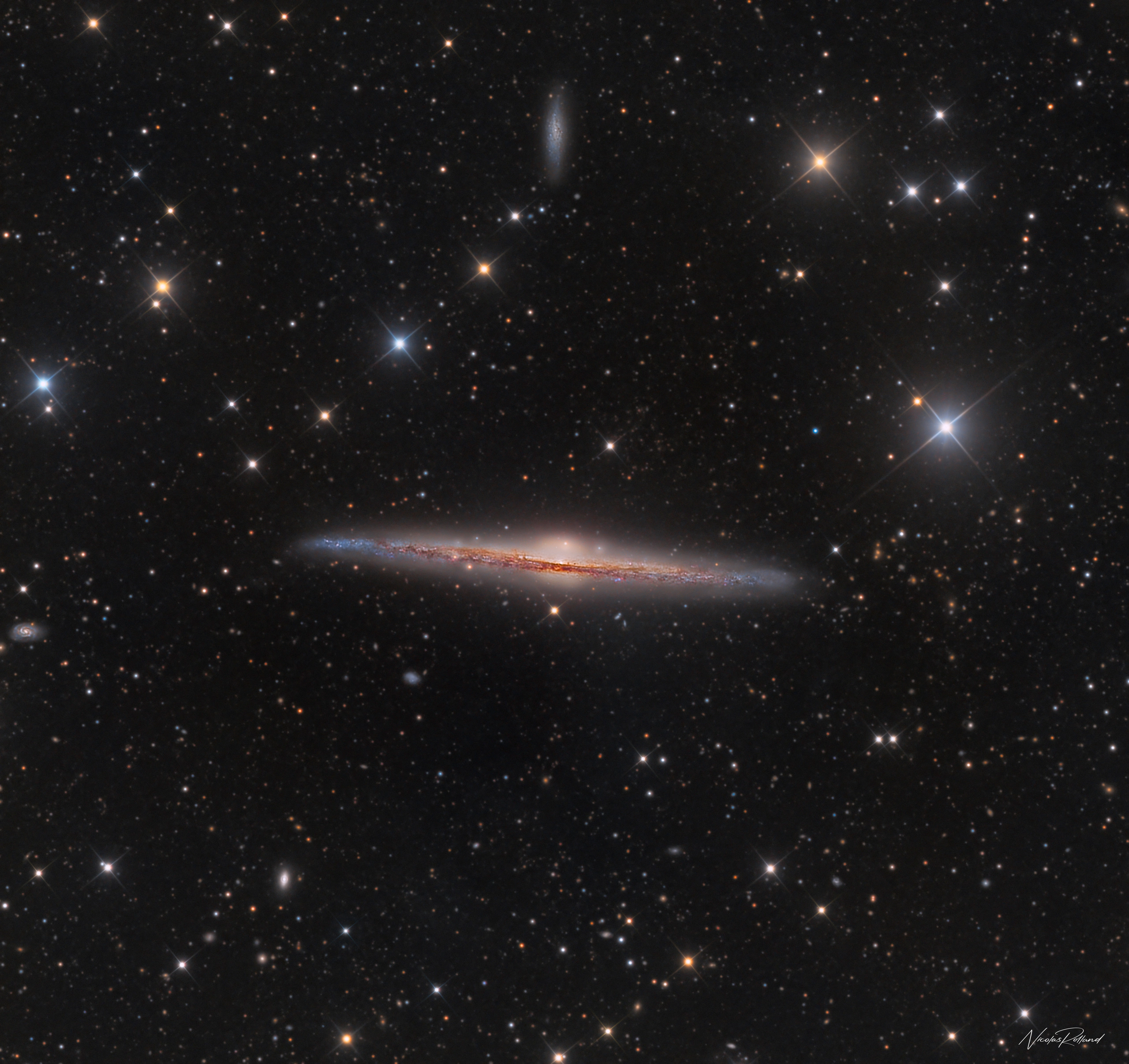
Processed by Nicolas Rolland, Paris. 25 hours gathered by Bernard Miller at Dark Sky New Mexico, Animas, USA.
Seen from any other angle this would be a broad spiral. From here it is a line, with everything else hidden behind its own dust.
A disc seen from within its own plane
NGC 4565 lies in Coma Berenices, between 30 and 50 million light-years away, and it is turned so precisely edge-on that the spiral arms which make up most of it are invisible. What shows instead is the disc in cross-section: a thin bright line of stars, split lengthwise by the dust lane that lies in the plane of every spiral galaxy including our own. From above it would look like NGC 4725 or Messier 101. From here it looks like a needle, and William Herschel recorded it as one in 1785.
Brighter than Andromeda, and slightly bent
This is a giant among spirals — more luminous than the Andromeda Galaxy, and around a hundred thousand light-years across. Deep surveys show its disc is not flat: it is warped, bent out of its own plane at the edges, and stretches further than a short exposure suggests. Warps are usually the mark of something pulling from outside, and this galaxy has candidates. At least two satellite galaxies orbit it, along with a population of 240 globular clusters, and it belongs to the Coma I Group.
A bulge that is still making stars
The bright swelling at the centre is not the kind of bulge most large spirals carry. Observations with the Spitzer space telescope identified it as a pseudobulge — a structure that still forms stars, where a classic bulge is made of old ones and has been quiet for billions of years. The distinction matters for how a galaxy is assembled: a classic bulge tends to come from a violent early merger, a pseudobulge from material working its way inward over a much longer time.
Twenty-five hours at 2,900 mm
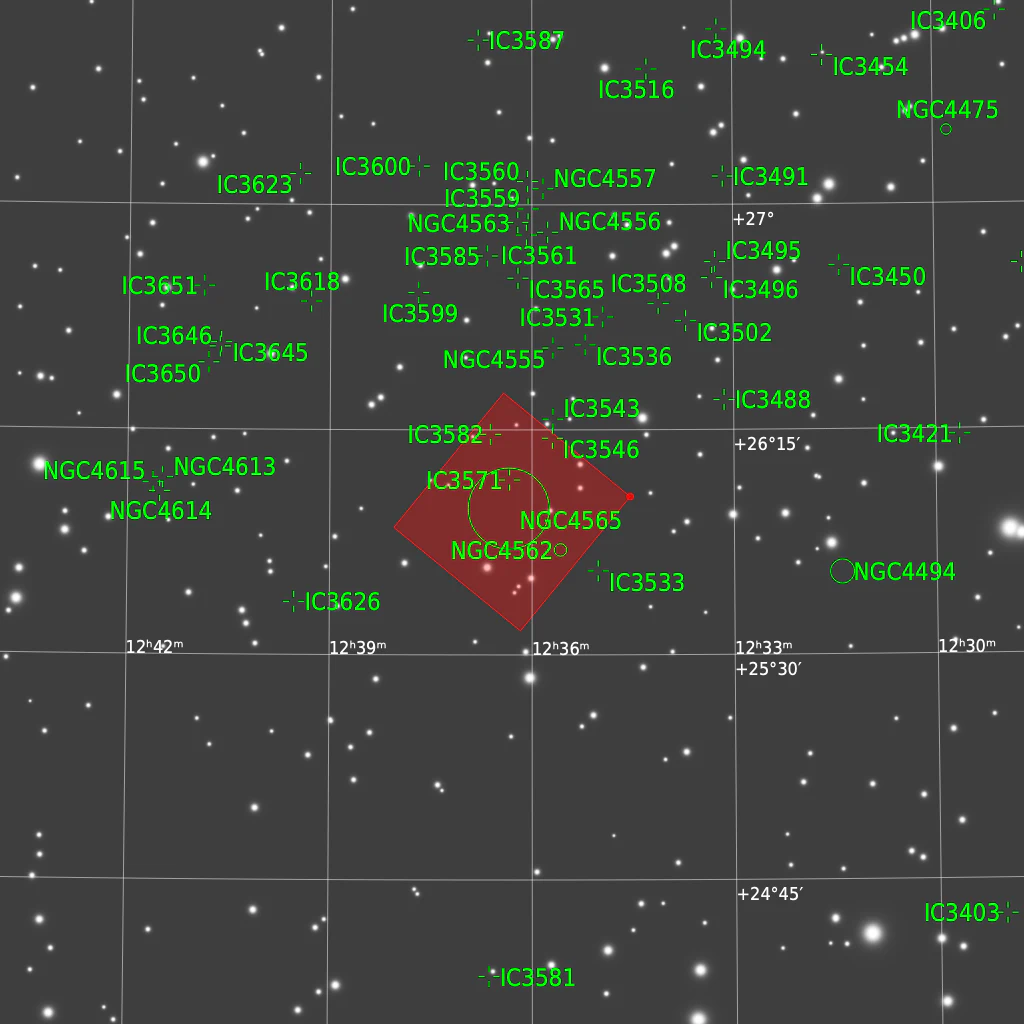
A Planewave CDK17 at f/6.8 with an FLI Proline 16803, from Dark Sky New Mexico in Animas — 2,900 millimetres of focal length across a field of 34.7 by 32.7 arcminutes, which the galaxy nearly fills. That is the point of shooting it this way. At shorter focal length the dust lane is a dark band and nothing more; at this scale it has texture — grain, mottling, uneven density along its length — and that texture is the one thing in this image that could not have been had another way. Twenty-five hours went in, nine of them luminance at twenty minutes a frame, which is the layer that carries it. NGC 4562, the Magellanic-type galaxy at the top of the field, comes along with the framing: it was set for the Needle, not for the pair. Bernard Miller gathered the data at Animas.