GALAXY
The Hamburger Galaxy
— NGC 3628 —
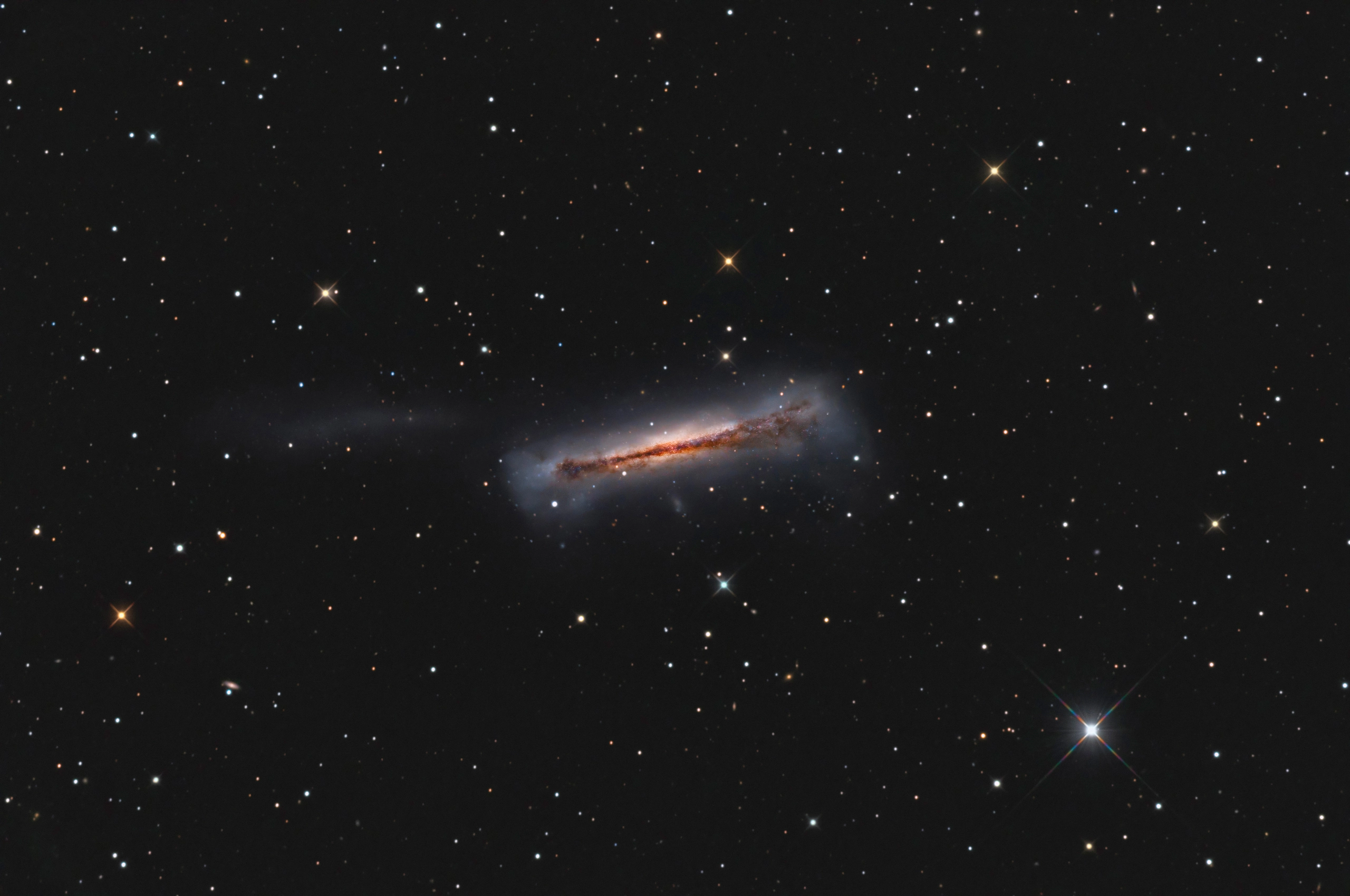
Processed by Nicolas Rolland, Paris. 1.6 hours gathered by Grand Mesa Observatory at Whitewater, Colorado, USA.
Messier looked for this galaxy and did not find it. It sits beside two he catalogued, and it is the one that got away.
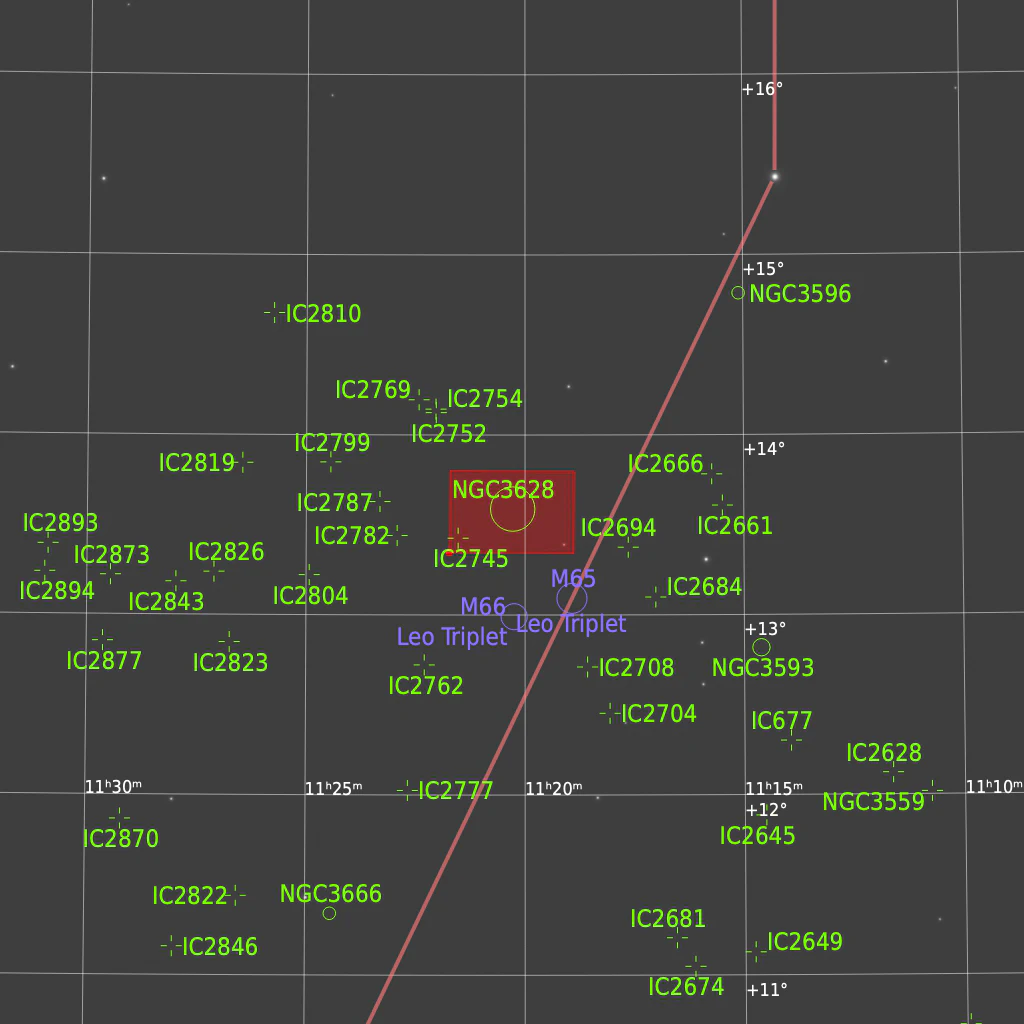
The third member of the Leo Triplet
NGC 3628 is an unbarred spiral in Leo, about 35 million light-years away, forming a small group with Messier 65 and Messier 66 known as the Leo Triplet. At magnitude 9.5 it is the faintest of the three and by some distance the hardest to see — Messier catalogued its two neighbours and missed this one entirely. William Herschel found it in 1784.
Edge-on, and split by its own dust
The galaxy is turned almost exactly edge-on to us, which is why it reads as a bar rather than a disc, and a broad lane of dust runs the length of it. That lane is not a feature added to the galaxy; it is the galaxy's own plane, seen from within the plane. Every spiral has one, and this orientation is the only one that shows it as a silhouette rather than as texture.
A tail three hundred thousand light-years long
A tidal tail extends from the disc — a long thin stream of stars and interstellar gas running some 300,000 light-years, roughly three times the width of our own galaxy. Material does not leave a galaxy on its own. The tail is what a close encounter pulls out and leaves behind, and it is the clearest evidence that the three members of the Triplet have passed near enough to disturb each other. A supermassive black hole sits at the centre of the disc.
Ninety-six minutes
A William Optics 12.5-inch Ritchey-Chrétien with a focal reducer and a monochrome sensor, from Whitewater in June 2020. The whole dataset is an hour and thirty-six minutes: fifty minutes of luminance in five-minute frames, and forty-six of colour in two-minute frames. Fifty minutes is very little for a tidal stream, and the stream is there — which says more about the sky over western Colorado and about twelve and a half inches of aperture than about the exposure. Two things do stay out of reach. The tail has no colour here: fifteen minutes per filter records the disc and leaves the stream monochrome, so what is visible is its shape and not what it is made of. And it does not fit. At this distance 300,000 light-years covers close to 29 arcminutes against a frame of 41.6 by 27.2, which means the tail runs the length of the field and off the short side of it. Grand Mesa Observatory gathered the data at Whitewater.