SOLAR SYSTEM
A date between a Comet and a Galaxy
— C/2017 T2 PANSTARRS & Messier 106 —
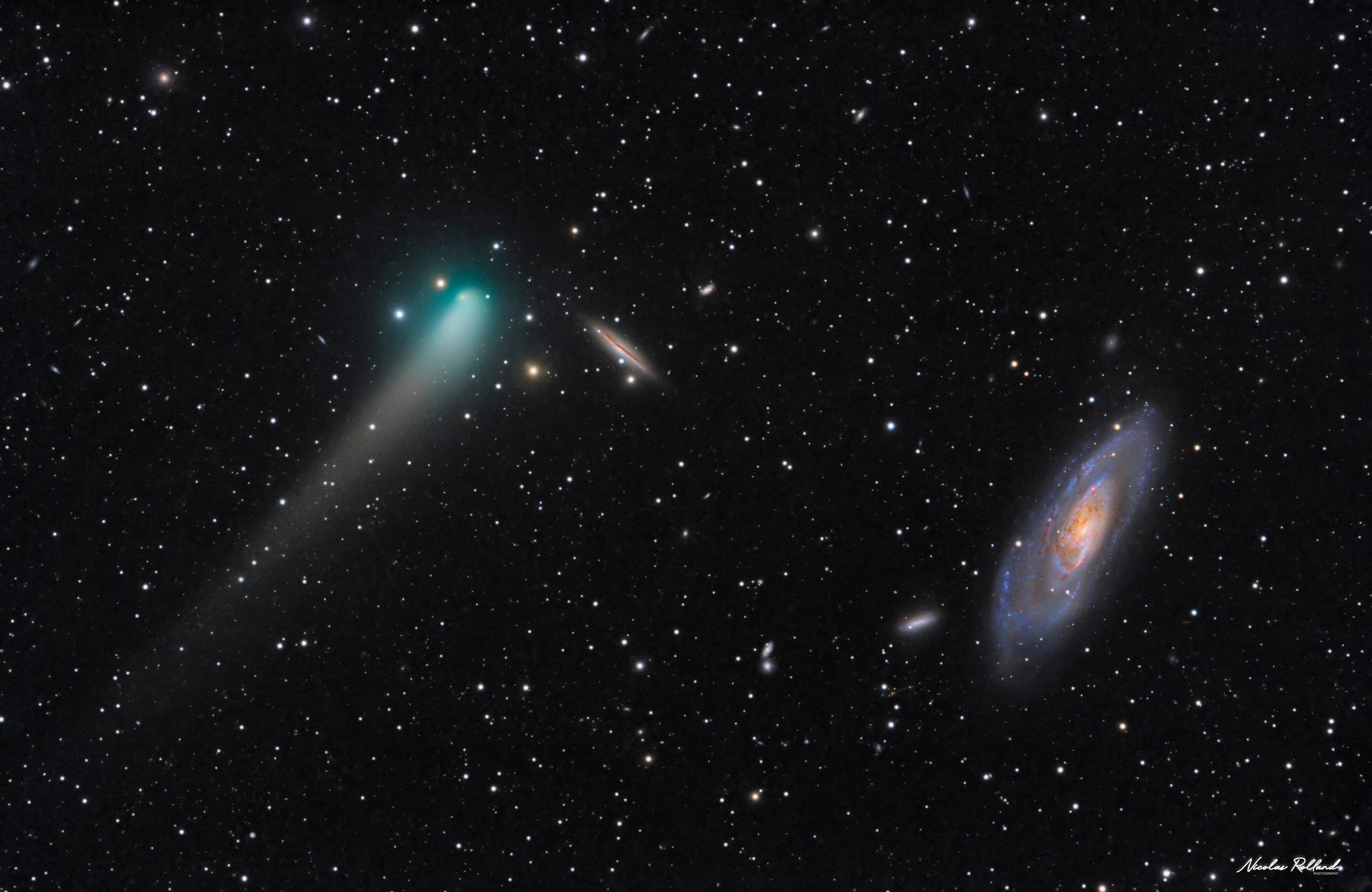
Processed by Nicolas Rolland, Paris. 2.6 hours gathered by Grand Mesa Observatory at Whitewater, Colorado, USA.
One of these two objects is fourteen light-minutes away. The other is twenty-four million light-years.
A comet from the edge of the solar system
C/2017 T2 PANSTARRS was found by the Pan-STARRS survey on 2 October 2017 and is an Oort cloud comet: it came in from a shell of icy bodies surrounding the solar system at around 74,000 astronomical units, more than a light-year out, and took millions of years to make the trip. Its closest approach to Earth was on 28 December 2019, at 1.52 astronomical units — 227 million kilometres. Through the first half of 2020 it brightened to magnitude 8, within reach of 50 mm binoculars, and it was widely followed.
A galaxy that has not moved
Messier 106 is an intermediate spiral in Canes Venatici, one of the largest and brightest galaxies in our neighbourhood, comparable to Andromeda in size and luminosity. It lies 23.7 million light-years away. Nothing about it has changed position in the sky since telescopes were invented, and nothing will: at that distance its own motion, which is considerable, comes to nothing measurable from here over a human lifetime.
Eight hundred and sixty billion times
Put the two distances side by side and the field stops making visual sense. Fourteen and a half light-minutes against 23.7 million light-years is a ratio of about 860 billion — the galaxy is that many times further away than the comet, and both arrive on the same sensor at similar brightness. There is no relationship between them beyond the direction they happen to occupy on one night. The comet crossed a degree of sky in a matter of days and has since gone; the galaxy will be exactly where it is for as long as anyone photographs it.
Two hours, and a subject that moves
A William Optics 156 refractor with a colour sensor under a UV/IR filter, from Whitewater on the night of 23 June 2020, between 10:08 pm and 12:17 am — two hours and ten minutes of elapsed time for two hours and forty minutes of exposure, in frames of three and five minutes. Those are short frames for a galaxy, and the length was set by the comet rather than by the galaxy: a comet moves against the stars, so a long exposure smears it, and a stack aligned on the stars smears it further. Every choice in this dataset is a compromise between an object that stays put and one that does not, and the session had to be short for the same reason. Grand Mesa Observatory gathered the data at Whitewater.