NEBULAE
Statue of Liberty Nebula
— NGC 3576 —
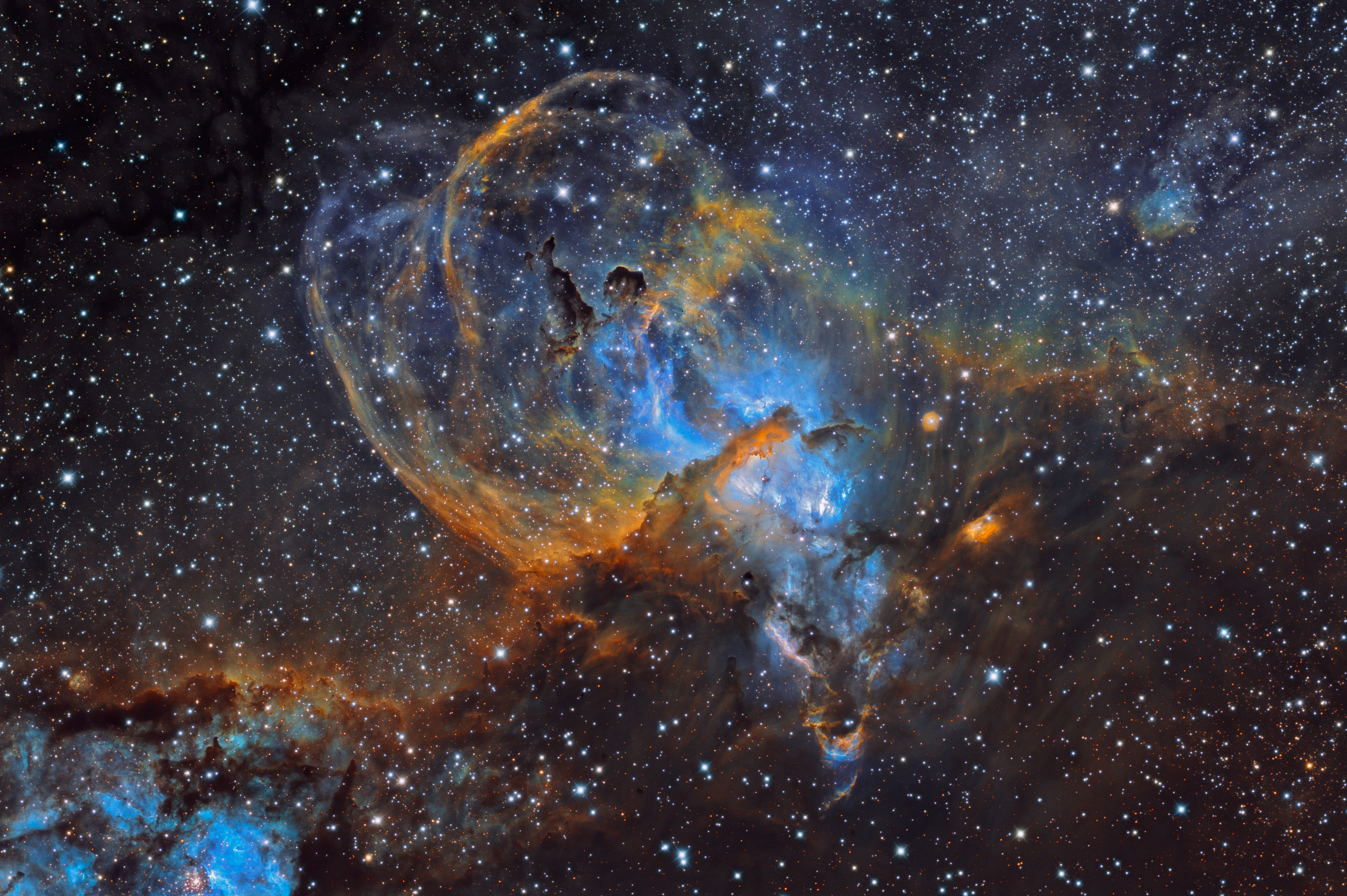
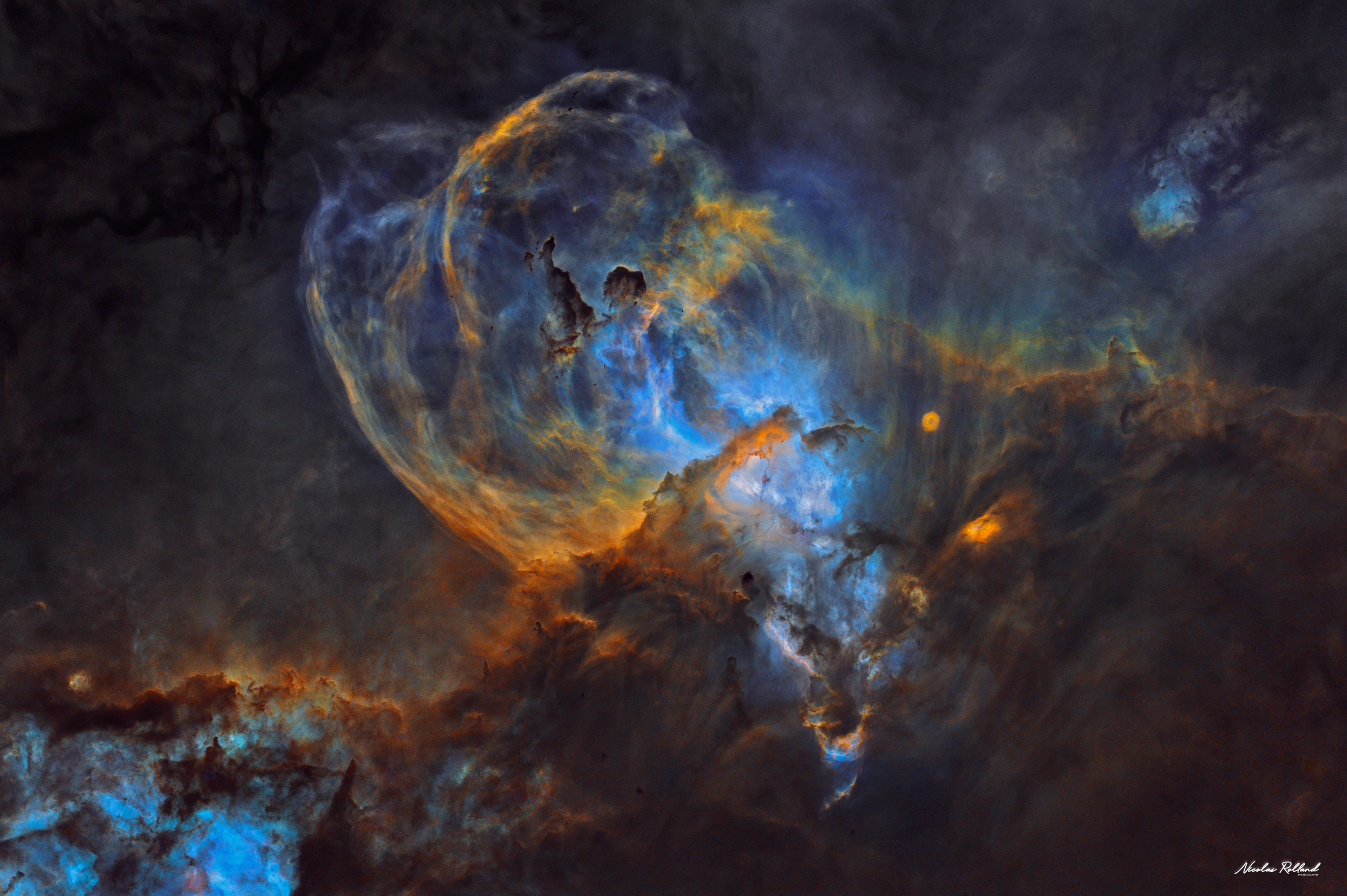
Processed by Nicolas Rolland, Paris. 36.6 hours gathered by Martin Pugh at El Sauce Observatory, Rio Hurtado, Chile.
The name comes from a shape somebody saw here. Look a moment longer and there are three or four others.
A hundred light-years of gas in Carina
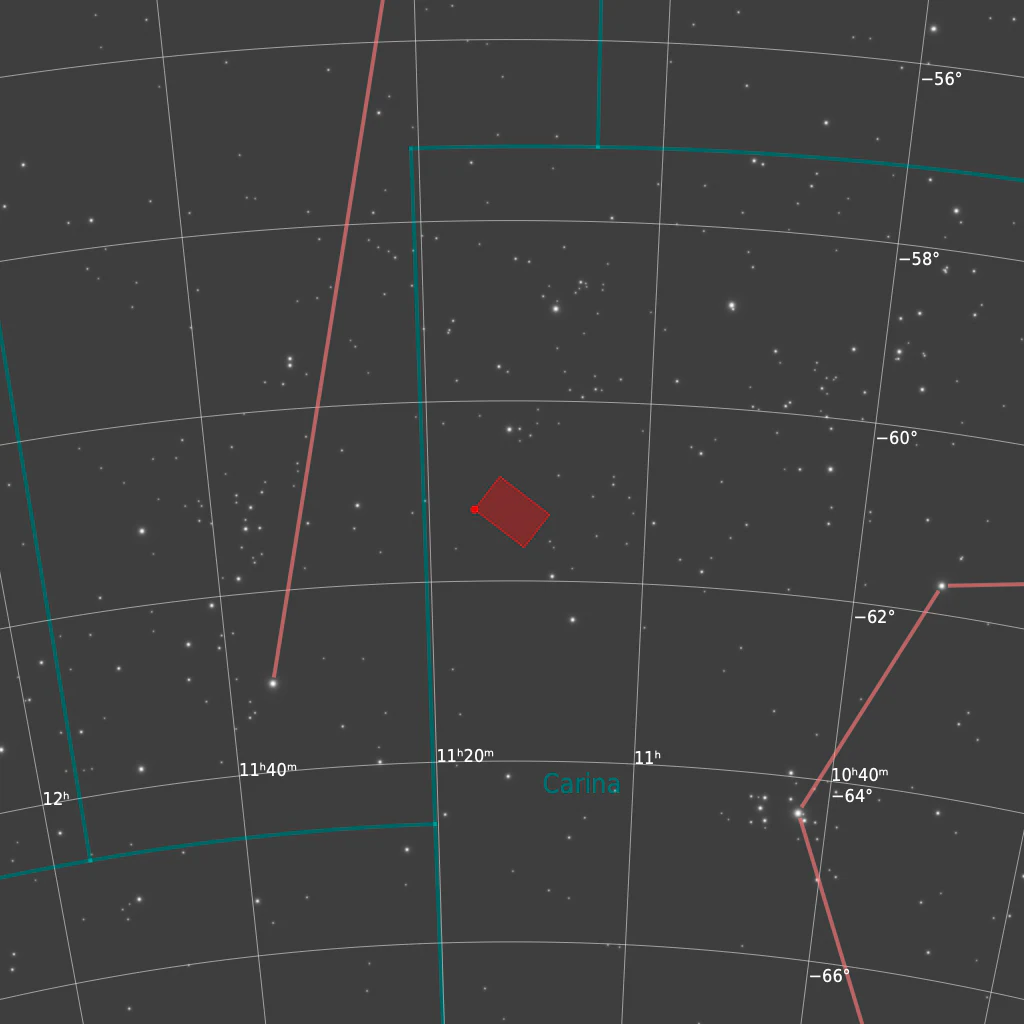
NGC 3576 is an emission nebula about 9,000 light-years away in Carina, spanning roughly a hundred light-years — wide enough that it nearly fills this frame, and part of the same arm of the Milky Way as the Carina Nebula further along. Its popular name came from an outline that resembles a standing figure with a raised arm. The resemblance is not the object; it is the shape the gas happens to have taken, and the same field yields a wolf's head, a dragon, and the profile of a crocodile depending on where you look.
Sculpted by what it produced
Those shapes have a single cause. The nebula is a star-forming region, and the massive stars it has already made are now taking it apart: their ultraviolet ionises the gas, and their winds push it. A star of thirty solar masses does this at a rate that outpaces the cloud's own gravity, so the material gets carved back from wherever a hot star sits. The dark patches across the frame are the parts that have held out — clumps dense and opaque enough to block the glowing gas behind them, and dense enough to be the next places stars form.
The two horns
Two curved filaments loop out from one side of the nebula, and they are the reason this object is photographed as often as it is. They are thought to mark a breakout: an ionised region grows inside a dense cloud until it reaches the edge, and when it does, the hot gas escapes into the thinner medium beyond and streams away, dragging the boundary out into arcs. What the horns record is the moment a nebula stopped being contained.
Thirty-six hours, thirty of them narrowband
A Planewave CDK17 at f/6.8 with adaptive optics ahead of the sensor, from Rio Hurtado in February 2020 — thirty-six hours in all, thirty of them across H-alpha, OIII and SII in half-hour frames, and six across red, green and blue. The narrowband carries the nebula and the broadband carries the stars, which is why their colours here are real while the gas is a mapping. Half-hour subframes are what the sulphur line requires: SII is the weakest of the three by a wide margin, and ten hours of it is roughly what it takes to give the red channel anything to work with. What thirty-six hours does not reach is inside the dark clumps. Whatever is forming in there is wrapped in dust and radiates in the infrared, and no filter used here will see it.
Hubble palette (SHO): SII in the red channel, H-alpha in green, OIII in blue. The nebula's colours are a mapping of three emission lines, not a record of what the eye would see. The star colours are real, taken from the separate RGB frames.