NEBULAE
The Cosmic Keyhole
— NGC 1999 —
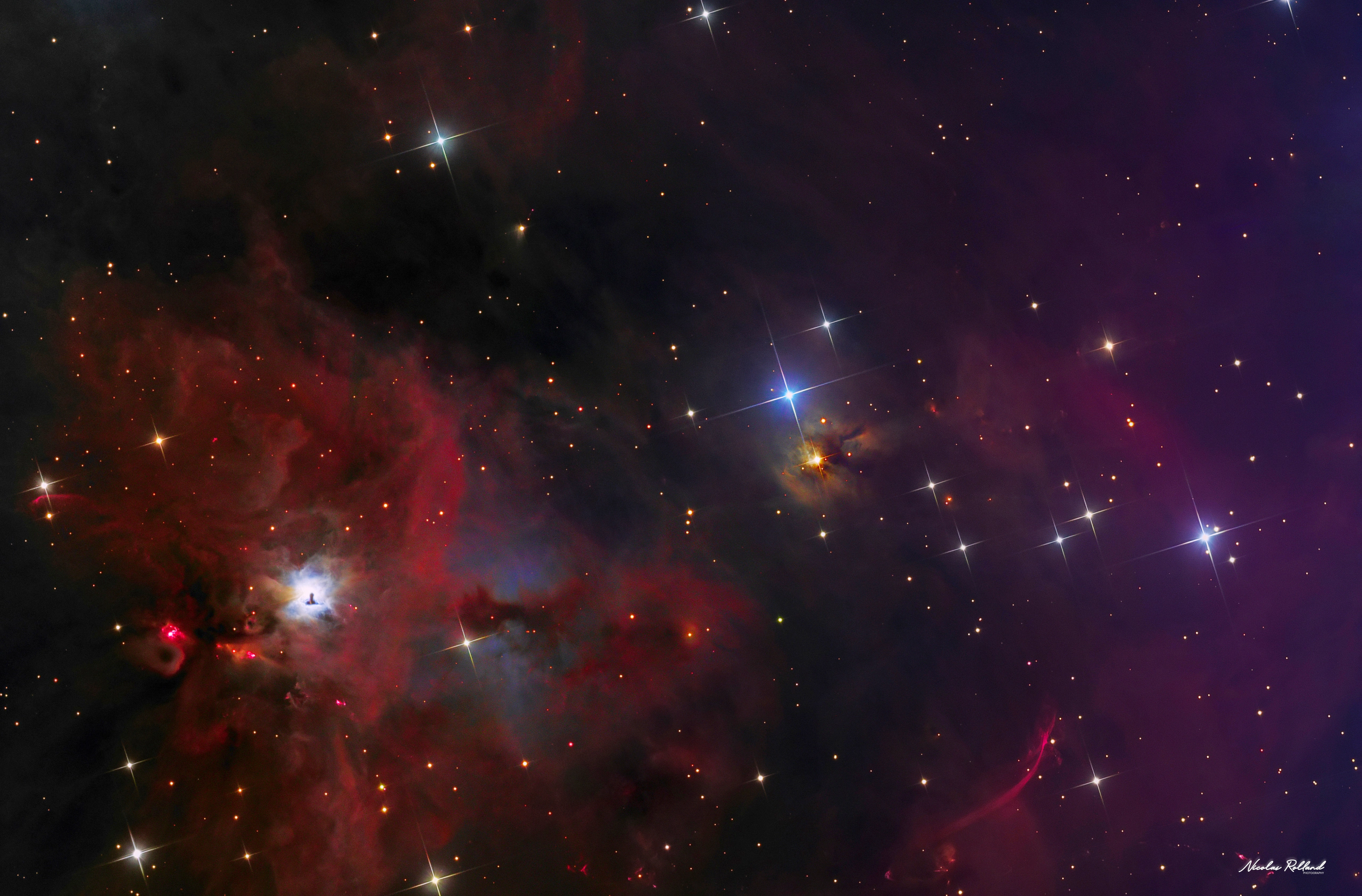
Processed by Nicolas Rolland, Paris. 24.7 hours gathered by Martin Pugh at El Sauce Observatory, Rio Hurtado, Chile.
Four things in this frame look unrelated to one another. All four are young stars shoving material out of their way.
A nebula lit by one variable star
NGC 1999 is a reflection nebula in Orion, about 1,500 light-years away. It produces no light of its own: the dust returns what reaches it, and what reaches it comes from V380 Orionis, a variable star — a triple system, in fact — embedded in the glowing cloud. That cloud is cold, dense gas and dust, the same material stars are made from, and it is still making them.
The hole is a hole
At the centre sits a dark patch about 10,000 astronomical units across, roughly a sixth of a light-year. Almost every dark shape in astrophotography is a cloud standing in front of something brighter. This one is not. Measurements at infrared and submillimetre wavelengths, where dust gives itself away by its own heat, found nothing there at all: the patch is empty space, a cavity in the cloud rather than a lump of it. How it got emptied is still open, and the leading answer is the same one that explains the rest of this field — jets and radiation from the young stars inside, clearing a volume around themselves.
Two outflows, one visible
The bright red arcs southwest of the nebula are HH 1 and HH 2, a Herbig-Haro object: the shock front where a jet from a forming star slams into the surrounding gas fast enough to make it glow. The two arcs point in opposite directions, 1.1 light-years apart, thrown out by the same source — an opaque core holding a multiple star system, invisible in the middle. Only one side shows here. The jet towards HH 1 is bright at optical wavelengths; the counter-jet towards HH 2 is detectable only in the infrared. At the bottom right is a third outflow, HH 222, known as the Waterfall: a stream of gas running ten light-years, which is most of the width of this frame, and whose source is still disputed between a young star's wind and a jet from a compact binary further off.
Twenty-four hours, and half a pair
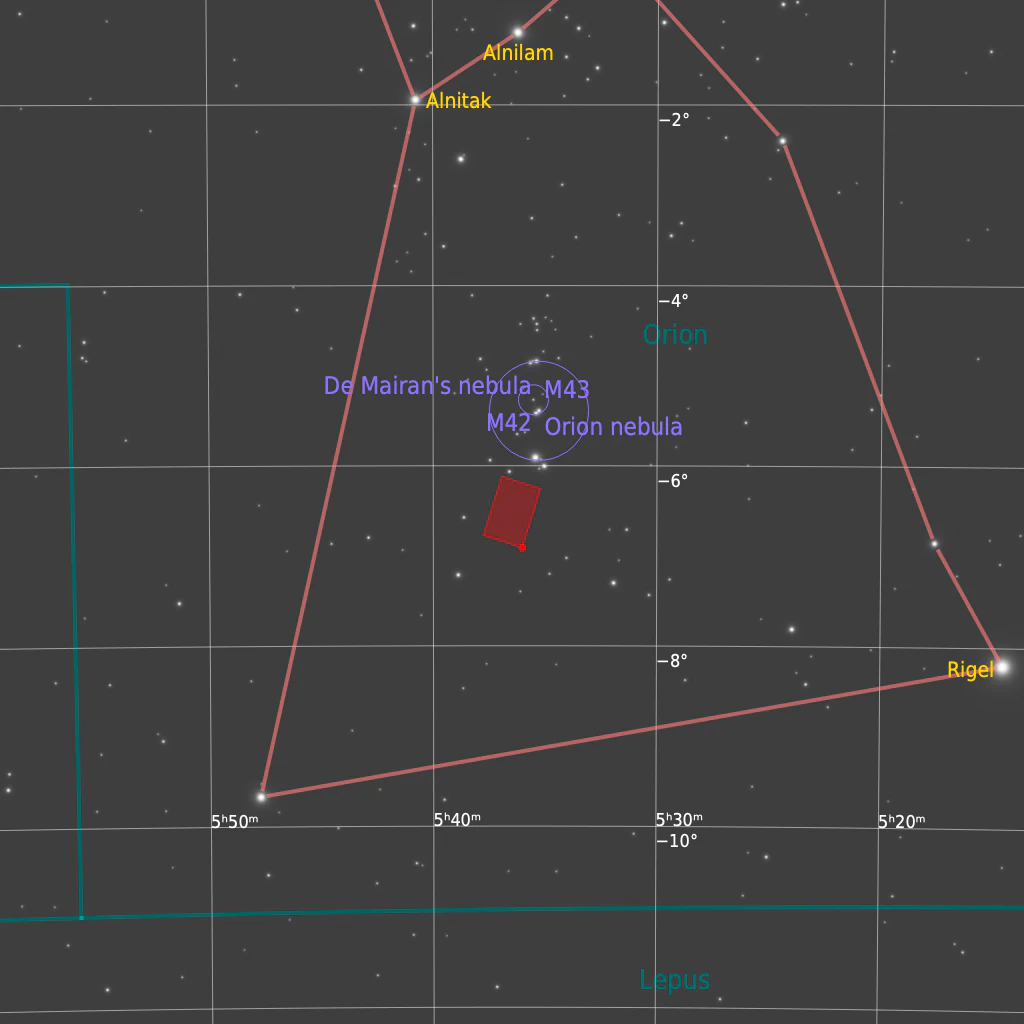
A Planewave CDK17 at f/6.8 with adaptive optics ahead of the sensor, from Rio Hurtado in January 2020 — twenty-four hours and forty minutes across a field of 41 by 27 arcminutes, twenty of them in luminance and colour at twenty minutes a frame and five in H-alpha at thirty. The two channels do different jobs here: the broadband carries the reflection nebula, which has no emission line to work with, and the H-alpha carries the shock fronts, which have almost nothing else. Where the dataset stops is written into the field itself. HH 1 and HH 2 were thrown out by the same source in opposite directions, and this image holds one of them — the other radiates in the infrared, and twenty-four hours of optical and hydrogen will not bring back a jet that does not emit in either.