STAR CLUSTER

The Wishing Well Cluster

— NGC 3532 —
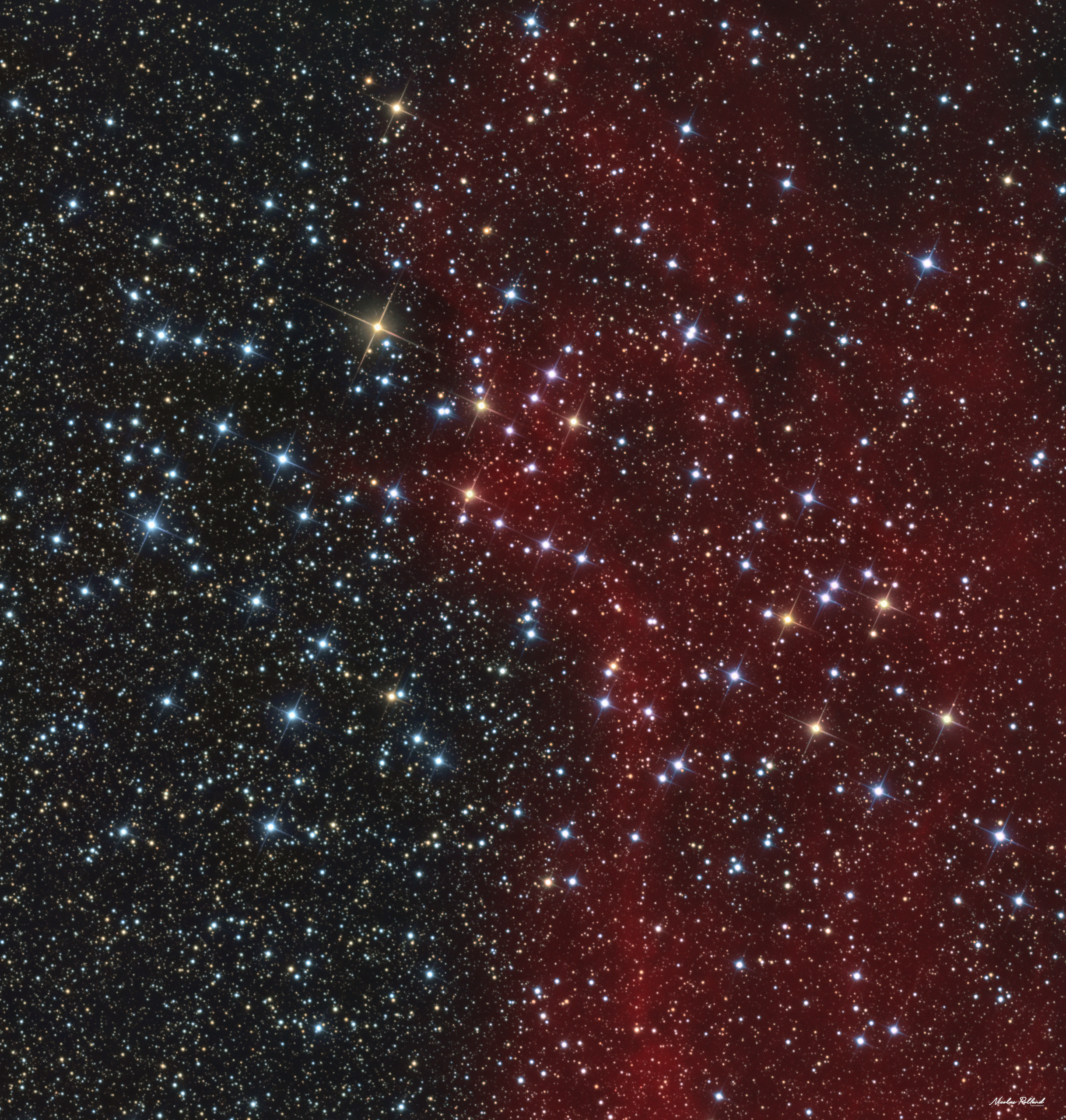
The Wishing Well Cluster NGC 3532 in Carina, one of the finest open clusters in the sky, in 6 hours of HaRGB

Processed by Nicolas Rolland, Paris. 6 hours gathered by Martin Pugh at El Sauce Observatory, Rio Hurtado, Chile.

On 20 May 1990 the Hubble Space Telescope opened its aperture door for the first time and pointed at this cluster.

First light

That first image was released the same day. It was sharper than anything taken from the ground, and it was also the first evidence that something was wrong: within weeks, engineers had traced the softness in Hubble's optics to a spherical aberration ground into the main mirror, and it would be three years before a servicing mission corrected it. NGC 3532 is therefore the object on which the world first saw both what the telescope could do and what it could not.

Coins in a well, or a rugby ball

The cluster lies about 1,300 light-years away in Carina and holds around 400 stars, spread across twice the apparent diameter of the full Moon. It has two unofficial names and neither is catalogued: some see the scatter of a handful of coins thrown into a well, others the oval of a rugby ball. At roughly 300 million years it is middle-aged for an open cluster — old enough that its heaviest members have already exploded, young enough that the next tier down are only now swelling into red giants while the rest still burn white and blue.

The red veil behind it

Most images of an open cluster show stars and black sky. This one does not, and the difference is the direction it faces: NGC 3532 sits against the Carina arm of the Milky Way, one of the densest concentrations of ionised hydrogen in the southern sky. The faint red wash across the field is that gas, recorded through an H-alpha filter and laid behind the cluster. It has nothing to do with the cluster itself — it is simply what happens to lie beyond it.

Six hours, and a frame too small

A Planewave CDK17 at f/6.8 with adaptive optics ahead of the sensor, from Rio Hurtado in July 2020 — six hours in all, four and a half across red, green and blue in ten-minute frames, and an hour and a half of H-alpha in three frames of thirty minutes. That is enough for the stars, which are bright, and only just enough for the veil: three frames establish that the hydrogen is there and stop short of giving it any structure. The other limit is the framing. This field runs 28 by 29 arcminutes and the cluster covers close to fifty, which means the frame holds its centre and leaves the outer members outside. Martin Pugh gathered the data at El Sauce.

Version française
Le 20 mai 1990, le télescope spatial Hubble a ouvert sa porte pour la première fois et l'a pointée sur cet amas.
 
Cette première image a été diffusée le jour même. Elle était plus nette que tout ce qu'on obtenait depuis le sol, et elle a aussi été le premier indice que quelque chose n'allait pas : en quelques semaines, les ingénieurs ont attribué le manque de piqué de l'optique de Hubble à une aberration sphérique taillée dans le miroir principal, et il a fallu trois ans pour qu'une mission de maintenance la corrige. NGC 3532 est donc l'objet sur lequel le monde a découvert à la fois ce que ce télescope pouvait faire et ce qu'il ne pouvait pas.
 
L'amas se trouve à environ 1 300 années-lumière dans la Carène et rassemble quelque 400 étoiles, étalées sur deux fois le diamètre apparent de la pleine Lune. Il porte deux noms officieux, dont aucun ne figure dans un catalogue : les uns y voient l'éparpillement de quelques pièces jetées au fond d'un puits, les autres l'ovale d'un ballon de rugby. Avec ses quelque 300 millions d'années, c'est un amas ouvert d'âge moyen — assez vieux pour que ses membres les plus lourds aient déjà explosé, assez jeune pour que la génération suivante se dilate seulement maintenant en géantes rouges quand les autres brûlent encore blanches et bleues.
 
La plupart des images d'amas ouverts montrent des étoiles et un ciel noir. Celle-ci non, et la différence tient à la direction qu'elle vise : NGC 3532 se détache sur le bras de la Carène, l'une des concentrations d'hydrogène ionisé les plus denses du ciel austral. Le lavis rouge et ténu qui traverse le champ est ce gaz, enregistré à travers un filtre H-alpha et posé derrière l'amas. Il n'a rien à voir avec l'amas lui-même : c'est simplement ce qui se trouve au-delà.
 
Un Planewave CDK17 à f/6,8, optique adaptative devant le capteur, depuis Rio Hurtado, en juillet 2020 — six heures en tout, dont quatre et demie réparties entre rouge, vert et bleu en poses de dix minutes, et une heure et demie de H-alpha en trois poses de trente minutes. C'est suffisant pour les étoiles, qui sont brillantes, et tout juste pour le voile : trois poses établissent que l'hydrogène est là sans lui donner la moindre structure. L'autre limite tient au cadrage. Ce champ couvre 28 sur 29 minutes d'arc quand l'amas en occupe près de cinquante, si bien que l'image en tient le centre et laisse les membres périphériques dehors. Martin Pugh a rassemblé les données à El Sauce.

Technical data
OpticsPlanewave CDK17 @ f/6.8
CameraSBIG STXL-11002 (AOX)
MountParamount ME
FiltersHa, R, G, B
LocationEl Sauce Observatory, Rio Hurtado, Chile
DateJuly 2020
Exposures6 hours R 9 × 600 sec · G 9 × 600 sec · B 9 × 600 sec · Ha 3 × 1800 sec
Distance~1,300 ly
SoftwarePixinsight, CCDstack, Photoshop
CopyrightsNicolas Rolland & Martin Pugh
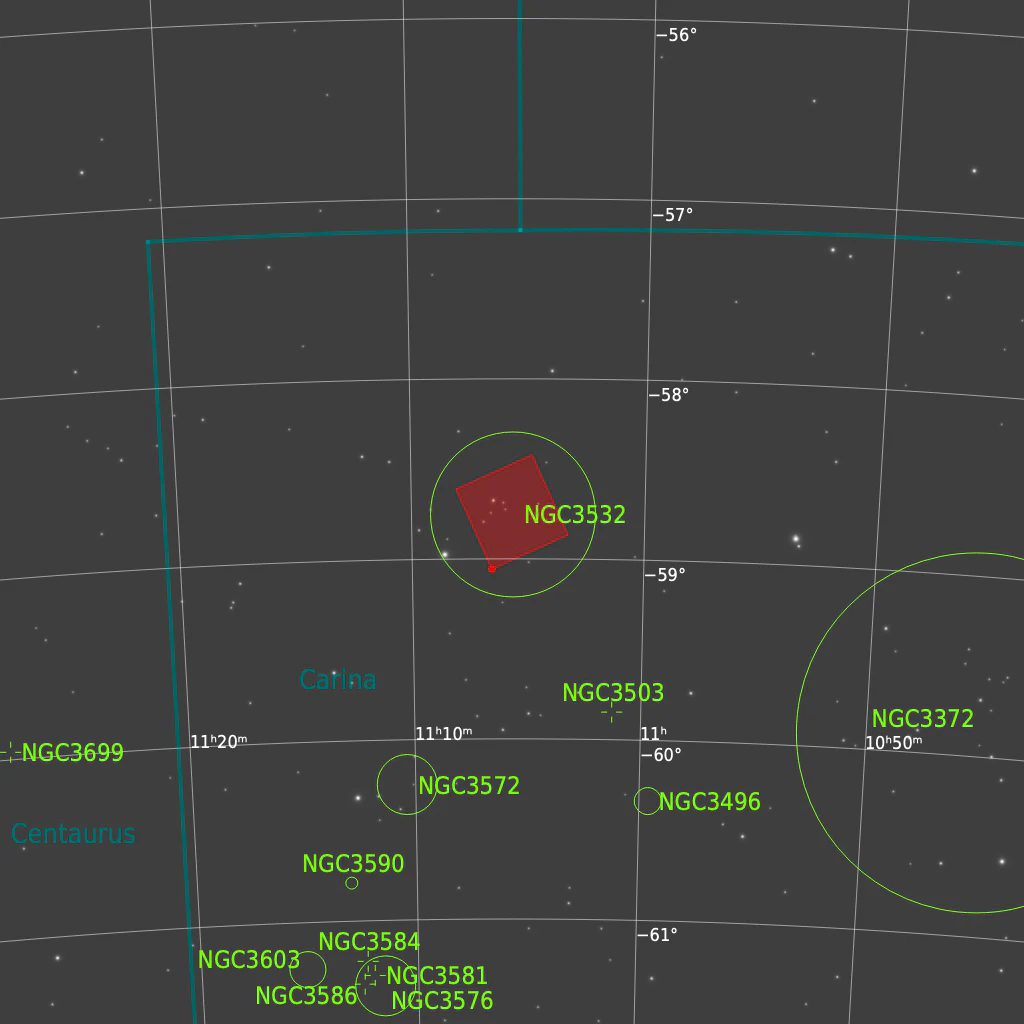
Finding chart The Wishing Well Cluster — finding chart
RA11h 05m 41.6s Dec-58° 44′ 22.8″ Size27.8 × 29.2 arcmin Orientationup is 336° E of N ConstellationCarina