STAR CLUSTER
The Pearl Cluster
— NGC 3766 —
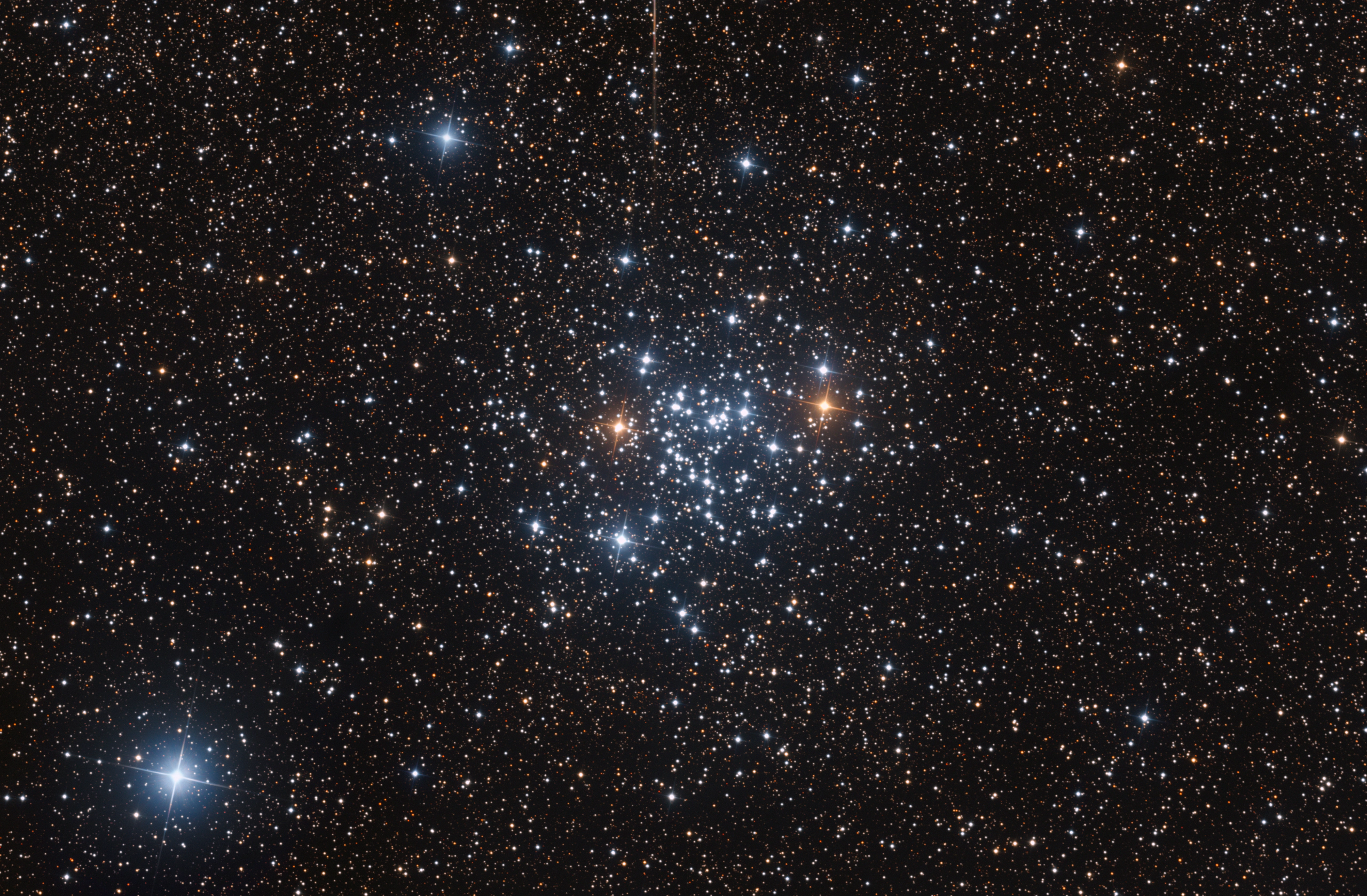
Processed by Nicolas Rolland, Paris. 3 hours gathered by Martin Pugh at El Sauce Observatory, Rio Hurtado, Chile.
A type of variable star was found here that did not exist in the classification before someone looked closely at this cluster.
Fourteen million years old
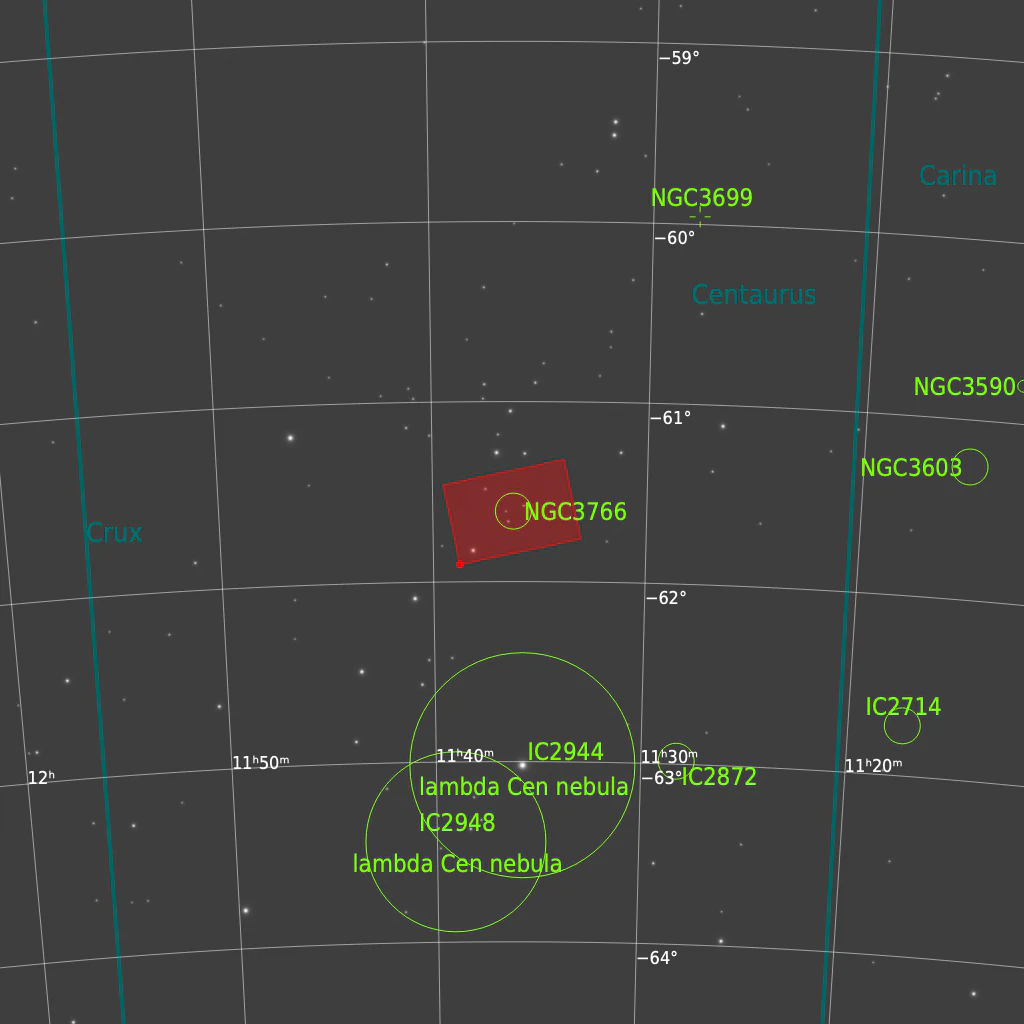
The Pearl Cluster is an open cluster in Centaurus, about 5,500 light-years away, roughly twelve arcminutes across and sitting inside a much larger star-forming region. Nicolas Louis de Lacaille catalogued it from the Cape between 1751 and 1752. At around 14.4 million years it is young by any measure — its most massive stars have not had time to leave the main sequence — and it is approaching us at 14.8 kilometres a second.
Who belongs and who does not
Around 137 stars are listed in the area, and a substantial number of them are not members at all: they lie in front of or behind the cluster and happen to fall in the same direction. Among those that do belong are eleven Be stars — hot stars spinning fast enough to throw off a disc of their own material — two red supergiants, and four Ap stars with unusually strong magnetic fields.
Thirty-six stars that broke the classification
Thirty-six stars in this cluster turned out to vary in a way that fitted no existing category. They are fast-rotating B-type stars on the main sequence, pulsing with periods under half a day and changing by only a few hundredths of a magnitude — too hot to be δ Scuti variables, too cool to be slowly pulsating B stars. Finding a new class of variable star requires monitoring a great many stars for a long time at a precision most surveys do not reach. This cluster is where that happened.
Three hours of colour, and nothing else
The CDK17 was working at f/6.8 from Rio Hurtado in February 2021, and the whole dataset is three hours: six ten-minute frames each in red, green and blue, with no luminance and no narrowband. On a cluster of magnitude 5.3 that is enough — the stars are bright, and what matters here is their colour, which is what separates the blue B-type members from the two red supergiants at a glance. What three hours of broadband does not reach is the star-forming region the cluster sits inside. That material is there, it emits in H-alpha, and none was recorded. This image is the cluster on its own, which is not quite how it exists. Martin Pugh gathered the data at El Sauce.