NEBULAE
The Pencil Nebula
— NGC 2736 —
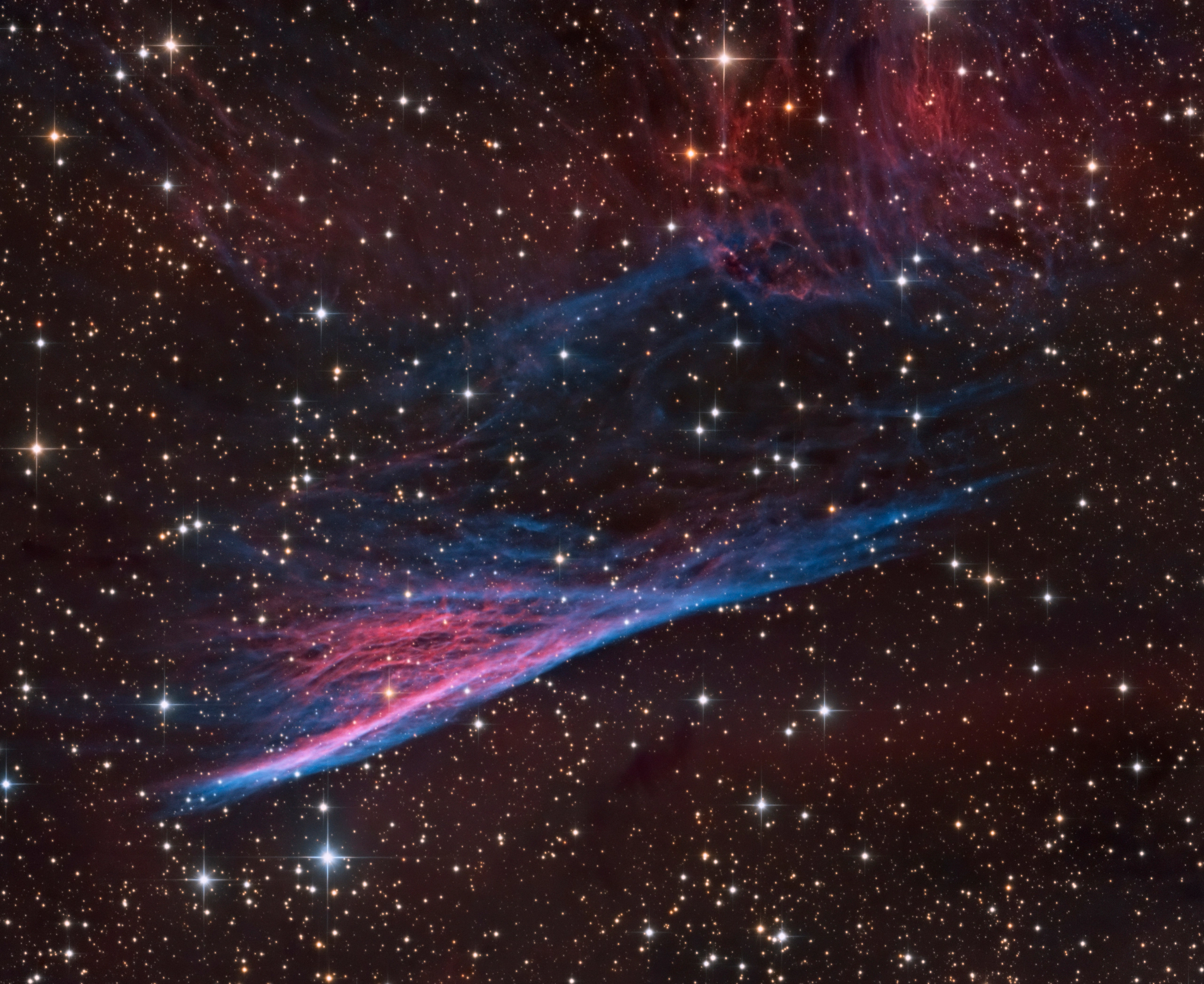
Processed by Nicolas Rolland, Paris. 30 hours gathered by Greg Turgeon at Deep Sky West, Rio Hurtado, Chile.
Blue here means the gas is still hot. Red means it has already cooled. The colours in this image are a measurement.
A fragment of something eight degrees wide
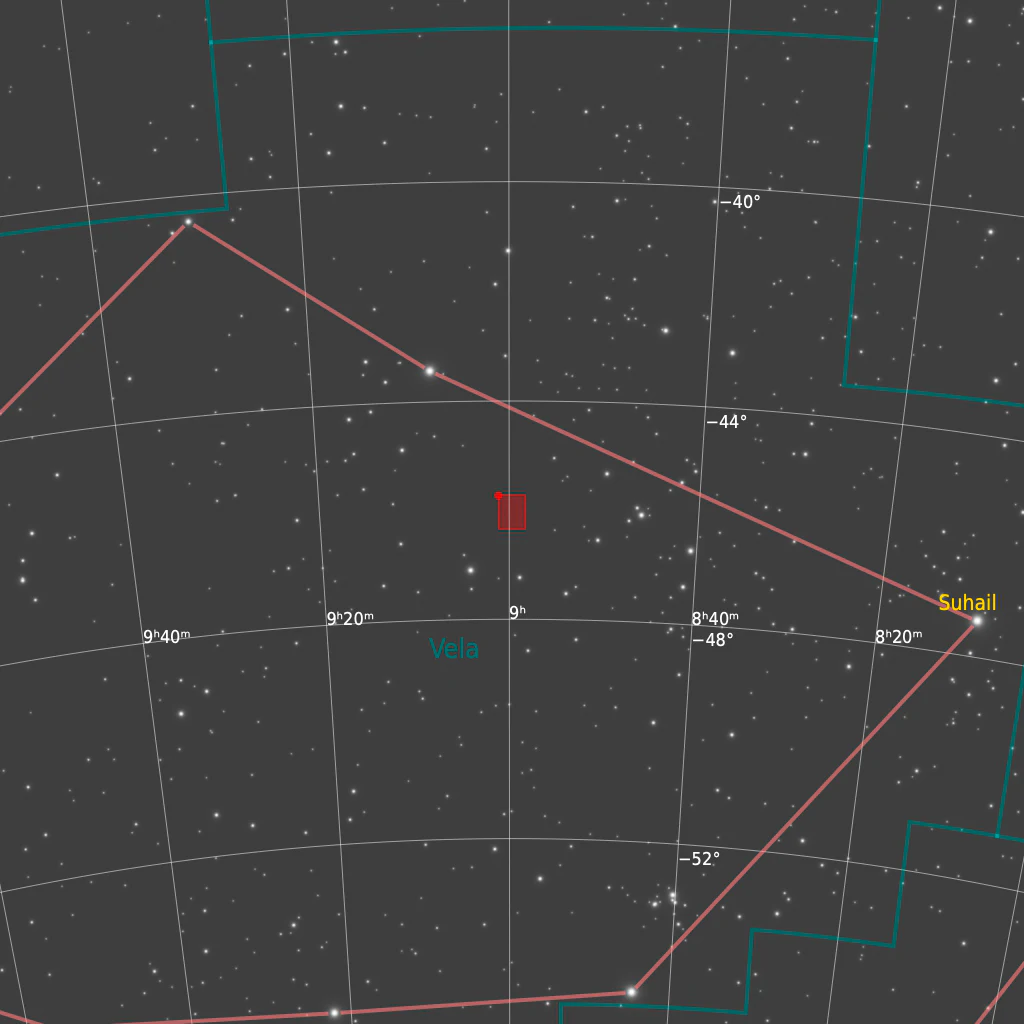
NGC 2736 belongs to the Vela supernova remnant, the debris of a star that exploded about 11,000 years ago in the southern constellation Vela, 815 light-years away. No record of the event survives, though it would have been 250 times brighter than Venus and visible in broad daylight from the southern hemisphere. What is left at the centre is a pulsar — the collapsed core of the star, spinning. The remnant now spans some eight degrees of sky. This frame covers thirty-six arcminutes of it.
A sheet seen edge-on
The pencil shape is a matter of viewing angle. What is actually there is a thin sheet of gas, and we happen to be looking along it rather than at it, which compresses the whole structure into a line. The sheet exists because the expanding shock wave has run into a denser region of interstellar gas — the collision is what makes it glow, and the ripples along its length are the shock finding the material uneven. It is still moving, at around 640,000 kilometres an hour. That works out to fifteen arcseconds a century, which is slow enough to look static and fast enough to measure on plates taken decades apart.
The colours are a cooling curve
When the shock hits, the gas is heated to millions of degrees. It then cools, and it emits visible light on the way down — which means the light coming from any part of this nebula depends on how long ago that part was struck. The regions still hot enough to hold doubly ionised oxygen give off the OIII line, mapped here to blue. The regions that have cooled further emit hydrogen alpha, mapped to red. The false colours in this image are not arbitrary: they follow a physical quantity, and reading across the nebula from blue to red is reading forward in time.
Thirty hours, and one frame of an ongoing collision
A Planewave CDK17 at f/6.8 with an FLI ML16803, from Rio Hurtado in January 2021 — thirty hours in all, with eleven in H-alpha and eight and a half in OIII at half an hour a frame, and the rest in luminance and colour at ten minutes. The two narrowband lines carry the two temperature regimes, and the broadband carries the stars, whose colours here are their own. The oxygen is the harder half: it marks the most recently shocked gas, which is also the thinnest, and eight hours is what it takes to separate it from the background. What thirty hours holds is a fragment. The Vela remnant runs across eight degrees of sky and this frame takes in less than one per cent of it, at one moment of a collision that has been going on for eleven thousand years. Greg Turgeon gathered the data at Deep Sky West.
HOO palette: H-alpha in the red channel, OIII in green and blue. The nebula's colours are not its true colours, but here they track the temperature of the gas. The star colours are real, taken from the separate RGB frames.