NEBULAE
The Running Chicken Feet
— RCW 61 —
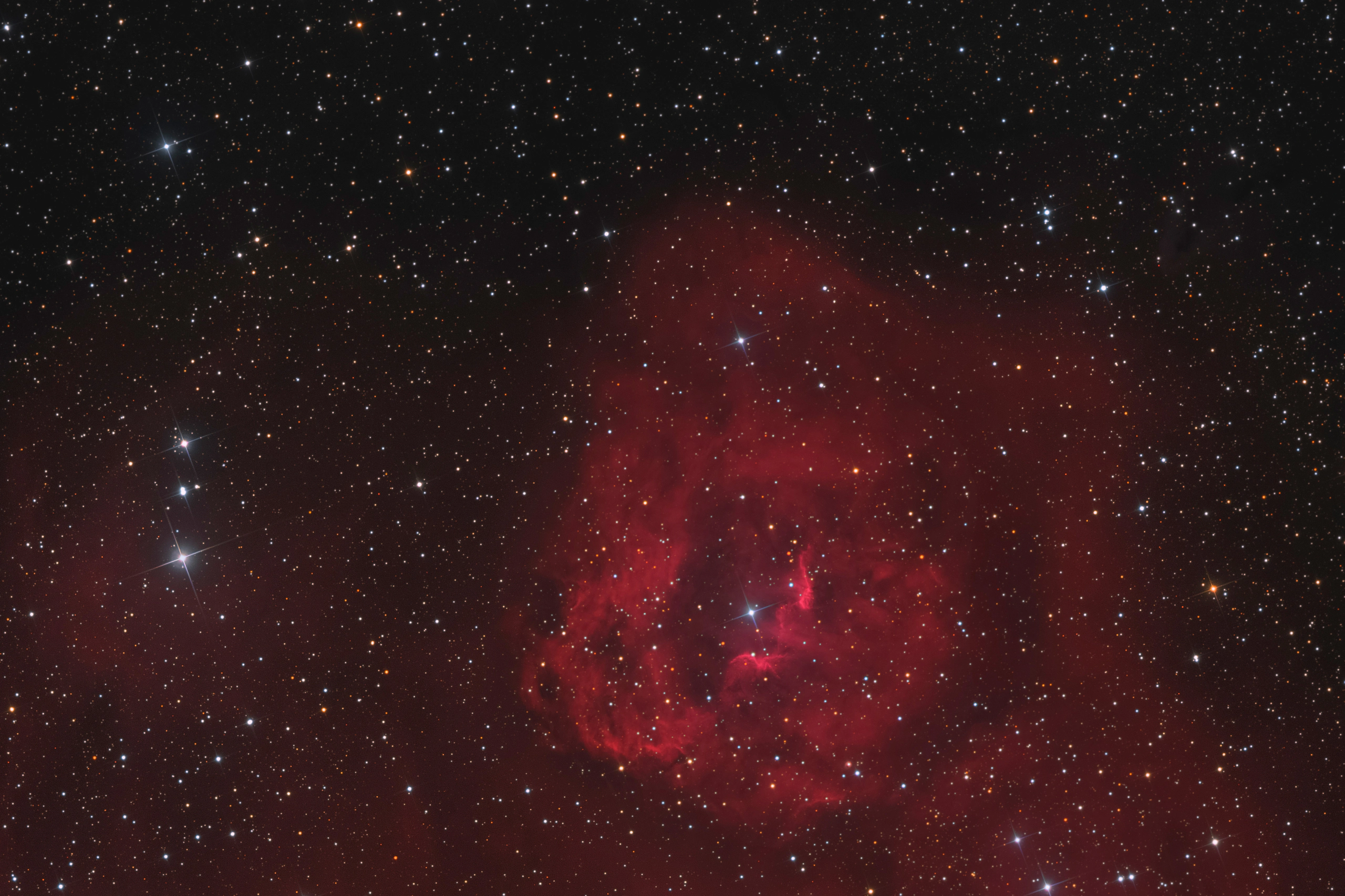
Processed by Nicolas Rolland, Paris. 18 hours gathered by Martin Pugh at El Sauce Observatory, Rio Hurtado, Chile.
Six stars light this entire cloud, and all six have names.
A foot of the Running Chicken
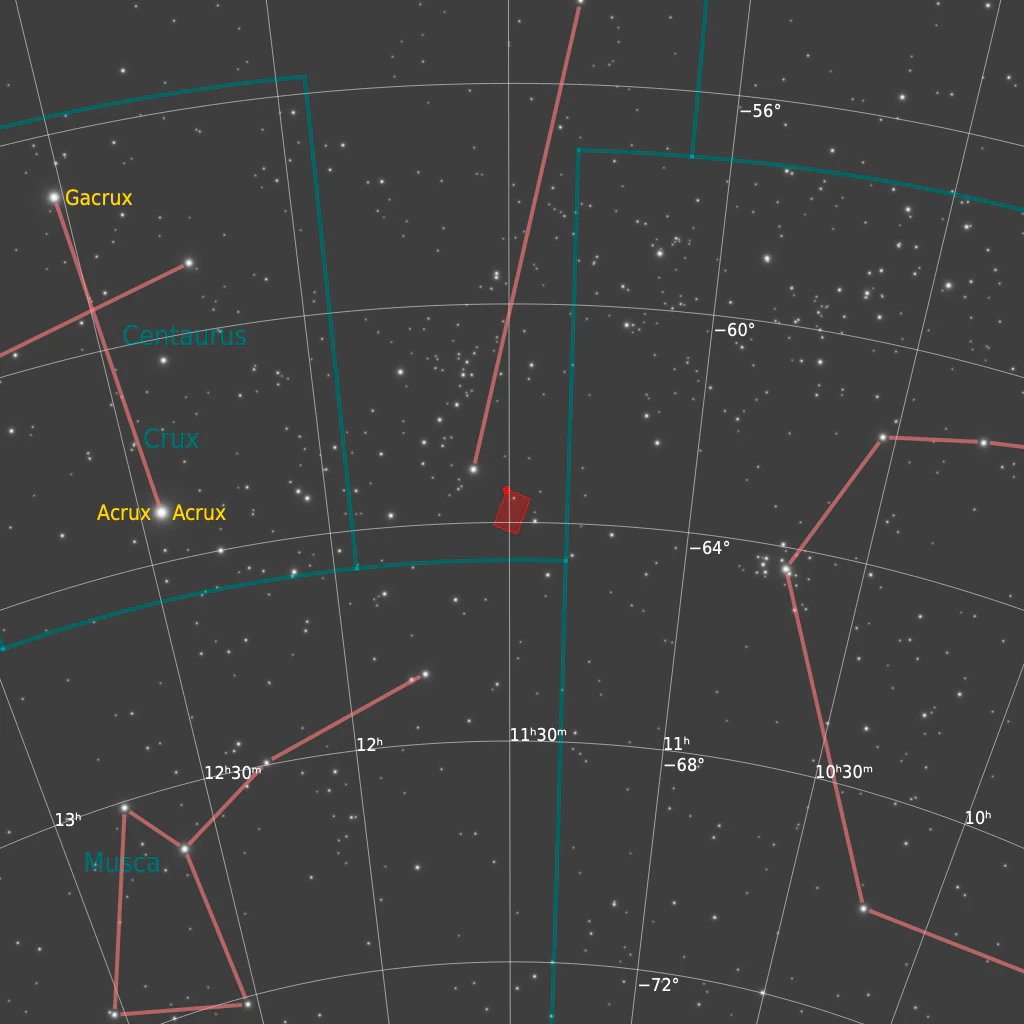
RCW 61 is an HII region in Centaurus, part of the complex known as the Running Chicken — IC 2944 and IC 2948, about 6,500 light-years away. The bird's outline covers several degrees of sky, and this frame holds the part at the bottom of it, the feet. The designation comes from the catalogue Rodgers, Campbell and Whiteoak compiled in 1960 from a photographic survey of the southern sky in hydrogen light, which is why the number means nothing to most people and everything to anyone working on southern emission nebulae.
Six stars doing all the work
An HII region is hydrogen that has had its electrons stripped away by ultraviolet light, and it glows as those electrons find their way back. Here the stripping is done by six stars, and they are identified: three O9 giants — HD 100099, CD −62 535 and HD 100444 — and three of class B. That is unusual. On most emission nebulae the ionising source is hidden inside the dust, or too far off to name, or spread across a cluster nobody has resolved. This cloud's entire energy budget comes from six objects that can be pointed at.
Where the light runs out
That budget sets the size of the nebula. An O star produces ultraviolet photons at a fixed rate, and each one can strip a single hydrogen atom; further out, atoms recapture their electrons faster than the photons arrive, and the gas goes neutral and dark. The boundary between the two is not the edge of the cloud — it is the distance at which the six stars stop being able to keep up. What looks like the shape of a nebula is the reach of the stars inside it.
Eighteen hours, and a hard line to reach
A Planewave CDK17 at f/6.8 with adaptive optics ahead of the sensor, from Rio Hurtado in May 2020 — eighteen hours across a field of 41 by 27 arcminutes, mostly narrowband in half-hour frames, with red, green and blue at twenty minutes for the stars. The H-alpha comes easily on a target like this. The OIII does not, and the reason is in the paragraph above: doubly ionised oxygen needs harder ultraviolet than singly ionised hydrogen, and O9 is the coolest of the O subtypes — close to the temperature below which that line largely stops appearing. Ten hours on the oxygen returns a thin signal here, not for want of exposure but because the six stars lighting this cloud are barely hot enough to produce it. Martin Pugh gathered the data at El Sauce.