GALAXY
The Warped Spiral
— NGC 134 —
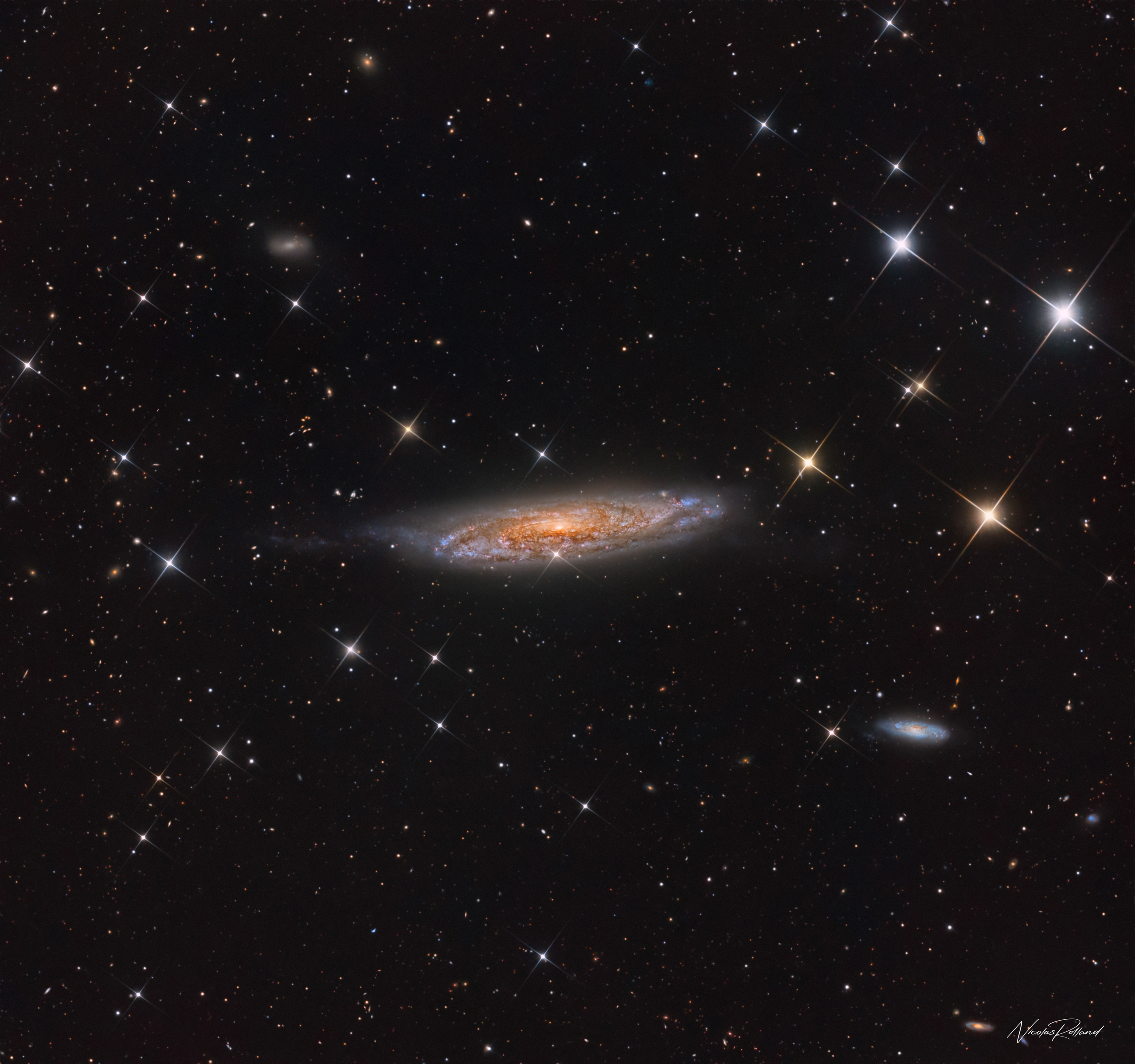
Processed by Nicolas Rolland, Paris. 24.5 hours gathered by Martin Pugh at El Sauce Observatory, Rio Hurtado, Chile.
This galaxy is wider than the Milky Way, and it is tilted just enough that the dust across its disc reads as a set of parallel lines.
A weakly barred spiral in Sculptor
NGC 134 lies about 60 million light-years away in Sculptor, in a small group of galaxies, and spans roughly 150,000 light-years — half again the width of our own. It is classified SAB(s)bc: a spiral with a bar too weak to dominate it, and arms that break into patches rather than sweeping cleanly around. John Herschel found it in 1834.
A nucleus still making stars
The core is bright, and it is bright for a reason: star formation is running there at a high rate, with young hot stars still being assembled. Further out, the red and pink knots strung along the arms are HII regions — clouds of hydrogen lit from inside by stars that have just switched on. The galaxy also carries a large population of globular clusters, which are the opposite case: stars that formed long ago and have been orbiting ever since.
The extensions at either end
Two faint extensions run out from the ends of the disc, well past where the bright structure stops. They are the sort of feature a close pass leaves behind — material pulled out of the plane and left to drift back. Nothing in the field settles the question, and the group NGC 134 belongs to holds several candidates.
Twenty-four hours, and a second look
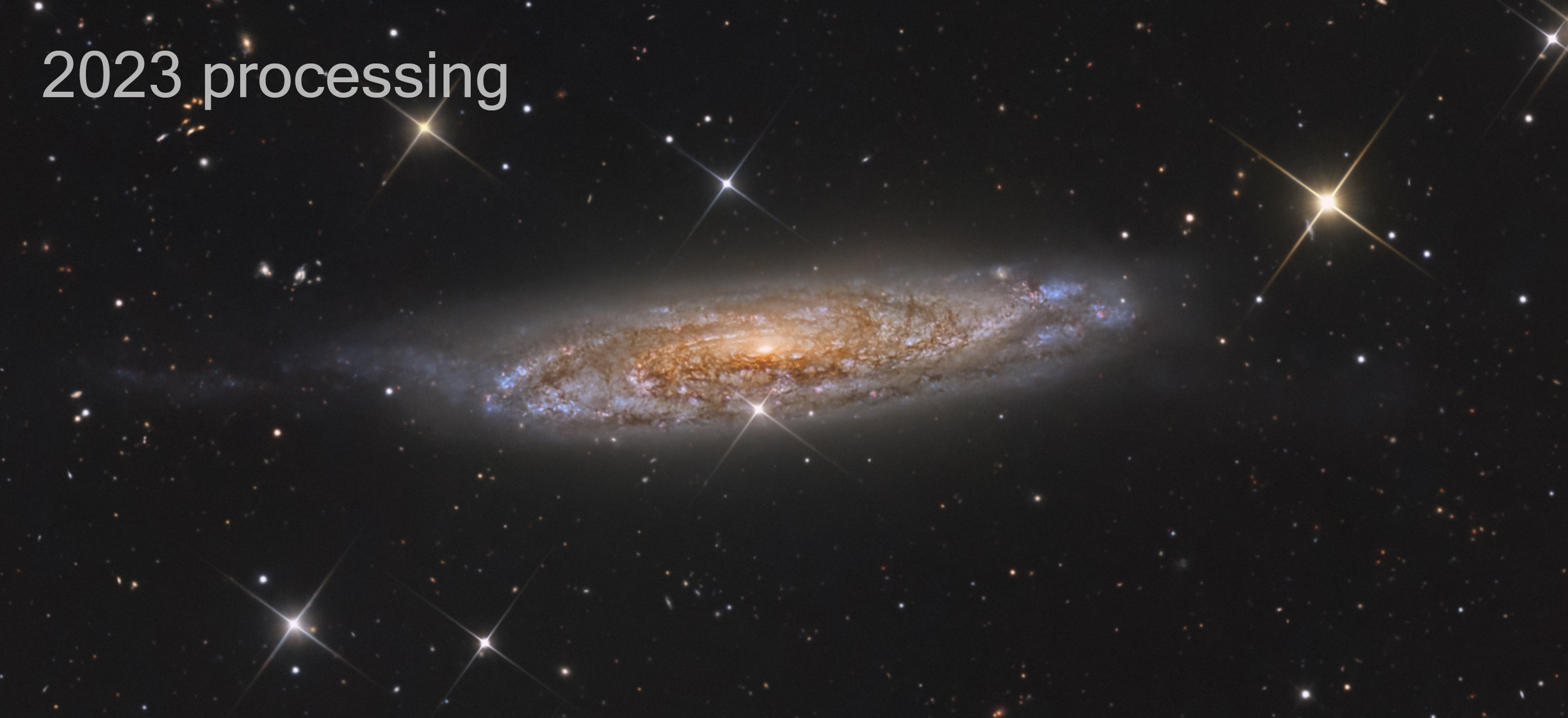
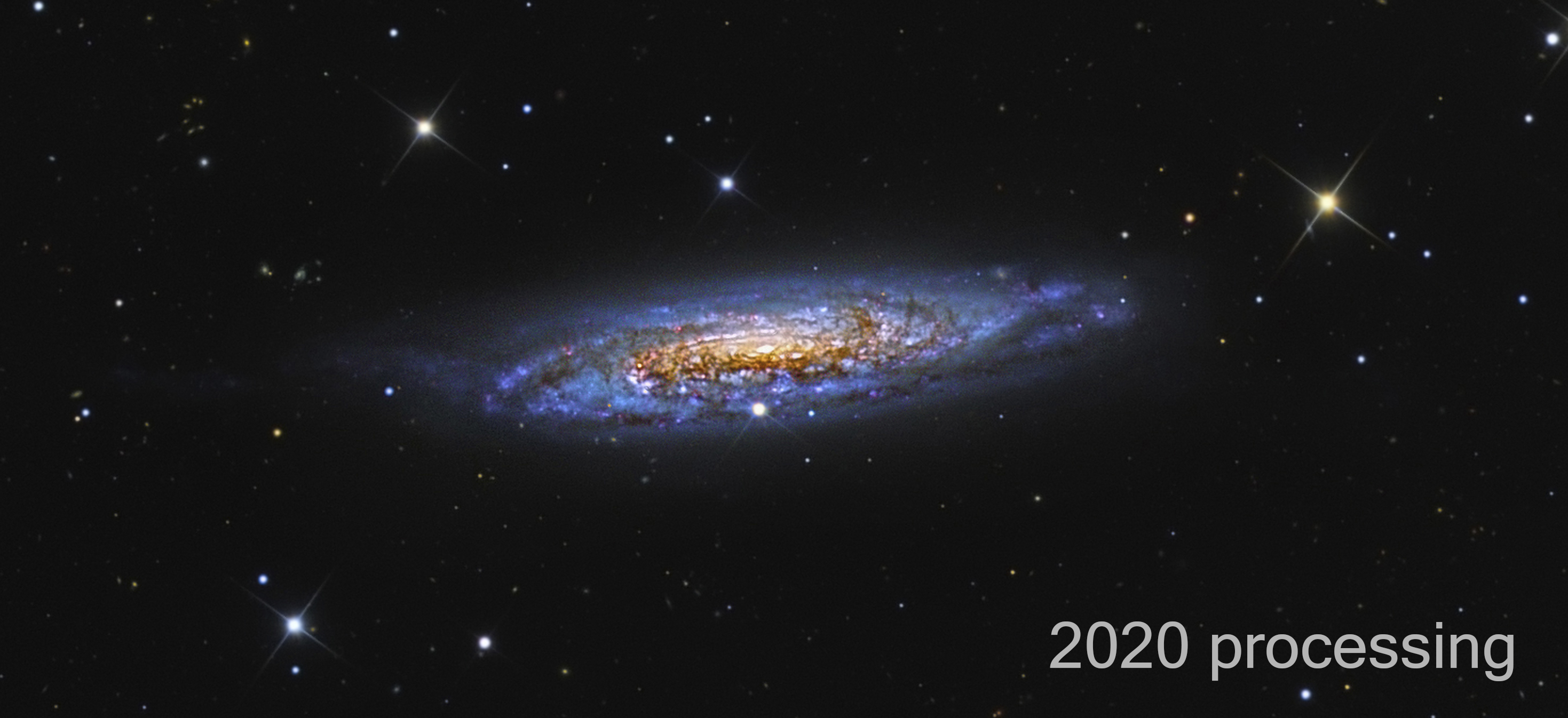
The CDK17 was working at f/6.8 with adaptive optics ahead of the sensor, from Rio Hurtado in November 2019. Twenty-four and a half hours went to the field: seven in luminance, fourteen split across red, green and blue, and three and a half in H-alpha. Those three and a half hours are what make the HII regions visible at all — without them the arms would be dust and starlight, and the star-forming knots would not separate from the general glow. The extensions at the ends of the disc sit at the other limit: they are there, and they stop where the luminance stops. This dataset was first processed in early 2020, and the version shown here was reprocessed in 2023 from the same frames — the slider below compares the two. Martin Pugh gathered the data at El Sauce.