GALAXY
The Hydra Cluster
— Abell 1060 —
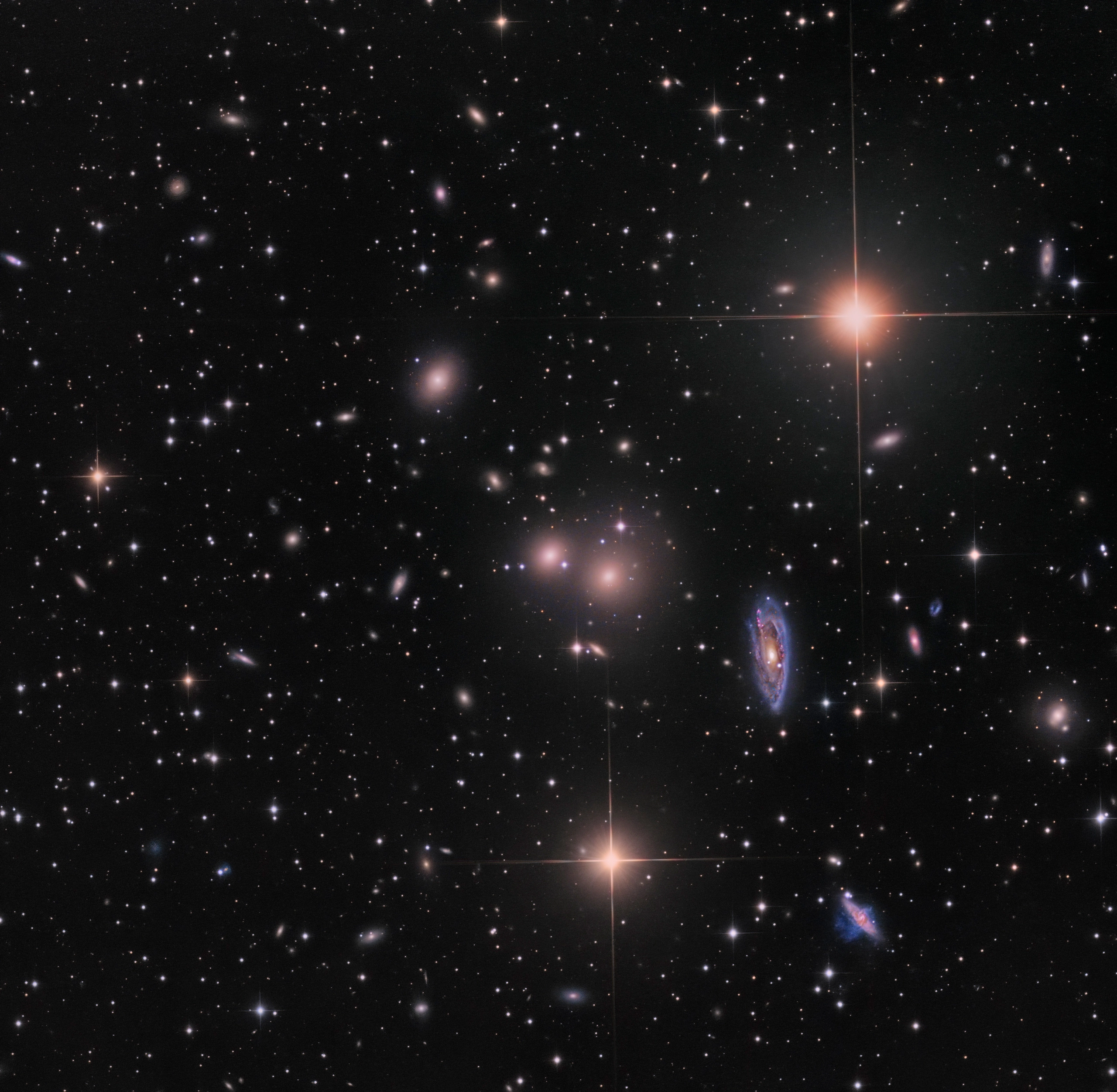
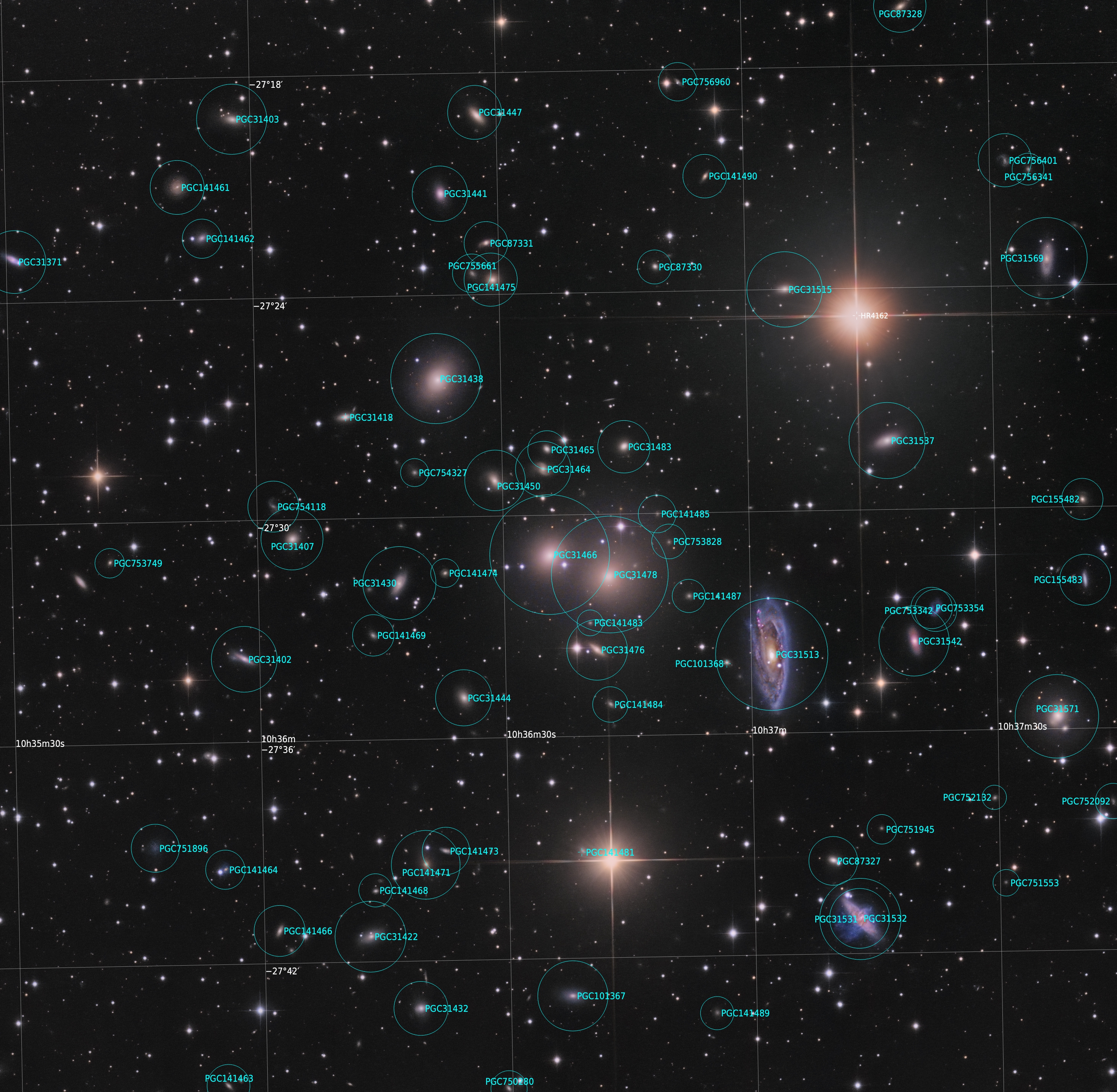
Processed by Nicolas Rolland, Paris. 2.6 hours gathered at El Sauce Observatory, Rio Hurtado, Chile.
Every fuzzy patch in this field is a galaxy. A hundred and fifty-seven of them are bright enough to count.
A hundred and fifty-seven galaxies
Abell 1060 lies about 190 million light-years away in Hydra and spans some ten million light-years. George Abell catalogued it in 1958, working through the photographic plates of the Palomar sky survey and picking out the places where galaxies crowd together — the same man who, eight years later, published the catalogue of faint planetary nebulae that carries his name on the other side of this site. Three galaxies dominate this one: the ellipticals NGC 3309 and NGC 3311 and the spiral NGC 3312, each roughly 150,000 light-years across.
The nearest cD galaxy
NGC 3311 is a cD galaxy, and the nearest one to us: a giant elliptical sitting at the gravitational centre of the cluster, with an outer envelope so faint and so extended that it fades into the light between the galaxies without a clear edge. It carries an exceptionally rich system of globular clusters, and those are bright enough to be measured one at a time. That is why this cluster keeps appearing in the literature on dark matter — a few thousand globulars, each with a measurable velocity, trace the shape of the halo they are orbiting in, and Hydra I is one of the few places close enough for the measurement to work.
Round on the sky, clumpy in depth
The cluster looks nearly circular here, which is what a settled, relaxed system would look like. Its galaxy velocities say something else: measured in three dimensions, the distribution is clumpy, and the smoothness is an effect of seeing it flattened onto the sky. The velocities are also unusually clean to work with. Abell 1060 is isolated in redshift, meaning very few unrelated galaxies happen to share its velocity range — which is what makes membership straightforward to establish here and difficult in most clusters.
Two and a half hours, and a star in the way
A Planewave CDK24 at f/6.5 with an FLI ProLine PL9000, from Rio Hurtado in January 2021 — two hours and thirty-six minutes in five-minute frames, of which ten minutes are luminance. Two frames. That sets the ceiling immediately: the bright members come through and the faint envelope of NGC 3311 does not, and reaching the light between the galaxies, which is what makes this cluster interesting, is an exposure of a different order. There is a second constraint in the frame. HR 4162, a fifth-magnitude star, sits inside the field with a halo spread across a good part of it, and how far the faint end can be lifted is set by how far that halo comes up with it.