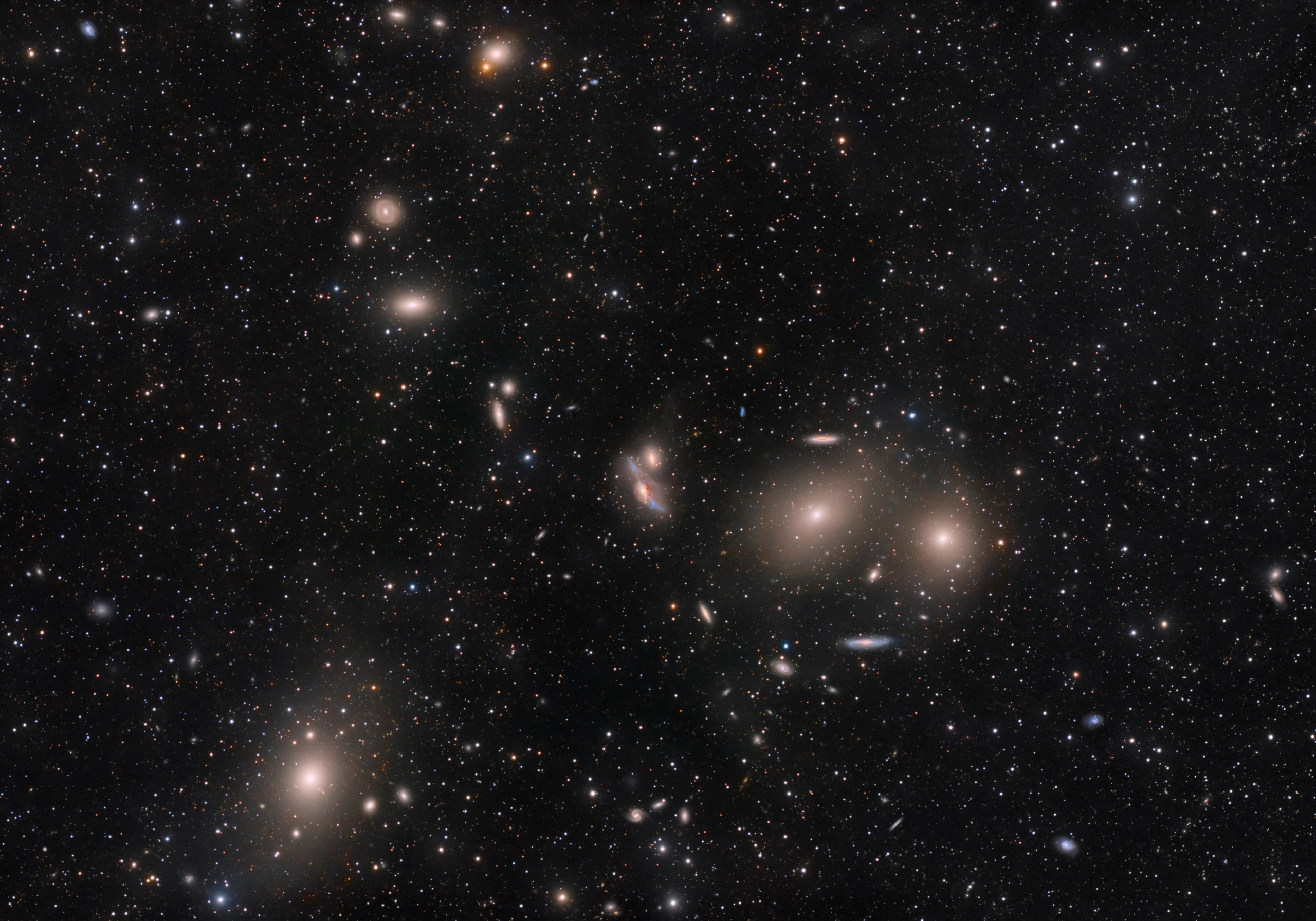
Markarian's Chain
Messier 84, Messier 86, NGC 4477, NGC 4473, NGC 4461,
NGC 4458, NGC 4438 and NGC 4435

Processed by Nicolas Rolland, Paris. 14 hours gathered by Grand Mesa Observatory at Whitewater, Colorado, USA.
These eight galaxies are not lined up by accident. They move together, and that was noticed before anyone could explain it.
A chain, and the man who saw it
Markarian's Chain is a curving line of galaxies at the heart of the Virgo Cluster. The Armenian astrophysicist Benjamin Markarian identified their common motion in the early 1960s — not their alignment, which anyone with a telescope can see, but the fact that at least some of them are travelling through space in the same direction at the same rate. Eight galaxies make up the chain: Messier 84, Messier 86, NGC 4477, NGC 4473, NGC 4461, NGC 4458, NGC 4438 and NGC 4435.
Ellipticals and lenticulars, no spirals
What the chain does not contain is as telling as what it does. Every member is elliptical or lenticular; not one is a spiral with open arms and active star formation. That is what the centre of a rich cluster does to its galaxies over time — repeated close passes strip the gas, star formation stops, and the disc structure smooths out. These are galaxies that have already been through it.
What the distances are worth
Individual distance estimates for these eight run from about 36 to about 61 million light-years, and it would be a mistake to read that spread as depth. The cluster as a whole sits around 54 million light-years away, and measuring any single galaxy at that range carries an uncertainty of several million in either direction. The numbers below are the best figures available for each, not a map of where they sit relative to one another.
- Messier 84 (NGC 4374), elliptical, about 46 million light-years
- Messier 86 (NGC 4406), elliptical, about 53 million light-years
- NGC 4477, lenticular, about 61 million light-years
- NGC 4473, elliptical, about 54 million light-years
- NGC 4461, lenticular, about 48 million light-years
- NGC 4458, elliptical, about 60 million light-years
- NGC 4438, lenticular, about 38 million light-years
- NGC 4435, lenticular, about 36 million light-years
Fourteen hours in two-minute frames
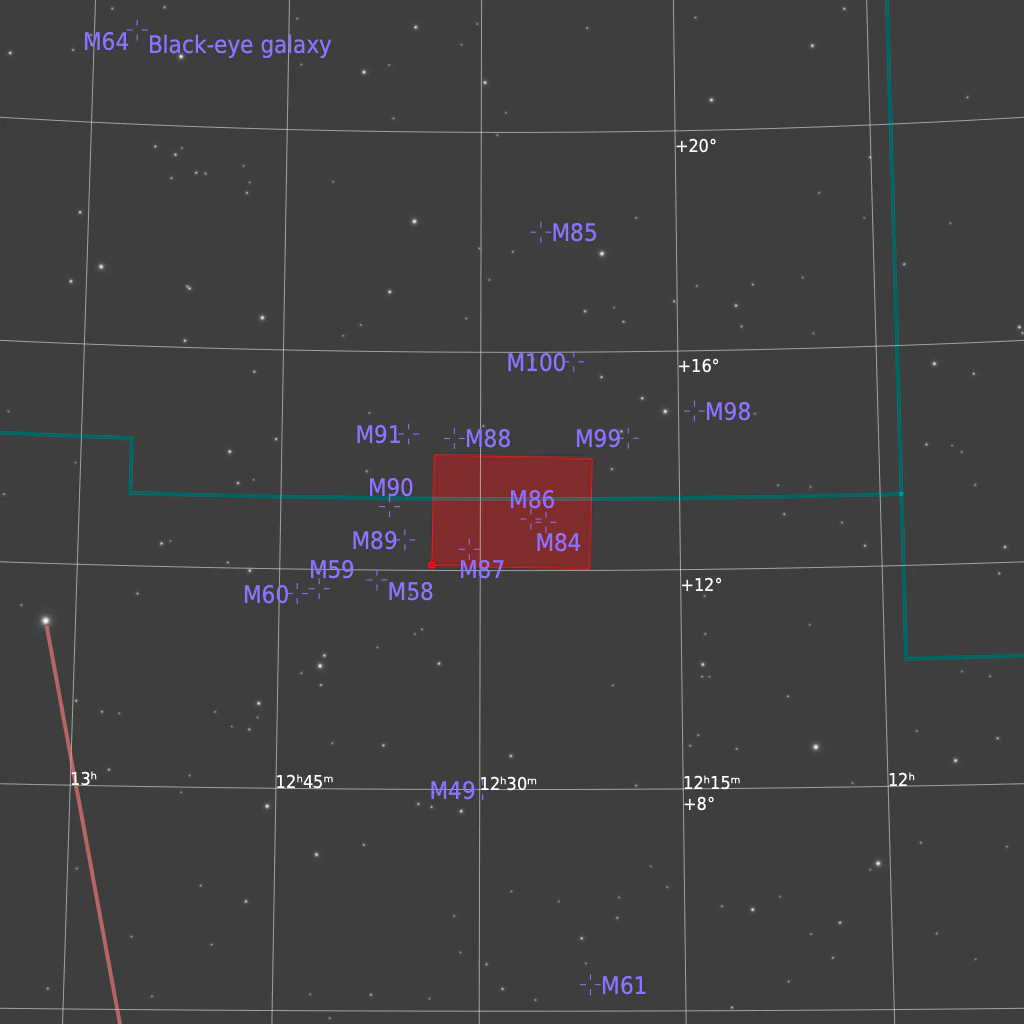
A Takahashi FSQ130 at f/5 with a monochrome sensor, from Whitewater in April 2021. Fourteen hours built from 421 frames of two minutes each — very short subframes for a target this faint, which is what a low-read-noise sensor allows and what a field containing several bright galaxies requires. The result holds the chain across 3.2 degrees. What it does not hold is the thing that would prove the collision: a filament of ionised hydrogen runs between NGC 4438 and Messier 86, and it only shows in H-alpha. No narrowband frame was taken, so the connection between those two galaxies is present in the field and absent from the image. Grand Mesa Observatory gathered the data at Whitewater.
Ces huit galaxies ne sont pas alignées par hasard. Elles se déplacent ensemble, et on l'a remarqué avant de savoir l'expliquer.
La Chaîne de Markarian est une ligne incurvée de galaxies au cœur de l'amas de la Vierge. L'astrophysicien arménien Benjamin Markarian a identifié leur mouvement commun au début des années 1960 — non pas leur alignement, que n'importe quel télescope montre, mais le fait qu'au moins certaines d'entre elles traversent l'espace dans la même direction et au même rythme. Huit galaxies composent la chaîne : Messier 84, Messier 86, NGC 4477, NGC 4473, NGC 4461, NGC 4458, NGC 4438 et NGC 4435.
Ce que la chaîne ne contient pas en dit autant que ce qu'elle contient. Tous ses membres sont elliptiques ou lenticulaires ; pas une seule spirale aux bras ouverts, en pleine formation d'étoiles. C'est ce que le centre d'un amas riche fait subir à ses galaxies au fil du temps : les passages rapprochés répétés arrachent le gaz, la formation stellaire s'arrête, et la structure en disque s'aplanit. Ce sont des galaxies qui y sont déjà passées.
Les estimations individuelles de distance pour ces huit galaxies s'échelonnent d'environ 36 à environ 61 millions d'années-lumière, et il serait erroné de lire cet écart comme de la profondeur. L'amas dans son ensemble se tient autour de 54 millions d'années-lumière, et mesurer une galaxie isolée à cette distance comporte une incertitude de plusieurs millions dans un sens ou dans l'autre. Les nombres ci-dessous sont les meilleures valeurs disponibles pour chacune, non pas une carte de leurs positions relatives.
- Messier 84 (NGC 4374), elliptique, environ 46 millions d'années-lumière
- Messier 86 (NGC 4406), elliptique, environ 53 millions d'années-lumière
- NGC 4477, lenticulaire, environ 61 millions d'années-lumière
- NGC 4473, elliptique, environ 54 millions d'années-lumière
- NGC 4461, lenticulaire, environ 48 millions d'années-lumière
- NGC 4458, elliptique, environ 60 millions d'années-lumière
- NGC 4438, lenticulaire, environ 38 millions d'années-lumière
- NGC 4435, lenticulaire, environ 36 millions d'années-lumière
Une lunette Takahashi FSQ130 à f/5 avec un capteur monochrome, depuis Whitewater, en avril 2021. Quatorze heures construites à partir de 421 poses de deux minutes — des poses très courtes pour une cible aussi faible, ce que permet un capteur à faible bruit de lecture et ce qu'impose un champ contenant plusieurs galaxies brillantes. Le résultat tient la chaîne sur 3,2 degrés. Ce qu'il ne tient pas, c'est ce qui prouverait la collision : un filament d'hydrogène ionisé court entre NGC 4438 et Messier 86, et il n'apparaît qu'en H-alpha. Aucune pose en bande étroite n'a été faite, de sorte que le lien entre ces deux galaxies est présent dans le champ et absent de l'image. Grand Mesa Observatory a rassemblé les données à Whitewater.
TECHNICAL DATA
ACQUISITION DETAILS
OPTICS Takahashi FSQ130 @ F/5
CAMERA QHY600M
MOUNT Paramount ME
FILTERS L, R, G, B
LOCATION The Grand Mesa Observatory, Whitewater, CO
DATE April 2021
EXPOSURES 14 hours (L 108 x 120 sec, R 105 x 120 sec, G 109 x 120 sec, B 99 x 120 sec)
PROCESSING SOFTWARE Pixinsight, CCDstack, Photoshop
COPYRIGHTS Nicolas Rolland & Grand Mesa Observatory

TARGET DETAILS
RA 12h 27m 37.2s
DEC +13° 04' 15.2"
SIZE 3.19 x 2.12 deg
ORIENTATION Up is 179 degrees E of N
CONSTELLATION Virgo
NUMBER OF GALAXIES 8