GALAXY

The Cigar Galaxy

— Messier 82 —
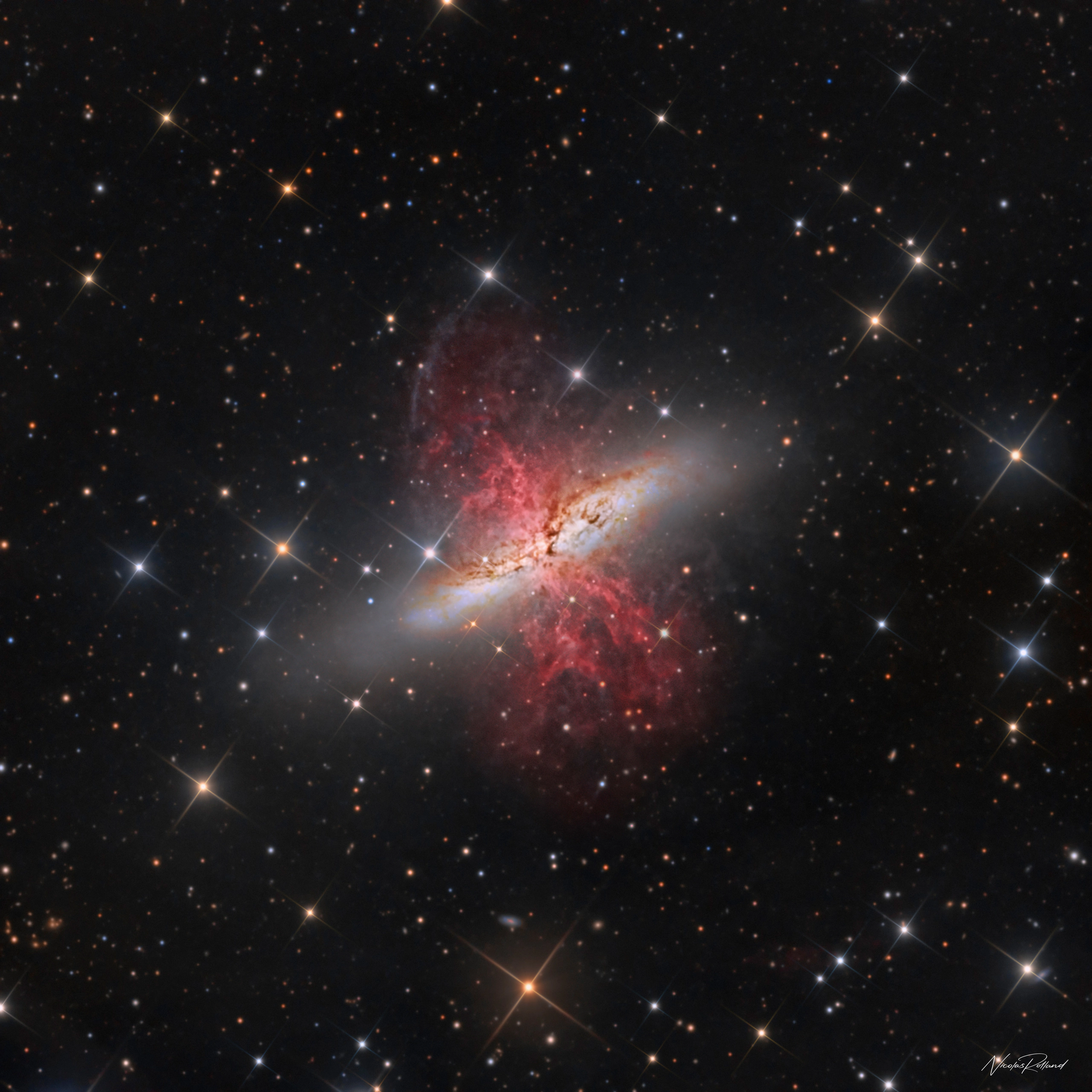
The Cigar Galaxy Messier 82, a starburst galaxy venting ionized gas far beyond its disk, in 46 hours of HaLRGB

Processed by Nicolas Rolland, Paris. 46 hours gathered by Bernard Miller at Dark Sky New Mexico, Animas, USA.

The red plumes above and below this galaxy are not part of it. They are gas on their way out.

A starburst, lit by a neighbour

Messier 82 is a starburst galaxy: it forms stars at a rate most galaxies never approach, and it has been doing so for tens of millions of years. It lies about 12 million light-years away in Ursa Major, and it puts out roughly five times the light of the Milky Way from a body a third the size. The cause is not internal. Some hundreds of millions of years ago it passed close to its neighbour M81, and the encounter drove gas inward and compressed it — the burst has been running ever since, on the fuel that pass delivered.

The wind coming out of it

A burst of that size cannot be contained. Massive stars form, burn through their fuel in a few million years and explode, and thousands of them doing so in the same small volume drive a wind out of the galaxy perpendicular to its disc. That is what the red filaments are: ionised hydrogen, thrown some ten thousand light-years clear of the disc at hundreds of kilometres a second. Part of it will fall back. Part of it is leaving for good, taking with it material that would otherwise have made the next generation of stars.

The first galaxy I photographed

This is also the first galaxy I ever pointed a telescope at, a C9.25 EDGE HD on a Losmandy G11 mount, in January 2014 — and the reason I looked was SN 2014J, which had appeared here days earlier and was the nearest type Ia supernova in decades. I photographed it for the first time in May 2017. Four supernovae have been recorded in Messier 82 altogether: SN 1986D, SN 2004am, SN 2008iz and SN 2014J. In a galaxy making massive stars this quickly, that is not a coincidence either.

Forty-six hours, six of them in hydrogen

A Planewave CDK17 at f/6.8 with an FLI Proline 16803, from Dark Sky New Mexico in Animas, across two campaigns in 2017 and 2022 — forty-six hours in all, nineteen of them luminance at twenty minutes a frame and six in H-alpha at thirty. Those six hours are the ones that matter here. The disc and the dust lanes come out of the broadband; the wind does not, because it is emission and almost nothing else, and a luminance frame records the galaxy with the plumes barely showing. Six hours is enough to establish where the filaments are and how far they reach. It is not enough to follow them to their end — the wind fades outward with no clear edge, and where it stops in this frame is a function of the exposure rather than of the gas. Bernard Miller gathered the data at Animas.
This image has been selected by AAPOD2February 15, 2022

Version française
Les panaches rouges au-dessus et au-dessous de cette galaxie n'en font pas partie. C'est du gaz en train de s'en aller.
 
Messier 82 est une galaxie à sursaut de formation d'étoiles : elle en fabrique à un rythme que la plupart des galaxies n'approchent jamais, et cela dure depuis des dizaines de millions d'années. Elle se tient à environ 12 millions d'années-lumière dans la Grande Ourse et rayonne à peu près cinq fois la lumière de la Voie lactée pour un corps trois fois plus petit. La cause n'est pas interne. Il y a quelques centaines de millions d'années, elle est passée près de sa voisine M81, et la rencontre a poussé le gaz vers l'intérieur en le comprimant — le sursaut fonctionne depuis, sur le combustible que ce passage lui a livré.
 
Un sursaut de cette ampleur ne se contient pas. Des étoiles massives se forment, épuisent leur combustible en quelques millions d'années et explosent, et des milliers d'entre elles le faisant dans un même petit volume soufflent un vent hors de la galaxie, perpendiculairement à son disque. C'est ce que sont les filaments rouges : de l'hydrogène ionisé, projeté à quelque dix mille années-lumière du disque, à des centaines de kilomètres par seconde. Une partie retombera. Une autre s'en va pour de bon, emportant une matière qui aurait autrement fabriqué la génération d'étoiles suivante.
 
C'est aussi la première galaxie que j'ai visée avec un télescope, un C9.25 EDGE HD sur une monture Losmandy G11, en janvier 2014 — et si je l'ai observée spécifiquement, c'est à cause de SN 2014J, apparue là quelques jours plus tôt, la supernova de type Ia la plus proche depuis des décennies. Je l'ai photographiée pour la première fois en mai 2017. Quatre supernovae ont été relevées dans Messier 82 en tout : SN 1986D, SN 2004am, SN 2008iz et SN 2014J. Dans une galaxie qui fabrique aussi vite des étoiles massives, ce n'est pas un hasard non plus.
 
Un Planewave CDK17 à f/6,8 équipé d'une FLI Proline 16803, à Dark Sky New Mexico, à Animas, sur deux campagnes en 2017 et 2022 — quarante-six heures en tout, dont dix-neuf en luminance par poses de vingt minutes et six en H-alpha par poses de trente. Ce sont ces six heures qui comptent ici. Le disque et les bandes de poussière sortent de la large bande ; le vent, non, parce qu'il est une émission et presque rien d'autre, et qu'une pose de luminance enregistre la galaxie sans que les panaches apparaissent vraiment. Six heures suffisent à établir où sont les filaments et jusqu'où ils portent. Elles ne suffisent pas à les suivre jusqu'au bout — ce vent s'efface vers l'extérieur sans bord net, et l'endroit où il s'arrête sur cette image tient au temps de pose et non au gaz. Bernard Miller a rassemblé les données à Animas.

Technical data
OpticsPlanewave CDK17 @ f/6.8
CameraFLI Proline 16803
MountParamount ME
FiltersHa, L, R, G, B
PaletteHALRGB Ha blended into red
LocationDark Sky New Mexico, Animas, USA
DateJanuary 2022 & 2017
Exposures46 hours L 58 × 1200 sec · R 28 × 900 sec · G 27 × 900 sec · B 28 × 900 sec · Ha 12 × 1800 sec
Distance~12 Mly
SoftwarePixinsight, CCDstack, Photoshop
CopyrightsNicolas Rolland & Bernard Miller
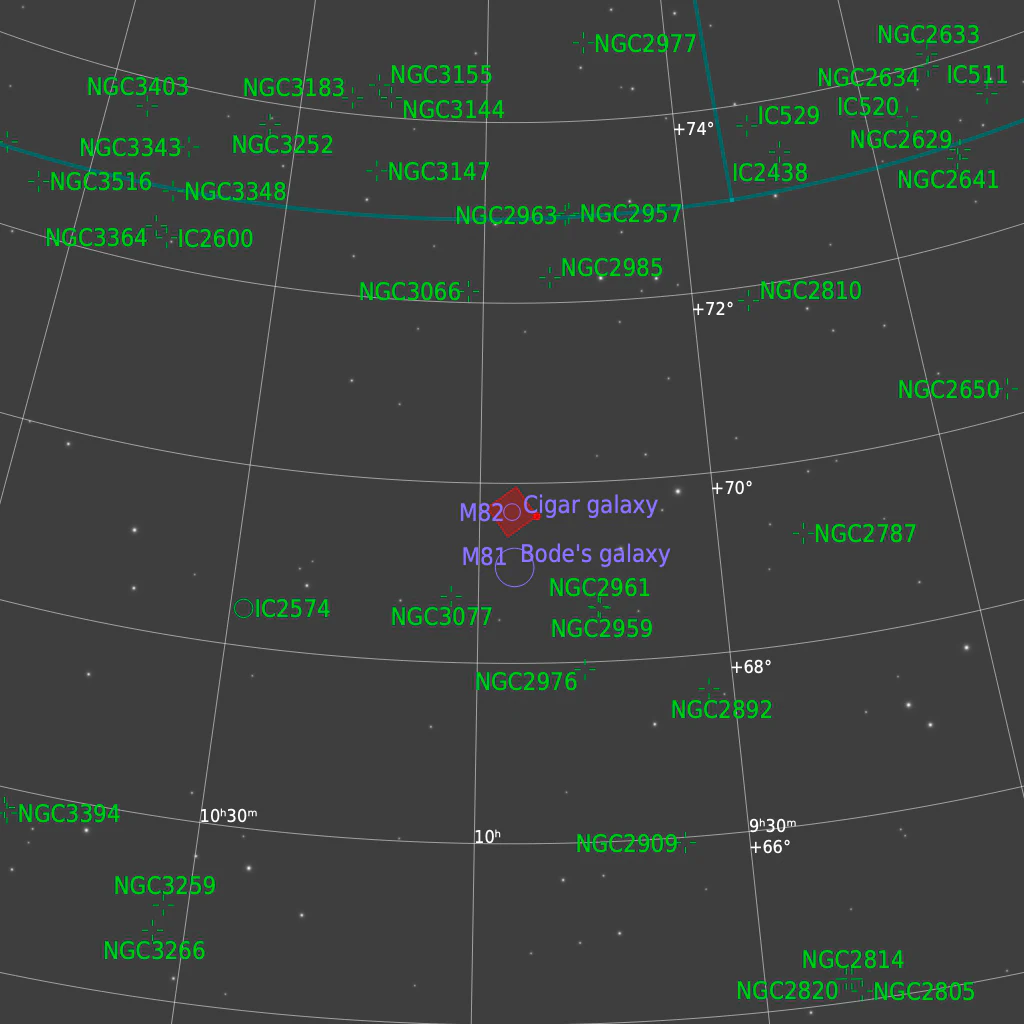
Finding chart The Cigar Galaxy — finding chart
RA09h 55m 53.2s Dec+69° 40′ 53.7″ Size23.8 × 23.8 arcmin Orientationup is -54.5° E of N ConstellationUrsa Major