Icon_nebula-1

From NGC 2077 to NGC 2055

NGC 2048 to NGC 2081, in the Large Magellanic Cloud

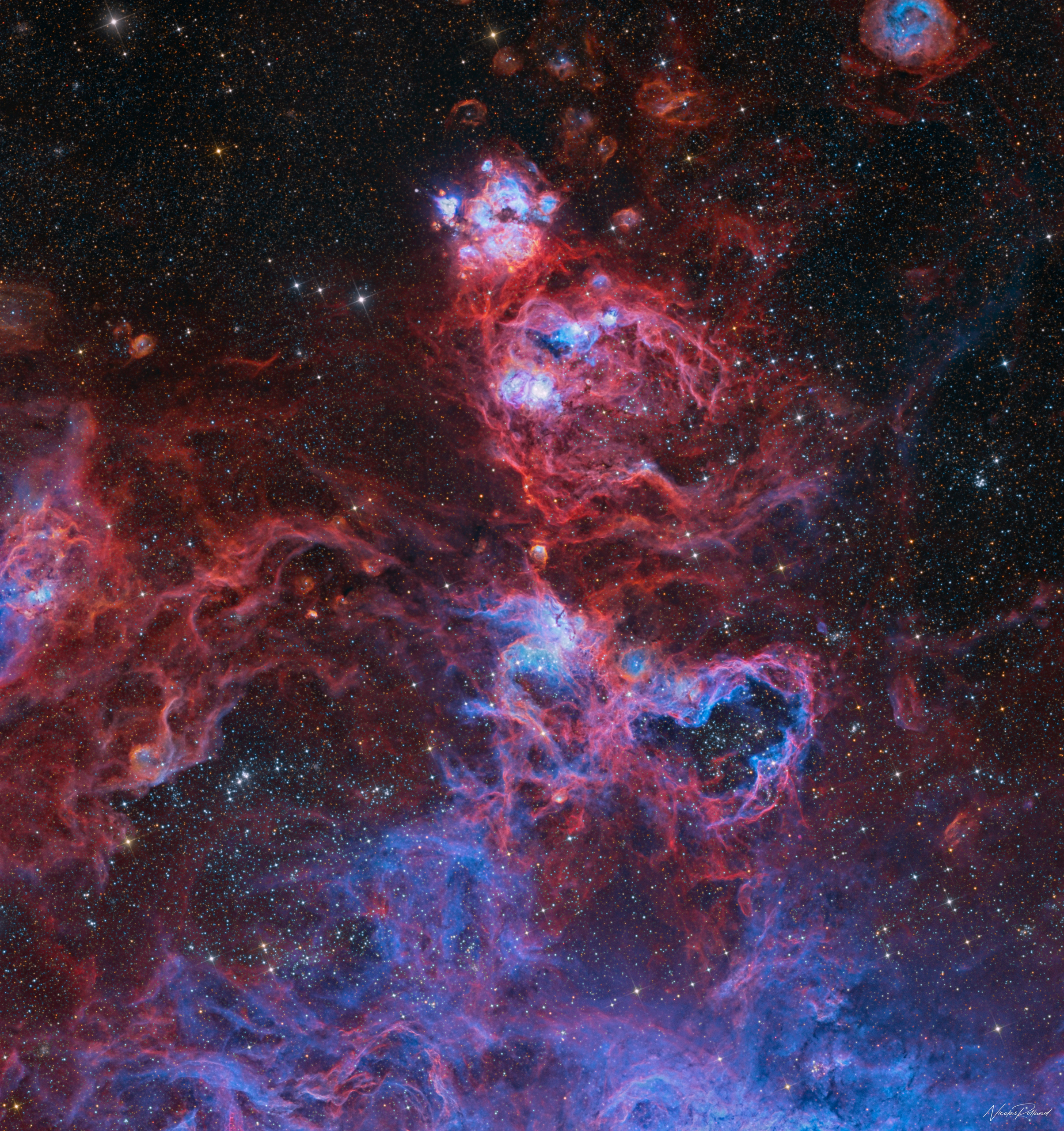
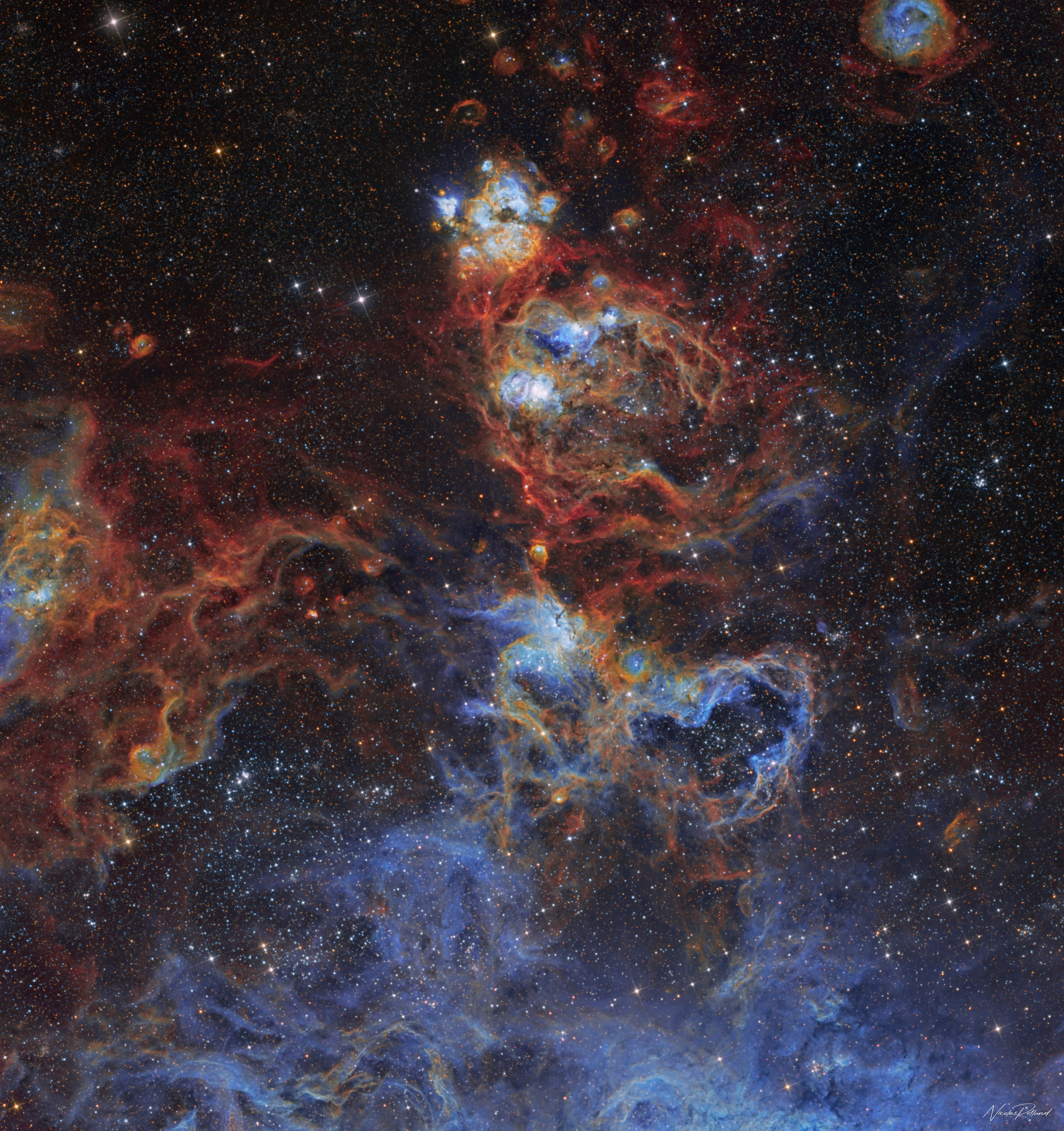
NGC 2077 to NGC 2055, a star-forming nebula complex in the Large Magellanic Cloud, in 51.2 hours of HOORGB, two-panel mosaic NGC 2077 to NGC 2055, a star-forming nebula complex in the Large Magellanic Cloud, in 70.7 hours of SHORGB, two-panel mosaic

Processed by Nicolas Rolland, Paris. 70.7 hours gathered by Martin Pugh at El Sauce Observatory, Rio Hurtado, Chile.

Every glowing thing in this frame is in another galaxy. Nothing here belongs to the Milky Way except the foreground stars.

Nurseries in the Large Magellanic Cloud

These HII regions all sit in the Large Magellanic Cloud, 170,000 light-years away, close on the sky to the Tarantula Nebula. The Cloud is rich in gas and dust and forming stars at a rate our own galaxy no longer matches: around 60 globular clusters, 400 planetary nebulae and 700 open clusters have been catalogued in it. What looks like a scattering of separate nebulae is one galaxy's worth of star formation seen from outside.

Two thousand light-years across

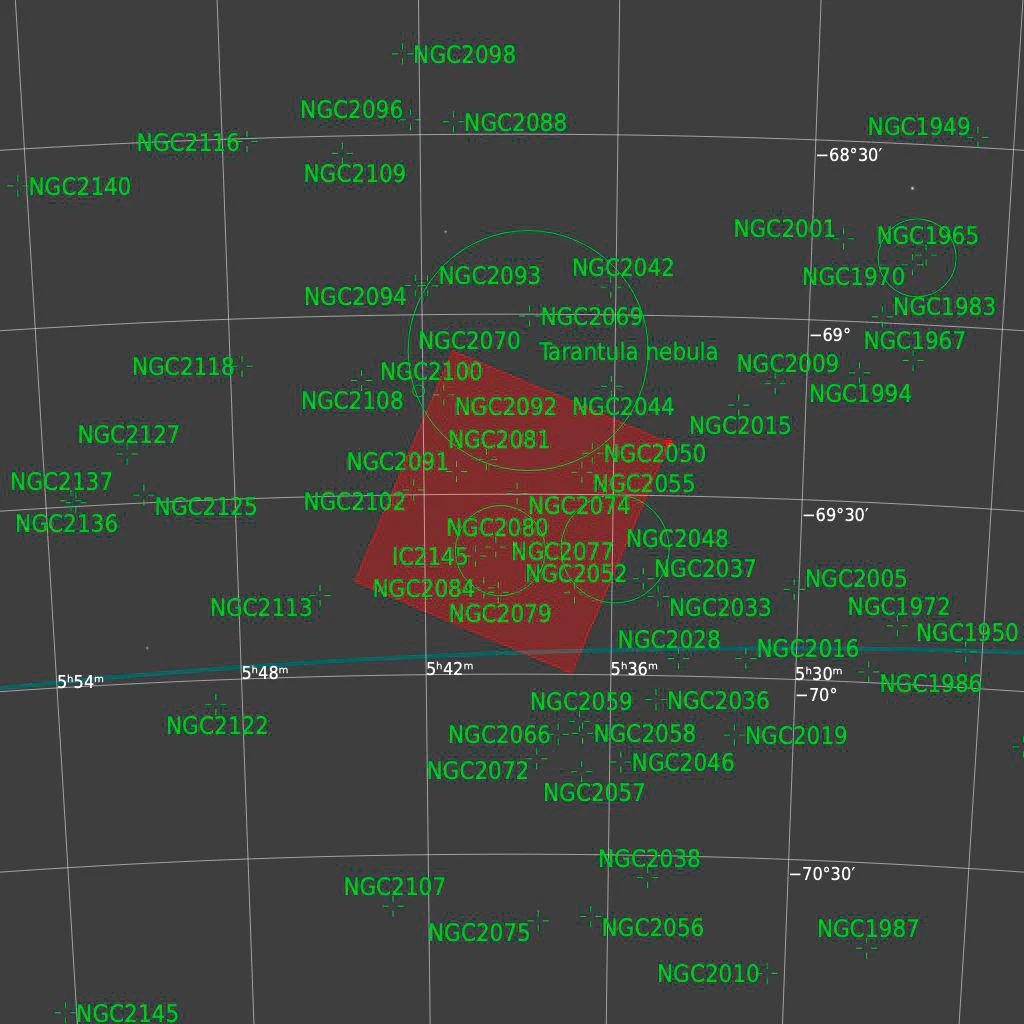
The mosaic covers 39 by 42 arcminutes. At the distance of the Cloud that is close to two thousand light-years from one side of the frame to the other — a span that would reach most of the way from the Sun to the Orion Nebula. Everything catalogued below fits inside it, and the reason they are catalogued separately is that from here they are separate: at 170,000 light-years, the gaps between them are wide enough to name.

What is in the field

Seven objects carry their own designations, and the dates say something about how they were found: those from 1826 were catalogued in one survey of the southern sky, those from 1834 in another eight years later.

  • NGC 2048: emission nebula, catalogued 1826
  • NGC 2050: open cluster, catalogued 1834
  • NGC 2055: open cluster, catalogued 1826
  • NGC 2073: emission nebula, catalogued 1826, containing a group of very young stars
  • NGC 2077: emission nebula, catalogued 1826
  • NGC 2079: emission nebula, catalogued 1826, part of a group with NGC 2078, NGC 2083 and NGC 2084
  • NGC 2081: open cluster with an associated emission nebula, catalogued 1834

Seventy hours, and two versions of them

The CDK17 was working at f/6.8 with adaptive optics ahead of the sensor, from Rio Hurtado in January 2022, across two panels. There are two images here, and they come from one dataset. The first is 51.2 hours: 19.5 in H-alpha, 19.5 in OIII, and 12 across red, green and blue for the star colours. The second adds 19.5 hours of SII and runs to 70.7. Those extra 19.5 hours buy no new structure — SII traces the same ionised gas as the other two lines and adds no detail the H-alpha does not already have. What they buy is a separation: three lines instead of two can be mapped to three channels, and gas at slightly different excitation states comes out in different colours. The slider shows what nineteen and a half hours of a third filter changes, which is a question of reading rather than of reach. Martin Pugh gathered the data at El Sauce.

This image has been selected by 1x.com Awarded

Tout ce qui brille dans ce cadre appartient à une autre galaxie. Rien ici n'est de la Voie lactée, sinon les étoiles d'avant-plan.

Ces régions HII se trouvent toutes dans le Grand Nuage de Magellan, à 170 000 années-lumière, proches sur le ciel de la nébuleuse de la Tarentule. Ce nuage est riche en gaz et en poussière, et il forme des étoiles à un rythme que notre galaxie n'atteint plus : on y a recensé une soixantaine d'amas globulaires, quatre cents nébuleuses planétaires et sept cents amas ouverts. Ce qui ressemble à un éparpillement de nébuleuses distinctes est la formation stellaire d'une galaxie entière, vue de l'extérieur.

La mosaïque couvre 39 sur 42 minutes d'arc. À la distance du Nuage, cela représente près de deux mille années-lumière d'un bord à l'autre du cadre — de quoi couvrir presque tout le trajet du Soleil à la nébuleuse d'Orion. Tout ce qui est catalogué ci-dessous y tient, et si ces objets portent des désignations séparées, c'est que d'ici ils sont séparés : à 170 000 années-lumière, les intervalles entre eux sont assez larges pour être nommés.

Sept objets portent leur propre désignation, et les dates disent quelque chose de la façon dont ils ont été trouvés : ceux de 1826 ont été catalogués lors d'un relevé du ciel austral, ceux de 1834 lors d'un autre, huit ans plus tard.

  • NGC 2048 : nébuleuse en émission, cataloguée en 1826
  • NGC 2050 : amas ouvert, catalogué en 1834
  • NGC 2055 : amas ouvert, catalogué en 1826
  • NGC 2073 : nébuleuse en émission, cataloguée en 1826, qui renferme un groupe de très jeunes étoiles
  • NGC 2077 : nébuleuse en émission, cataloguée en 1826
  • NGC 2079 : nébuleuse en émission, cataloguée en 1826, membre d'un groupe avec NGC 2078, NGC 2083 et NGC 2084
  • NGC 2081 : amas ouvert associé à une nébuleuse en émission, catalogué en 1834

Le CDK17 travaillait à f/6,8, avec une optique adaptative devant le capteur, depuis Rio Hurtado en janvier 2022, sur deux panneaux. Il y a ici deux images, et elles proviennent d'un seul jeu de données. La première représente 51,2 heures : 19,5 en H-alpha, 19,5 en OIII, et 12 réparties entre rouge, vert et bleu pour la couleur des étoiles. La seconde y ajoute 19,5 heures de SII et atteint 70,7. Ces 19,5 heures supplémentaires n'apportent aucune structure nouvelle — le SII trace le même gaz ionisé que les deux autres raies et n'ajoute aucun détail que le H-alpha ne donne déjà. Ce qu'elles apportent est une séparation : trois raies au lieu de deux peuvent être affectées à trois canaux, et des gaz d'états d'excitation légèrement différents ressortent en couleurs différentes. Le curseur montre ce que change un troisième filtre en dix-neuf heures et demie, ce qui relève de la lecture et non de la portée. Martin Pugh a rassemblé les données à El Sauce.

TECHNICAL DATA

ACQUISITION DETAILS

OPTICS Planewave CDK17 @ F/6.8
CAMERA SBIG STXL-11002 (AOX)
MOUNT Paramount ME
FILTERS Ha, OIII, SII, R, G, B
LOCATION El Sauce Observatory, Rio Hurtado, Chile
DATE January 2022
EXPOSURES SHO 70.7 hours (Ha: 39*1800s, OIII: 39*1800s, SII: 39*1800s, R: 16*900s, G: 16*900s, B: 17*900s)
EXPOSURES HOO 51.2 hours (Ha: 39*1800s, OIII: 39*1800s, R: 16*900s, G: 16*900s, B: 17*900s)
PROCESSING SOFTWARE Pixinsight, CCDstack, Photoshop
COPYRIGHTS Nicolas Rolland & Martin Pugh

ngc-2077-nebula-mosaic-hoorgb-chart

TARGET DETAILS

RA 05h 39m 12.7s
DEC -69° 32' 58.0"
SIZE 39.2 x 41.7 arcmin
ORIENTATION Up is -23.2 degrees E of N
CONSTELLATION Dorado
DISTANCE 170,000 ly