NEBULAE
The Cocoon Nebula
— IC 5146 —
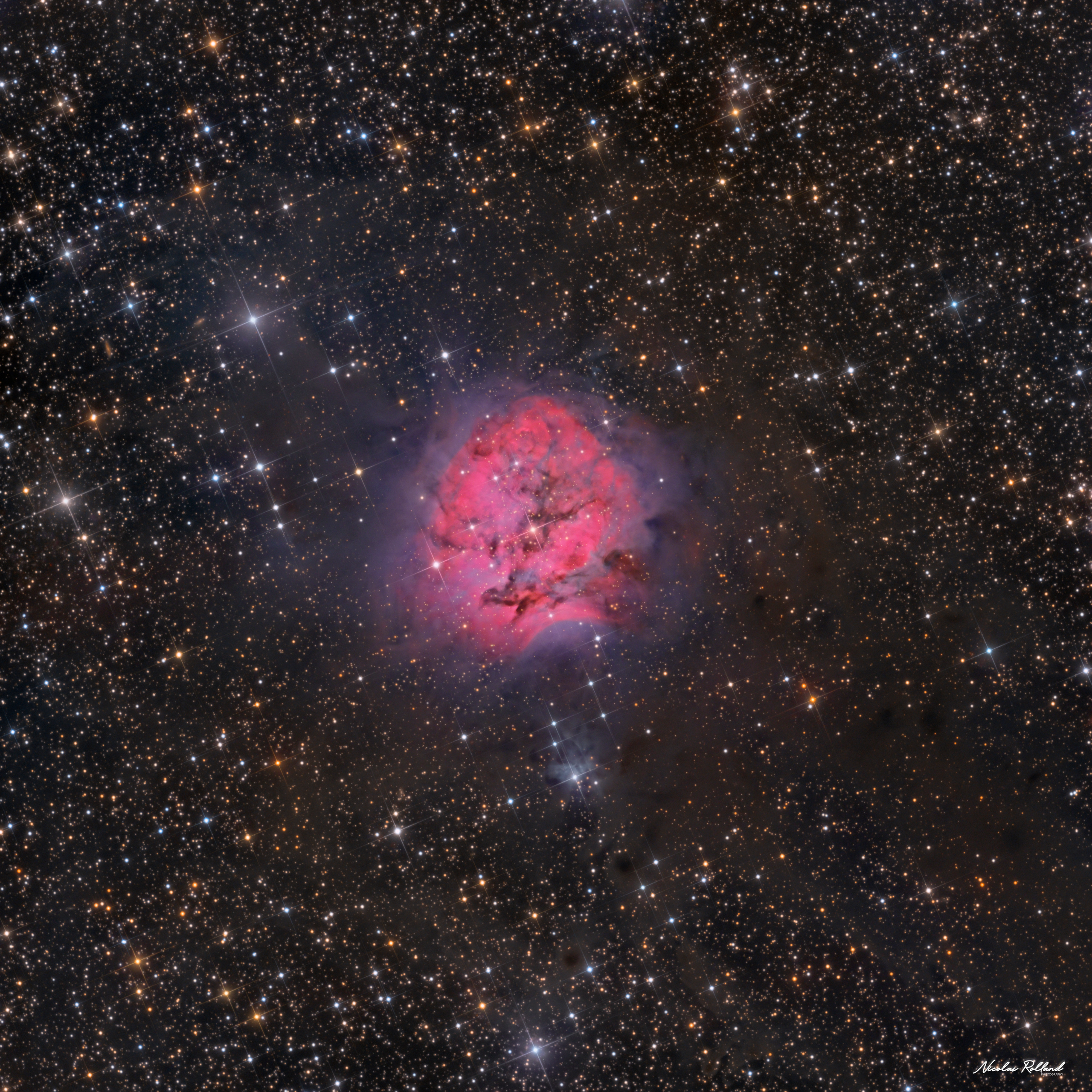
Processed by Nicolas Rolland, Paris. 24 hours gathered by Martin Pugh at Sierra Remote Observatories, California, USA.
At the head of a dark trail that runs off the edge of this frame, twenty stars have just switched on.
A nebula at the end of a lane
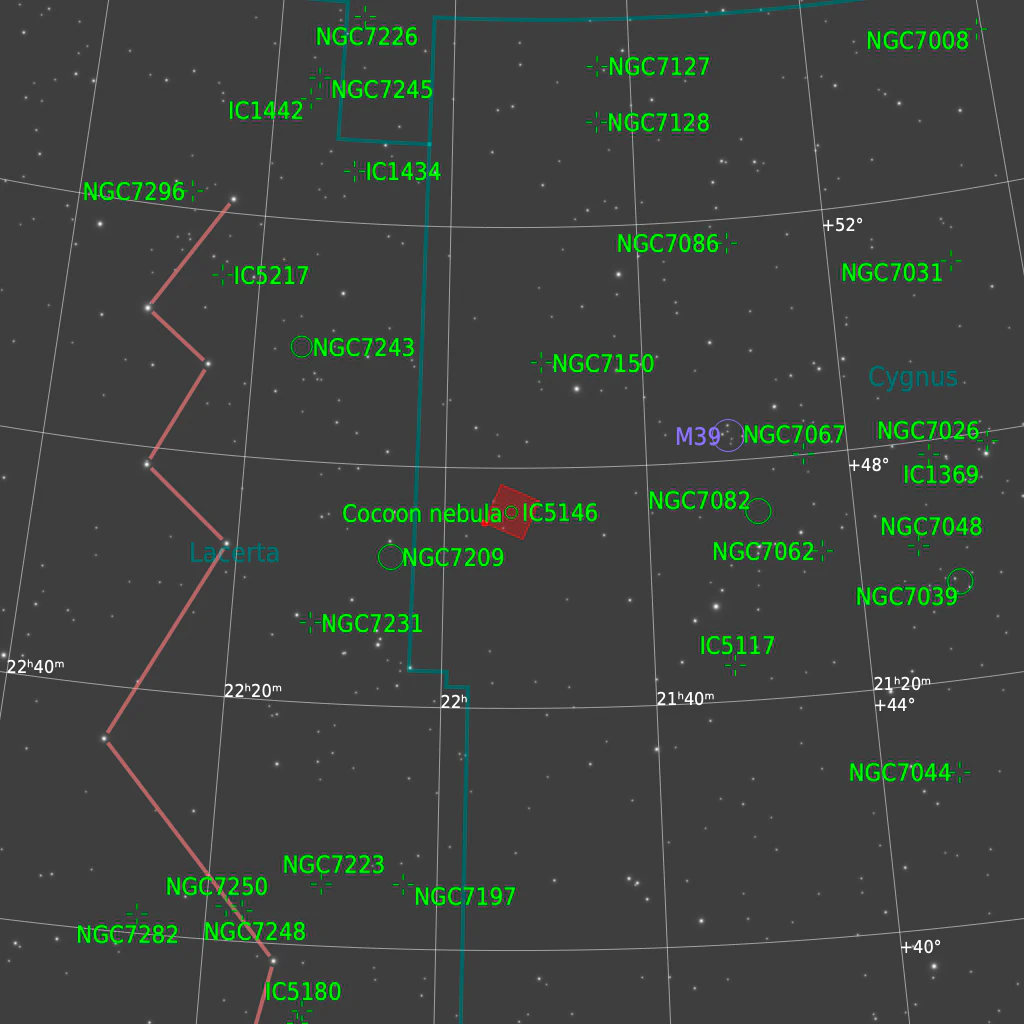
The Cocoon Nebula is two things at once: an emission nebula and an open cluster of about twenty stars, 2,500 light-years away in Cygnus and some fifteen light-years across. It sits at the head of a long dark lane, and the arrangement is not a coincidence. The lane is the cloud these stars were made from; the nebula is the part of that cloud they have already lit up. What looks like two separate objects placed end to end is one object at two stages of the same process.
A hundred thousand years old
The gas glows because the young stars inside it are ionising it, and the star doing most of that work is around a hundred thousand years old. On any stellar timescale that is nothing — the Sun has been running for forty-five thousand times longer. It has not finished clearing the material it condensed out of, and it will not stay embedded for long. The frame catches the cluster in the short interval between forming and emerging, which is the only interval in which a cocoon is visible at all.
Barnard 168, which emits nothing
Wrapped around the cluster and running back from it is Barnard 168, the dark nebula that makes the trail. It emits nothing, reflects nothing, and has no brightness of its own to record. What makes it visible is the star field it stands in front of: it reads as a gap, and only because Cygnus behind it is crowded enough to make the edges of the gap obvious. Point the same telescope at a sparse part of the sky and a cloud like this one would leave no trace.
Sixty-three hours, and a luminance that is not one
A Planewave CDK17 at f/6.8 with an Apogee U16M, from Sierra Remote Observatories in California in July 2012 — twenty-four hours in all, eight of them H-alpha at half an hour a frame. The star density in this part of Cygnus is the constraint, and it works against both subjects at once: the nebulosity and the dark lane are equally liable to disappear under the field in front of them. The stars were therefore extracted and the background processed on its own before the two were recombined, which left several hundred residuals and halos to be cleaned by hand. The field runs 43 arcminutes, which holds the Cocoon and the beginning of the trail. Barnard 168 continues past the edge, and how far it can be followed is set by the star field, not by the exposure — a dark nebula is only ever as deep as the light behind it. Martin Pugh gathered the data at Sierra Remote Observatories.