STAR CLUSTER
Wild Duck Cluster
— Messier 11 —
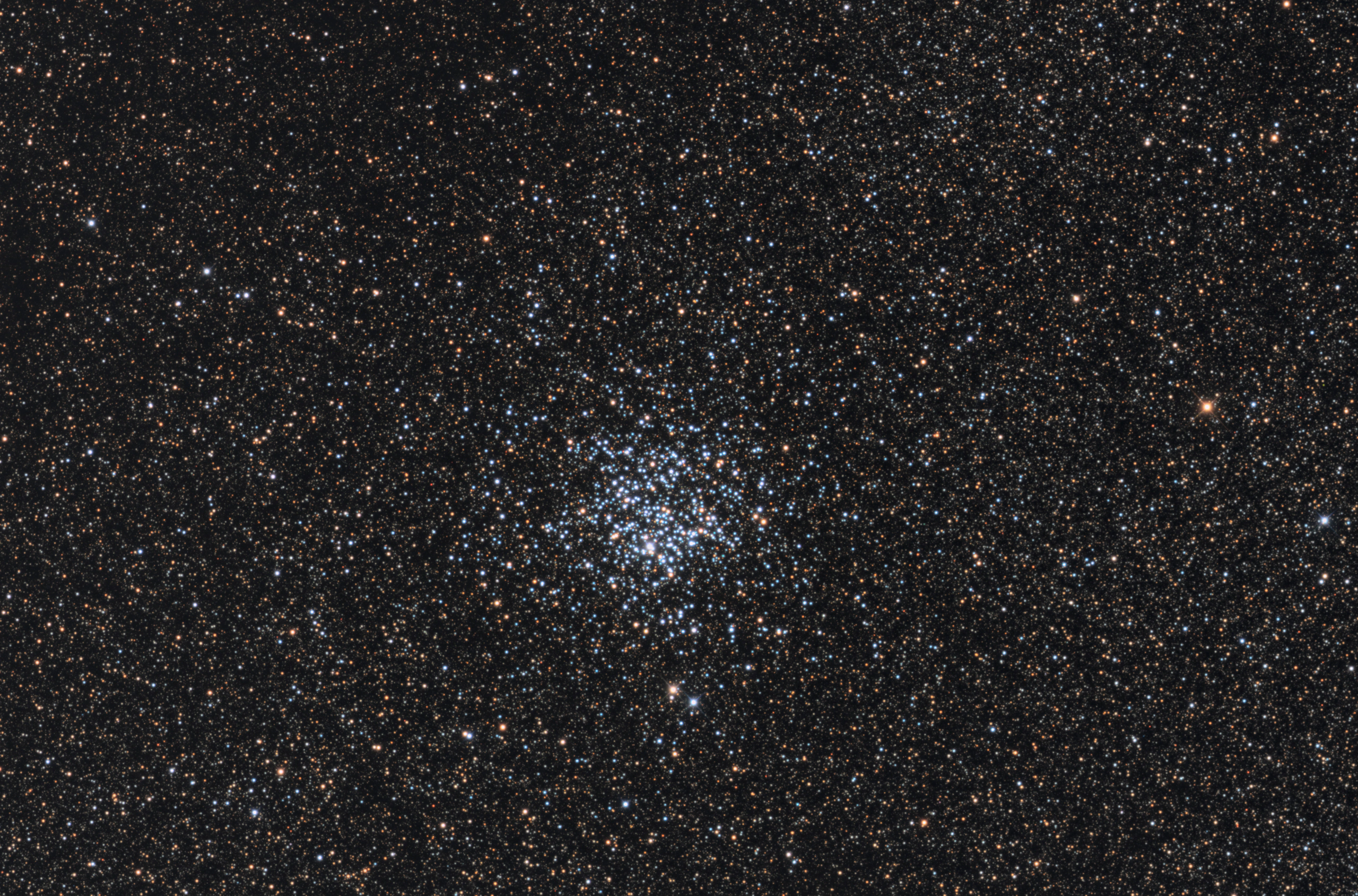
Processed by Nicolas Rolland, Paris. 12 hours gathered by Martin Pugh at El Sauce Observatory, Rio Hurtado, Chile.
The stars in this cluster sit about a light-year apart. From the Sun, the nearest star is four times further away.
A flight of wild ducks
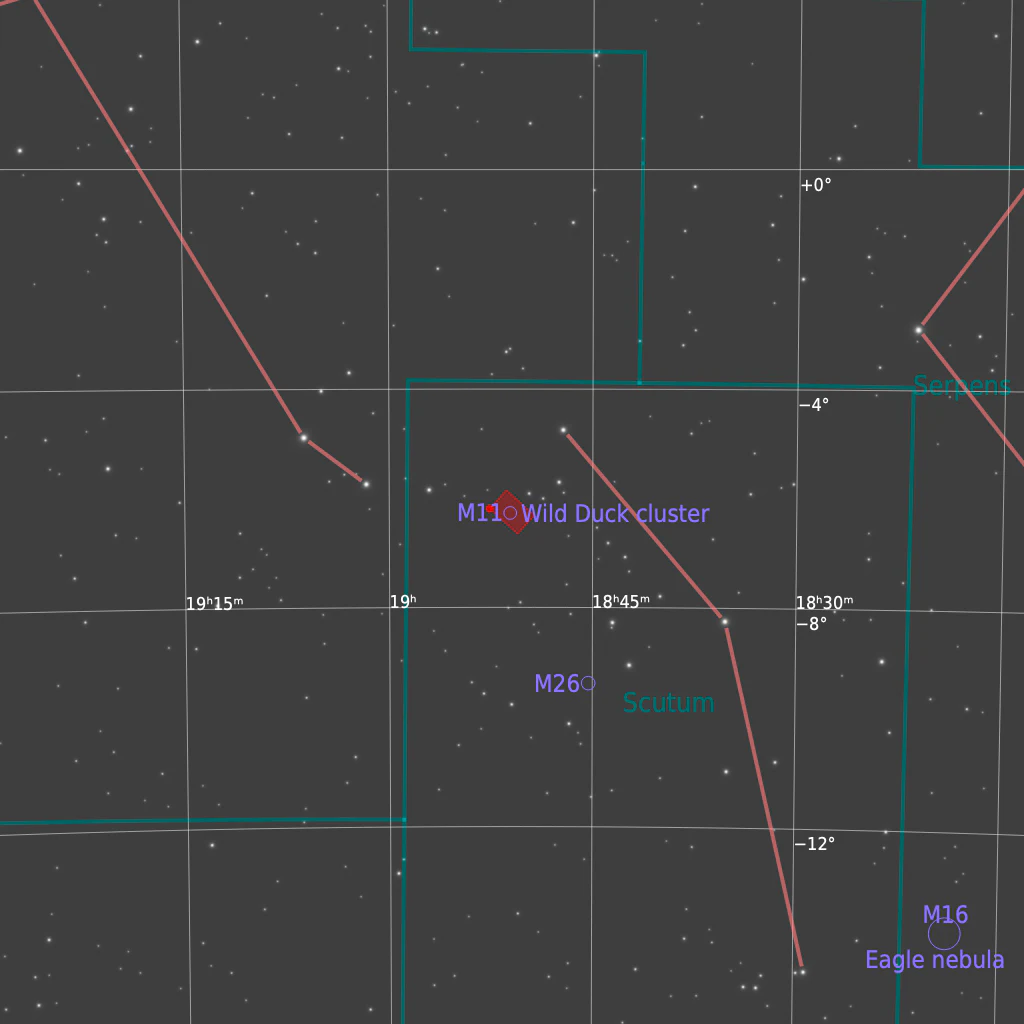
Messier 11 is an open cluster in Scutum, about 6,100 light-years away. Gottfried Kirch found it from Berlin in 1681 and could only record it as a nebulous patch; William Derham resolved it into stars in 1733, and Messier added it to his catalogue in 1764. The name came later still, from Admiral William Henry Smyth, who wrote that the brighter members reminded him of a flight of wild ducks — a wedge of bright stars with one at the point, which is what the eye still picks out first.
Three thousand stars, packed
Around three thousand stars belong to it, which makes it one of the richest open clusters known, and they are separated by roughly a light-year on average. That figure is worth holding against the neighbourhood we live in, where the nearest star to the Sun is four light-years off. Some five hundred members are brighter than magnitude 14, and the brightest reaches 8.5. Packed that tightly, the cluster looks less like an open cluster than like a globular, and it is often described that way.
The colours are masses
Every star here formed at the same time, around 220 million years ago, so nothing about the colour spread across this field has to do with age. It has to do with mass. A heavier star burns through its hydrogen faster, and at 220 million years the heaviest members of this cluster have already left the main sequence and swollen into yellow giants, while the lighter ones are still on it, still blue and hot. Reading the colours here is reading a mass ranking, not a chronology.
Twelve hours of colour, and no luminance
A Planewave CDK17 at f/6.8 with adaptive optics ahead of the sensor, from Rio Hurtado in May 2020 — twelve hours in twenty-minute frames, split evenly between red, green and blue, with no luminance channel at all. On a cluster of magnitude 5.5 there is nothing faint to reach, and luminance would have added depth the subject has no use for while diluting the one thing it needs, which is colour fidelity between the yellow giants and the blue stars around them. The limit is not exposure but separation: near the centre the members sit a few arcseconds apart, and how many stay countable depends on how steadily the image is held between guide corrections. Martin Pugh gathered the data at El Sauce.