NEBULAE
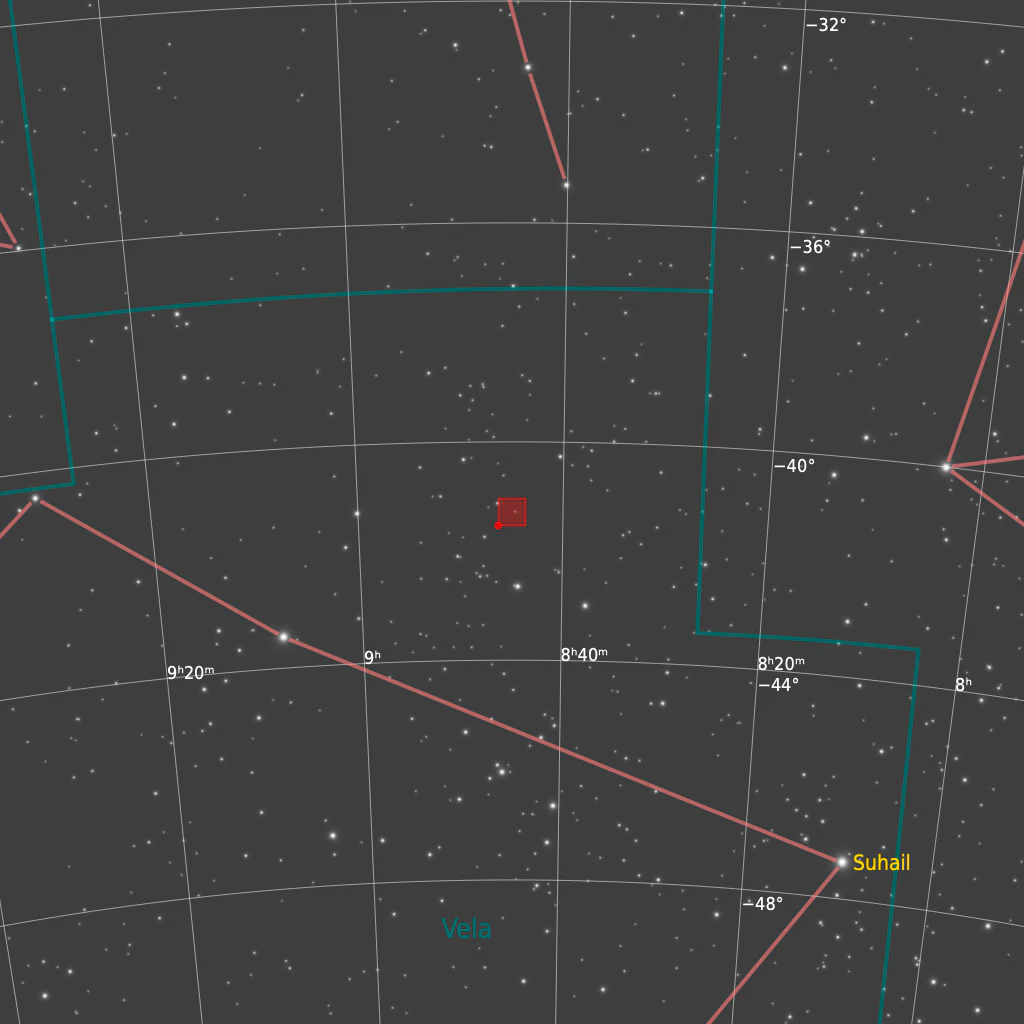
An Emission Nebula in Vela
— Gum 15 —
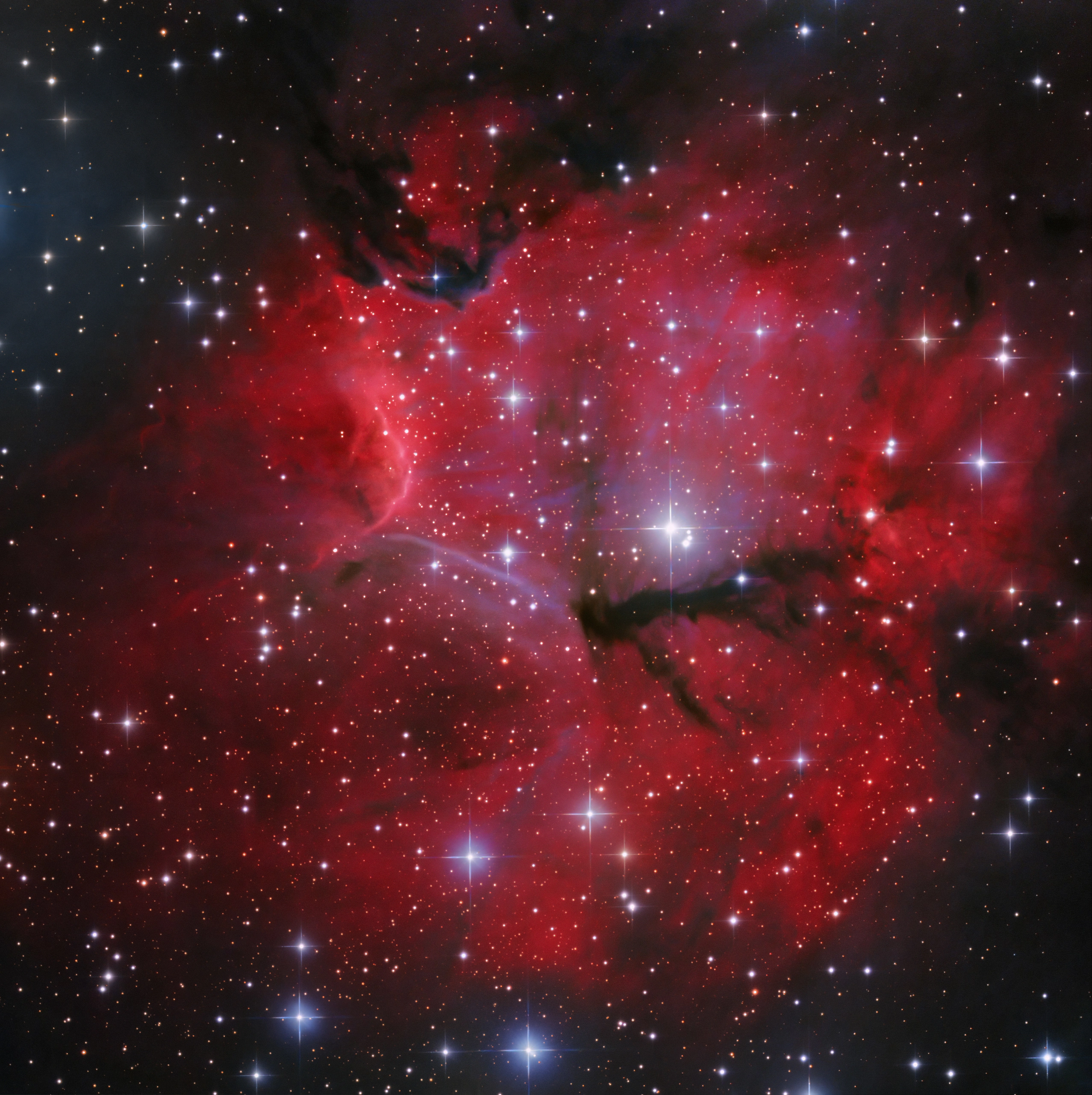
Processed by Nicolas Rolland, Paris. 18.6 hours gathered at El Sauce Observatory, Rio Hurtado, Chile.
This is an emission nebula photographed without a single narrowband filter. The red in it is the red it emits.
From a catalogue made in five years
Gum 15 lies in Vela, about 3,000 light-years away, and it takes its designation from Colin Gum, an Australian astronomer who photographed the southern sky in hydrogen light and published a catalogue of 84 emission regions in 1955. He died five years later, at thirty-six, in a skiing accident. The catalogue outlived him by a long way — the Gum Nebula, the vast bubble that dominates this part of the sky, carries his name, and the numbered entries are still in use.
HD 74804, and the wind
The bright star at the centre of the nebula is HD 74804, a multiple system. Stars of this kind put out a wind — a stream of particles leaving the surface fast enough to escape — and where that wind meets the cloud around it, it pushes. Gum 15 is a small region and it has more than one of these acting on it, from inside and from the neighbourhood beyond. The bays and lanes that cut into it are not gaps in the gas; they are places the gas has been moved out of.
Colours that are not assigned
Nearly every image of an emission region is made through narrowband filters, and their colours are a choice — three wavelengths mapped onto three channels, in whatever arrangement makes the structure clearest. This one was not. Eighteen and a half hours went through red, green and blue filters, which pass what the eye would pass, and the result is the nebula in the colours it actually has: red because hydrogen alpha is red, at 656 nanometres, and the stars in the tones their surface temperatures give them. It is a rarer picture of an HII region than a narrowband one, and a less dramatic one.
Eighteen hours, and the contrast it costs
A Planewave CDK24 at f/6.5 with an FLI ProLine PL9000, from Rio Hurtado in December 2019 — eighteen and a half hours in ten-minute frames, sampling at 0.62 arcseconds per pixel across a field of half a degree square. Broadband on an emission nebula has one cost and it is the whole cost: an H-alpha filter passes a band a few nanometres wide and rejects the rest of the sky, while a red filter passes a hundred nanometres and lets the sky in with the signal. The nebula's light arrives diluted by everything else at that wavelength, so the contrast between gas and background has to be built out of exposure alone. Eighteen hours is what that takes here, and the faintest outer material is where it stops.