GALAXY
Trio in Virgo
— Arp 286 —
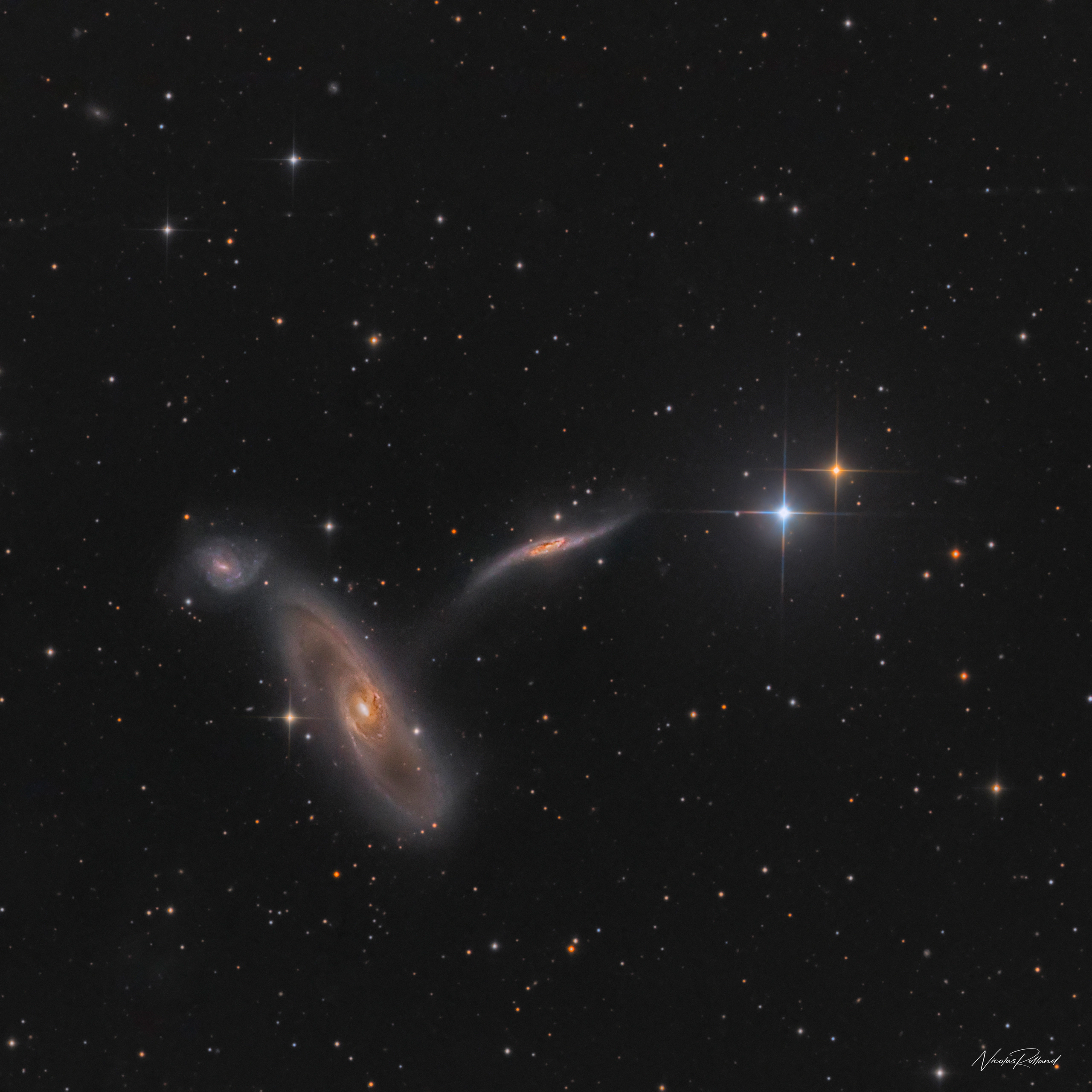
Processed by Nicolas Rolland, Paris. 5.3 hours gathered at El Sauce Observatory, Rio Hurtado, Chile.
Something has bent the galaxy on the right out of shape. It is not the small blue one sitting next to it.
Three galaxies, 68 million light-years away
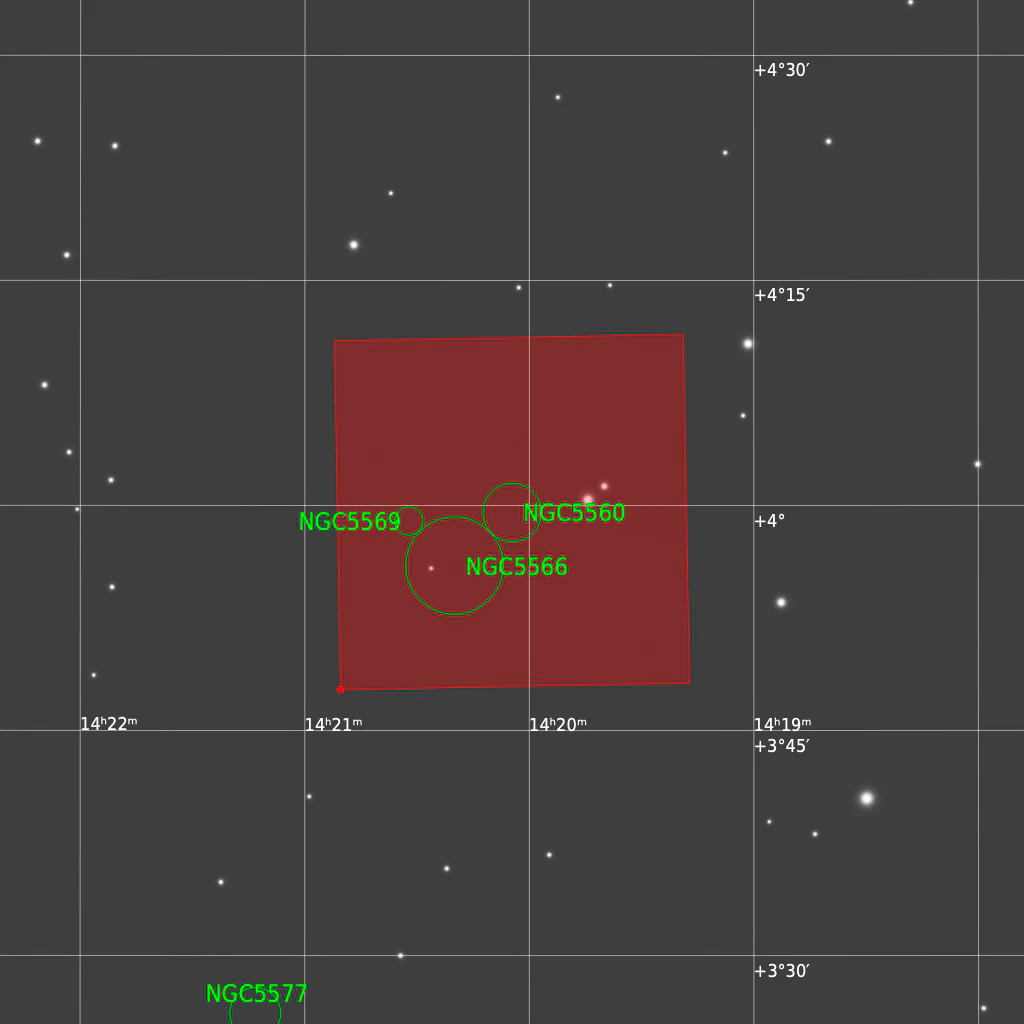
Arp 286 is a trio in Virgo, about 68 million light-years from us, also catalogued as the NGC 5566 group. The large spiral at the centre is NGC 5566, some 150,000 light-years across — wider than the Milky Way, and the dominant member by a long way. Above and to its left is NGC 5569, a small blue spiral. To the right is NGC 5560, and it is the one that has been damaged. Faint bridges of material run between the three, drawn out of their discs by the encounter.
Which one is doing the pulling
The obvious suspect is the wrong one. NGC 5569 sits close to the distorted galaxy and looks the part, but it has nowhere near the mass needed to warp a disc that size. The force runs the other way: from NGC 5566, the giant at the centre, out to NGC 5560. The small blue spiral is in the same field and largely a bystander. Working out which galaxy is deforming which is a question of mass, not of proximity on the sky, and the answer is not the one the picture suggests.
The atlas of what did not fit
Halton Arp published his Atlas of Peculiar Galaxies in 1966, and this group is entry 286 in it. The atlas was not a collection of curiosities. Galaxies were classified at the time by shape — spirals, ellipticals, and the sequence between them — and Arp gathered 338 objects that the scheme could not place: discs with tails, rings, jets, arms running the wrong way. Most of them turned out to have the same explanation. They were not new kinds of galaxy but ordinary ones caught in the middle of an interaction, and the atlas became a catalogue of galaxies in the act of changing each other.
Five hours, and an APOD
A CDK24 at f/6.5 with an FLI ProLine PL9000, from Rio Hurtado in March 2022. Five hours and eighteen minutes across luminance, red, green and blue, in ten-minute frames — the shortest integration of any page on this site by a wide margin, and NASA selected it as Astronomy Picture of the Day on 10 June 2022. Depth is not what made the frame. What made it was the sky over the Río Hurtado valley, an aperture of 24 inches, and a target bright enough at magnitude 10.6 that five hours reaches the discs comfortably. Where five hours does show is the bridges. They are the faintest thing here, and they are present rather than resolved: their outlines are visible, the structure inside them is not.