NEBULAE
The Horsehead Nebula
— IC 434 & Barnard 33 —
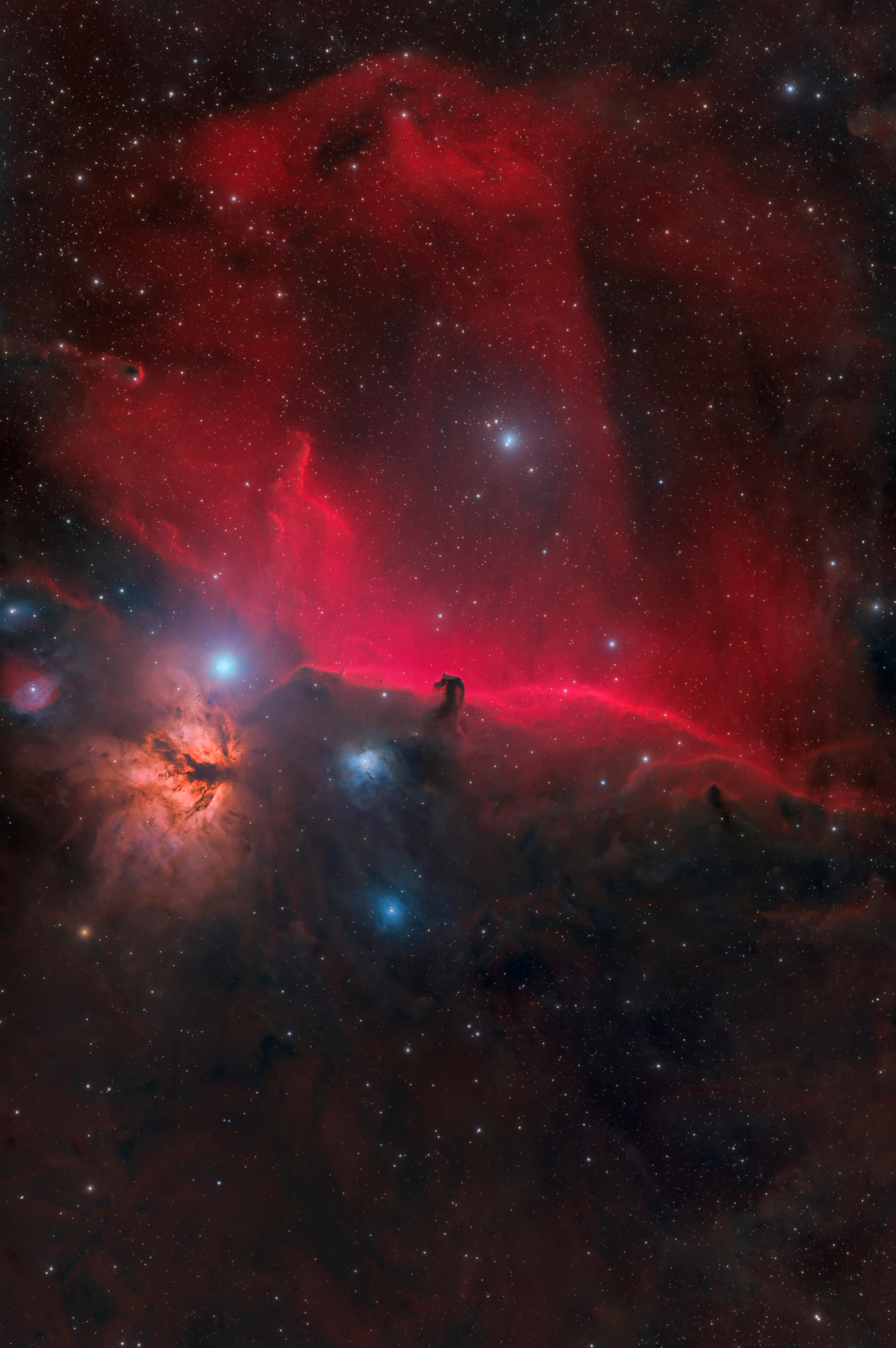
Processed by Nicolas Rolland, Paris. 9.5 hours gathered by Grand Mesa Observatory at Whitewater, Colorado, USA.
A wall of glowing hydrogen runs across this field. One cloud stands in front of it, and that is the whole of the Horsehead.
Found on a photographic plate, in 1888
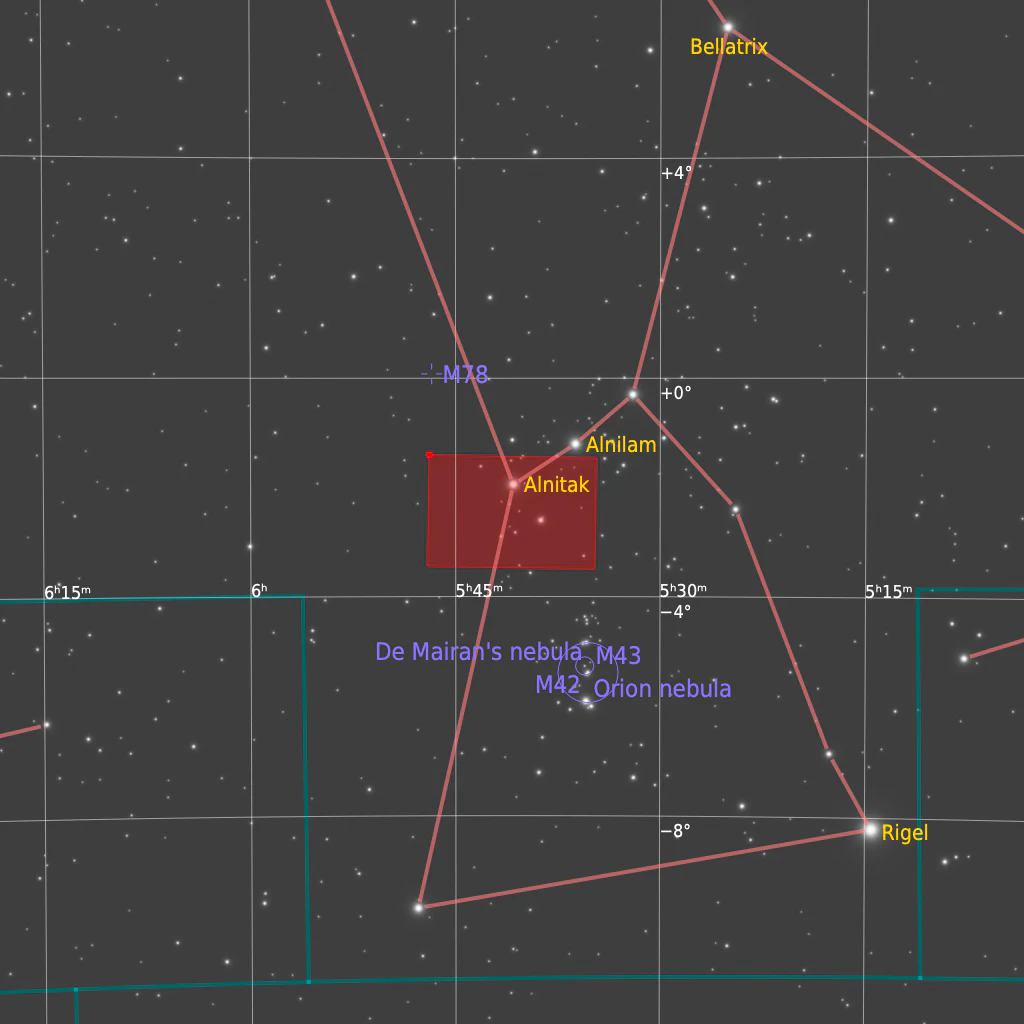
Barnard 33 is a dense column of gas and dust in Orion, about 1,350 light-years away and some five light-years tall, sitting just below Alnitak at the eastern end of the belt. It emits nothing. What makes it visible is IC 434 behind it, and what makes it famous is a shape nobody had seen until it was photographed: Williamina Fleming picked it out on a Harvard plate in 1888, and it was among the first objects of its kind found on a photograph rather than through an eyepiece. Young stars are forming at the base of the column, and the same radiation that lights the background is eroding the head — in a few million years there will be no horse left to recognise.
IC 434, the ridge behind it
The red wall the Horsehead stands against is IC 434, an emission nebula spanning twice the width of the full Moon. Its colour is a single wavelength: hydrogen alpha at 656.3 nanometres, the light hydrogen gives off when an electron falls back into place after being stripped away. Doing the stripping is Sigma Orionis, a hot multiple star system off the edge of this frame, whose ultraviolet keeps the whole ridge ionised. Turn that star off and the Horsehead becomes invisible along with everything behind it.
The Flame, and a cluster with an age gradient
This nebula is rarely imaged, and when it is, usually in H-alpha with broadband colour. Because it is two kinds of nebula at once, the Astrofleet team chose to record it through the whole filter set instead — luminance, red, green, blue, and all three narrowband lines. The result is an LRGB and SHO image combined. The SII layer was held back and kept mainly to the centre, where it adds detail without taking over; the faint integrated flux nebula around the complex was brought up from the luminance; the stars are RGB.
Sixty-three hours, and a luminance that is not one
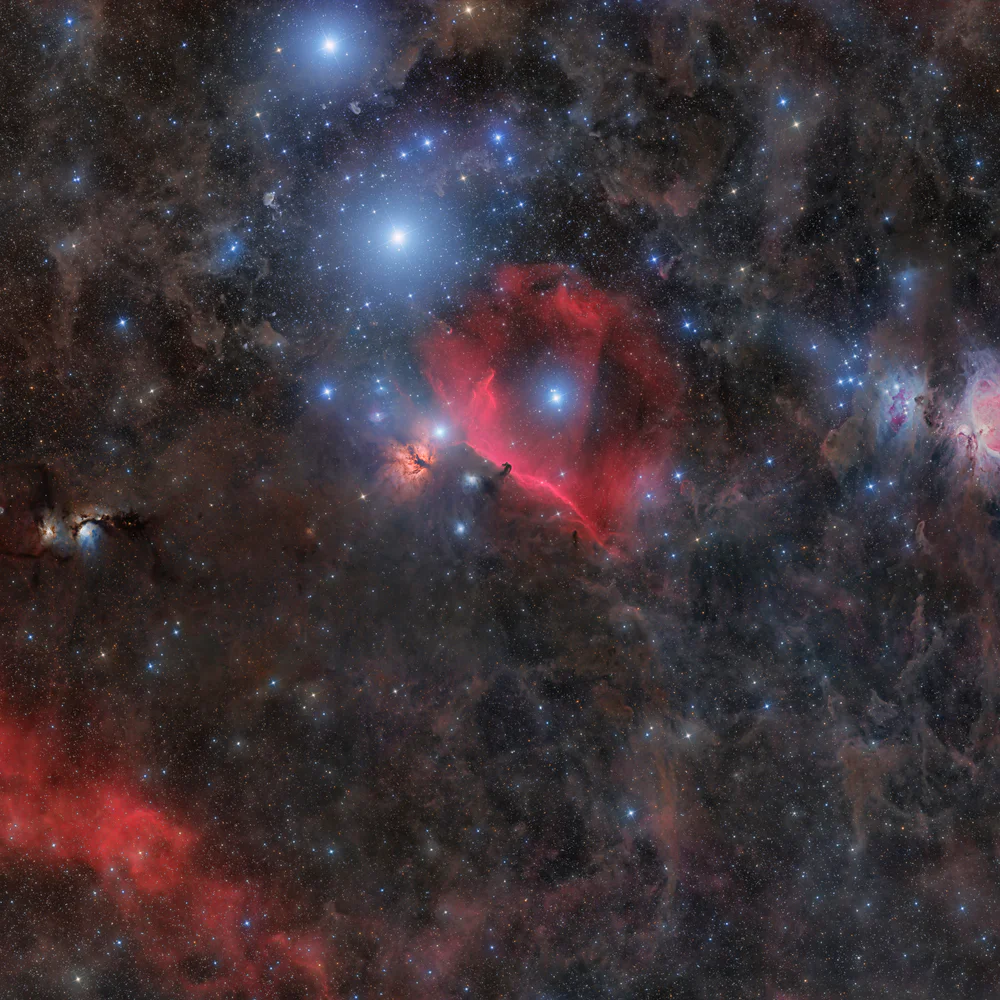
A Takahashi FSQ130 at f/5 with a monochrome sensor, from Whitewater in November 2020 — nine and a half hours across a field of 2 by 3 degrees, which holds the Horsehead, the Flame and the length of the IC 434 ridge together. Four of those hours are H-alpha in ten-minute frames; the rest is luminance and colour in frames of two minutes, short because there is nothing faint here that needs longer. The H-alpha is what carries the ridge, and the ridge is what carries the Horsehead: a dark nebula has no signal of its own, so the depth reached on Barnard 33 is entirely a function of how well the gas behind it was recorded. This frame is a small part of the Orion molecular cloud, which runs on well past its edges. Grand Mesa Observatory gathered the data at Whitewater.