NEBULAE
The Soul Nebula
— IC 1848 —
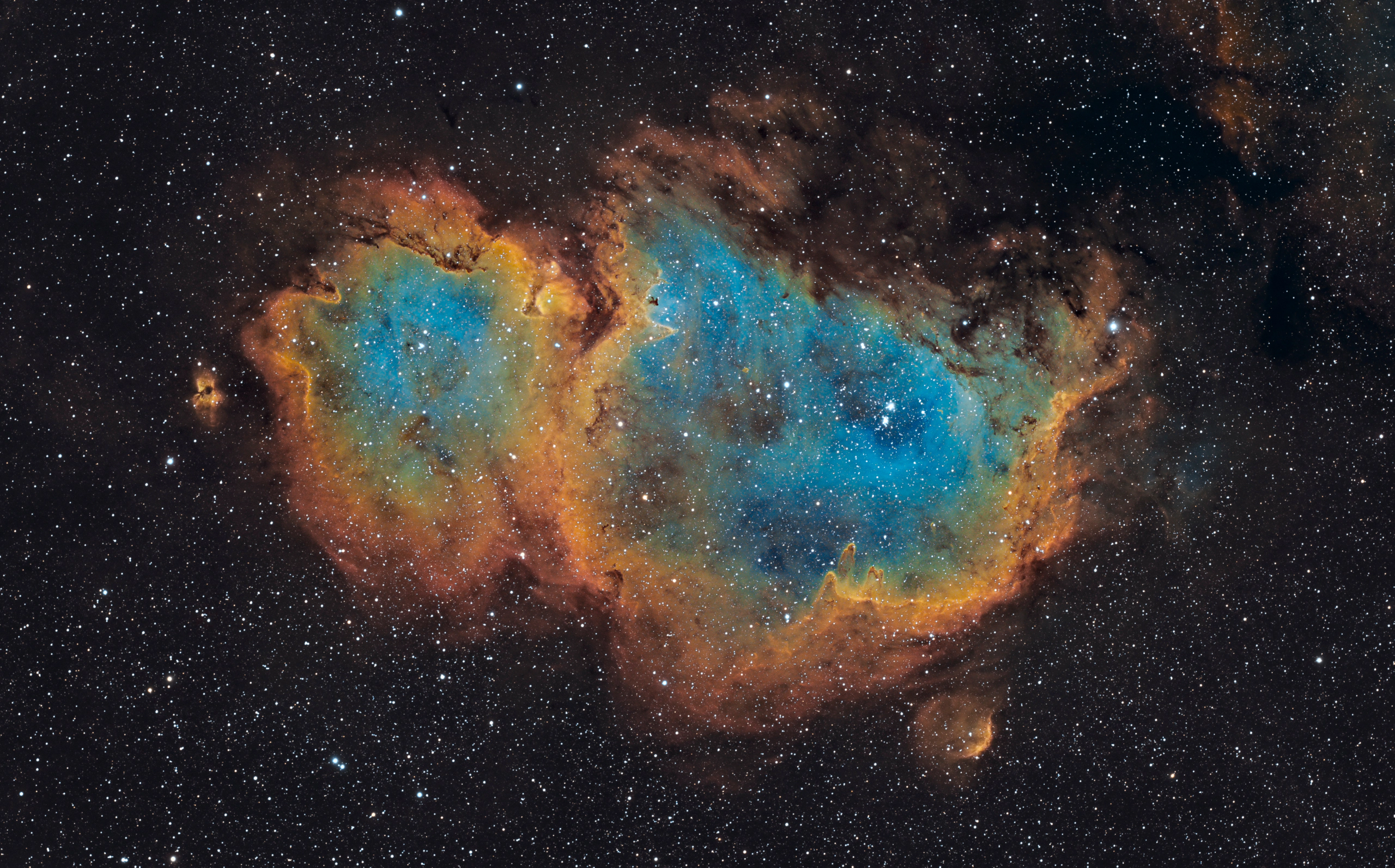
Processed by Nicolas Rolland, Paris. 20.6 hours gathered by Grand Mesa Observatory at Whitewater, Colorado, USA.
The hollows in this cloud were carved out by the stars that came out of it.
One complex, three catalogue names
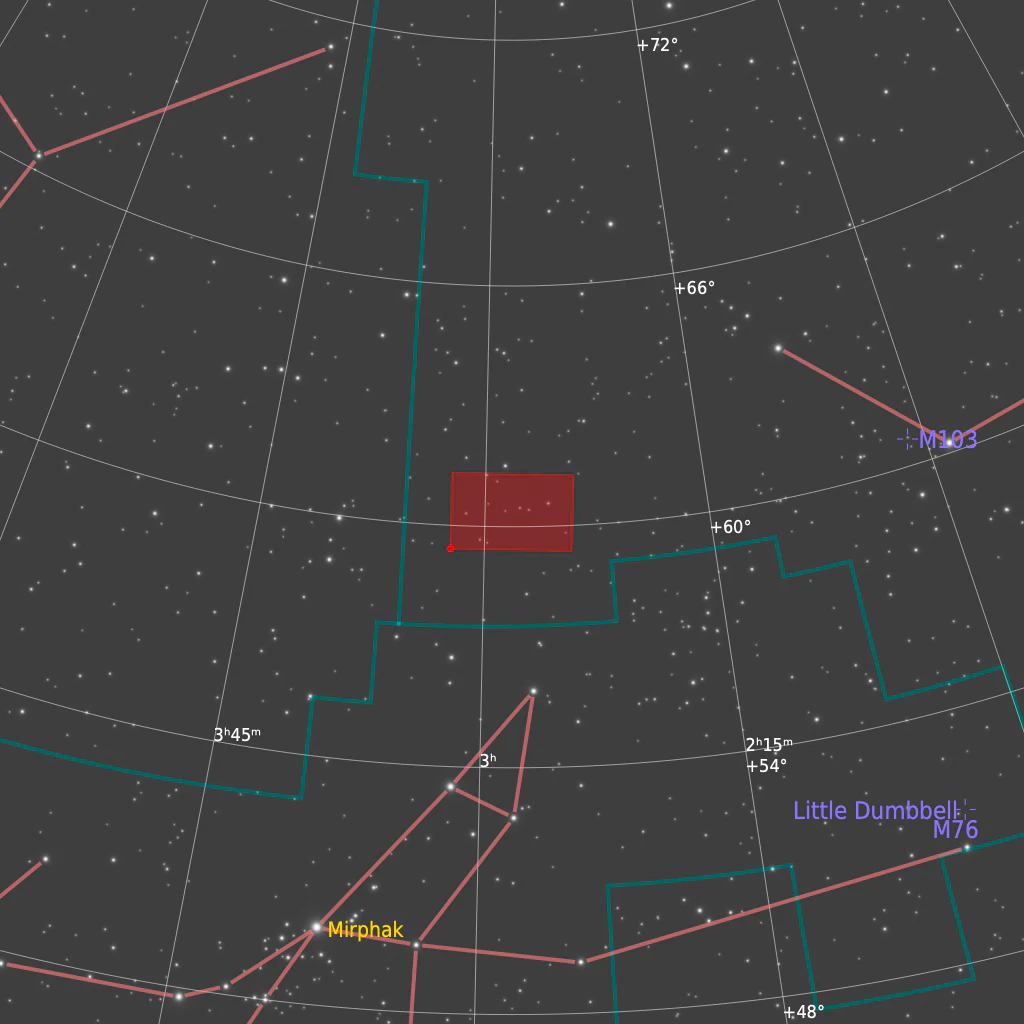
The Soul Nebula lies about 6,500 light-years away in Cassiopeia, in the Perseus arm of the Milky Way, next to the Heart Nebula — the two are part of the same star-forming complex. It carries several designations, and they are all the same object seen through different surveys: IC 1848 from the Index Catalogue, Sh2-199 from Sharpless, and W5 from Westerhout's radio survey. The last one comes up most often in the literature, because much of what is known about this region was worked out at radio and infrared wavelengths rather than in visible light.
Cavities blown from the inside
Several open clusters sit inside the nebula, and their most massive members have hollowed it out. A star of thirty or forty solar masses puts out a wind fast enough to push gas away from it for tens of light-years, and enough ultraviolet to ionise whatever it cannot move. What is left is a set of large cavities with the clusters at their centres, walls of compressed gas at their edges, and pillars standing where a dense clump held out against the erosion. The nebula is being taken apart by its own products.
Each generation setting off the next
W5 is one of the clearest cases anywhere of star formation triggering more of itself. Infrared surveys of the region found an age gradient: the stars in the middle of each cavity are the oldest, those along the rims are younger, and the youngest of all sit inside the pillars at the edges. That is the signature of a shock front. As the cavity expands it compresses the gas ahead of it past the point where it can hold itself up, and the collapse that follows makes the next batch of stars — which then blow their own cavity into whatever is left.
Twenty hours, and nothing but three lines
A Takahashi FSQ130 at f/5 with a monochrome sensor, from Whitewater in October 2020 — twenty and a half hours across a field of 3 by 1.9 degrees, and every frame narrowband: nine hours of H-alpha, six of OIII, five and a half of SII, with no broadband at all. On an emission nebula that wide the three lines are the only practical way to reach the faint structure, and the trade is visible in the stars, whose colours here come from the same three filters as the gas and are not their own. What twenty hours reaches is the shape of the cavities and the outline of the pillars. What it does not reach is what the pillars contain: the young stars inside them are still wrapped in dust, they emit in the infrared, and no optical filter will find them. Grand Mesa Observatory gathered the data at Whitewater.
Hubble palette (SHO): SII in the red channel, H-alpha in green, OIII in blue. The colours are a mapping of three emission lines, not a record of what the eye would see, and the star colours come from the same three filters as the nebula.