NEBULAE
A Ruptured Cometary Globule
— CG 4 —
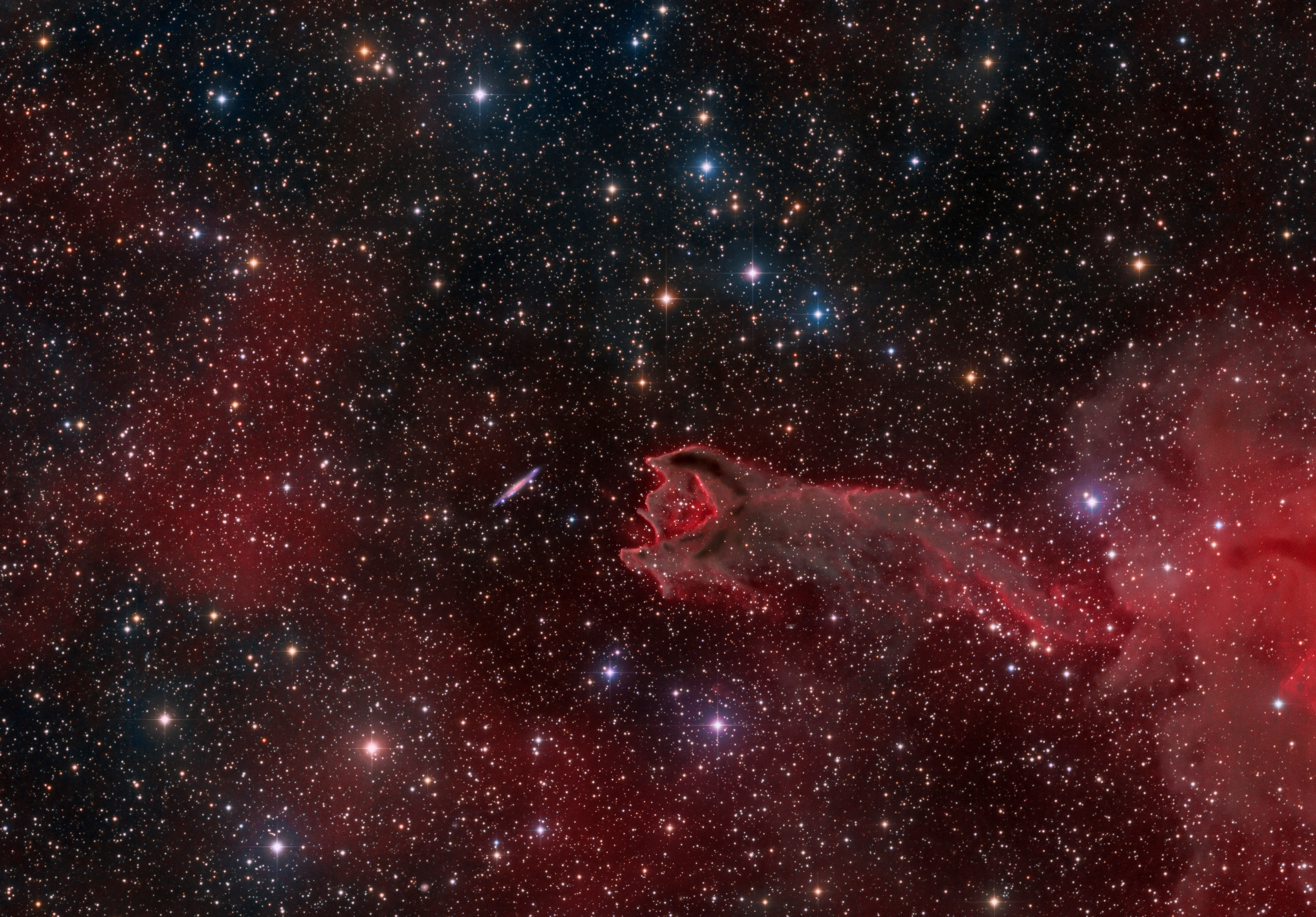
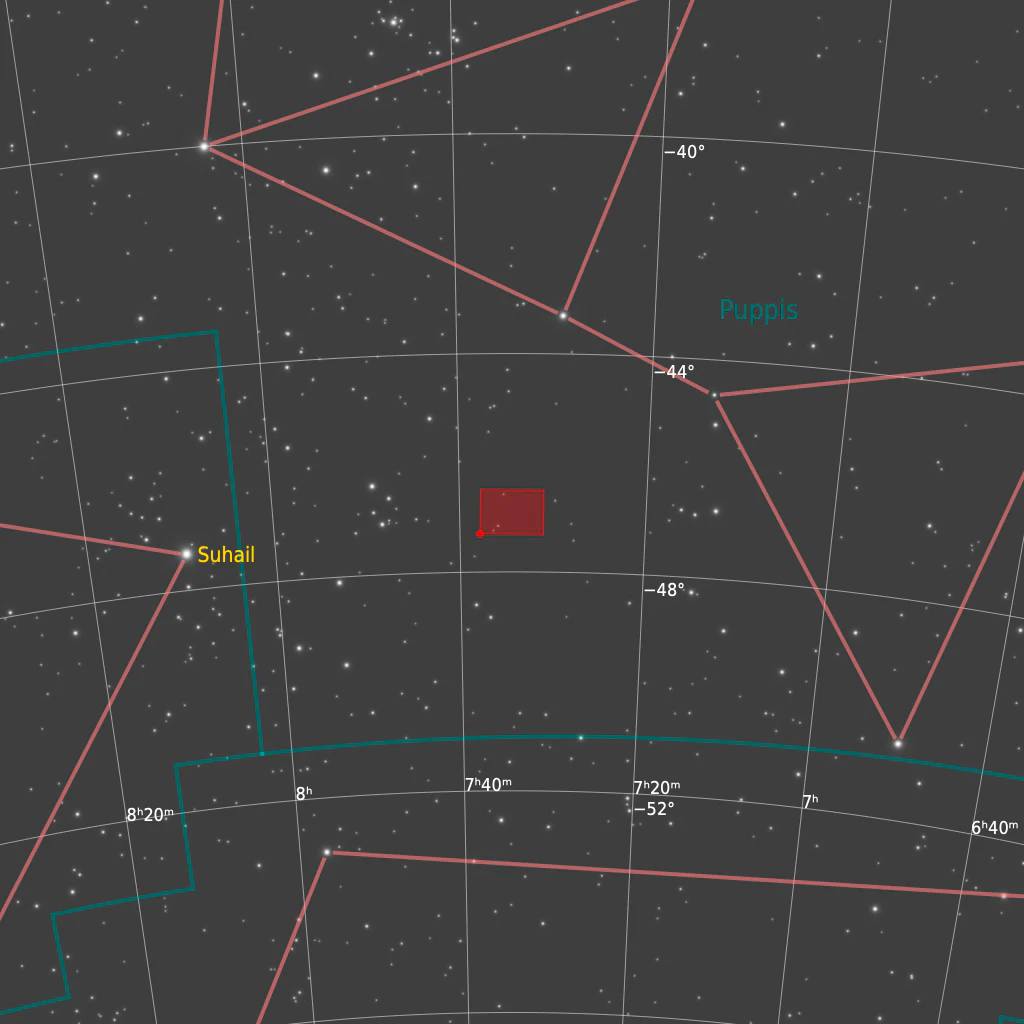
Processed by Nicolas Rolland, Paris. 38.3 hours gathered by Martin Pugh at El Sauce Observatory, Rio Hurtado, Chile and Heaven's Mirror Observatory, Yass, Australia.
The claw at the centre of this frame is 1,300 light-years away. The galaxy it appears to be reaching for is millions.
A globule shaped by something far away
CG 4 is a cometary globule in Puppis: a cold cloud of gas and dust with a dense head and a long faint tail, resembling a comet and having nothing whatever to do with one. Its head is roughly a light-year and a half across, its tail some eight. It is one of about thirty such globules in the same region, and their tails all point the same way — away from the centre of the Gum Nebula, the vast bubble of ionised gas they sit inside. Whatever is doing the pushing is not in the frame; the shape is the only evidence of it.
The head is torn open
This one is damaged in a way most are not. The head has ruptured, and no one has established why. Globules of this kind are places where stars form — several show young stars embedded in their heads — and a star switching on inside would be one candidate. So would the same radiation that draws out the tail, working on a head that had already been weakened. The rupture is recent enough to still be visible as a break, which puts a limit on how long ago it happened, and that is about as far as the question has been taken.
The galaxy is not involved
The bright spiral to the left looks like part of the scene and is not. It lies far outside our own galaxy, millions of light-years beyond CG 4, and it falls in this direction by chance. Nothing connects the two: the globule is not reaching for it, and the galaxy has no influence on the globule. It is worth saying plainly, because the image invites the opposite reading and there is nothing in the picture to correct it — depth is the one thing a photograph cannot show.
Two telescopes, two continents, three years
This is a composite of two datasets. The wide field came from a Riccardi Honders of 305 millimetres at f/3.8, at Heaven's Mirror Observatory in Australia in December 2018 — 17.3 hours across H-alpha and colour, which is what a field of 70 by 49 arcminutes and a tail this faint require. The head came from a Planewave CDK17 at El Sauce in Chile in February 2021, 21 hours at longer focal length for the detail inside the rupture. Neither instrument could have produced the frame alone: the fast 305 has the field and not the scale, the CDK17 has the scale and not the field. Thirty-eight hours in total, gathered on two continents two and a half years apart, and the join between them is the part of the image that had to be invisible. Martin Pugh gathered both sets.