NEBULAE
Ghost Nebula
— VdB 141 —
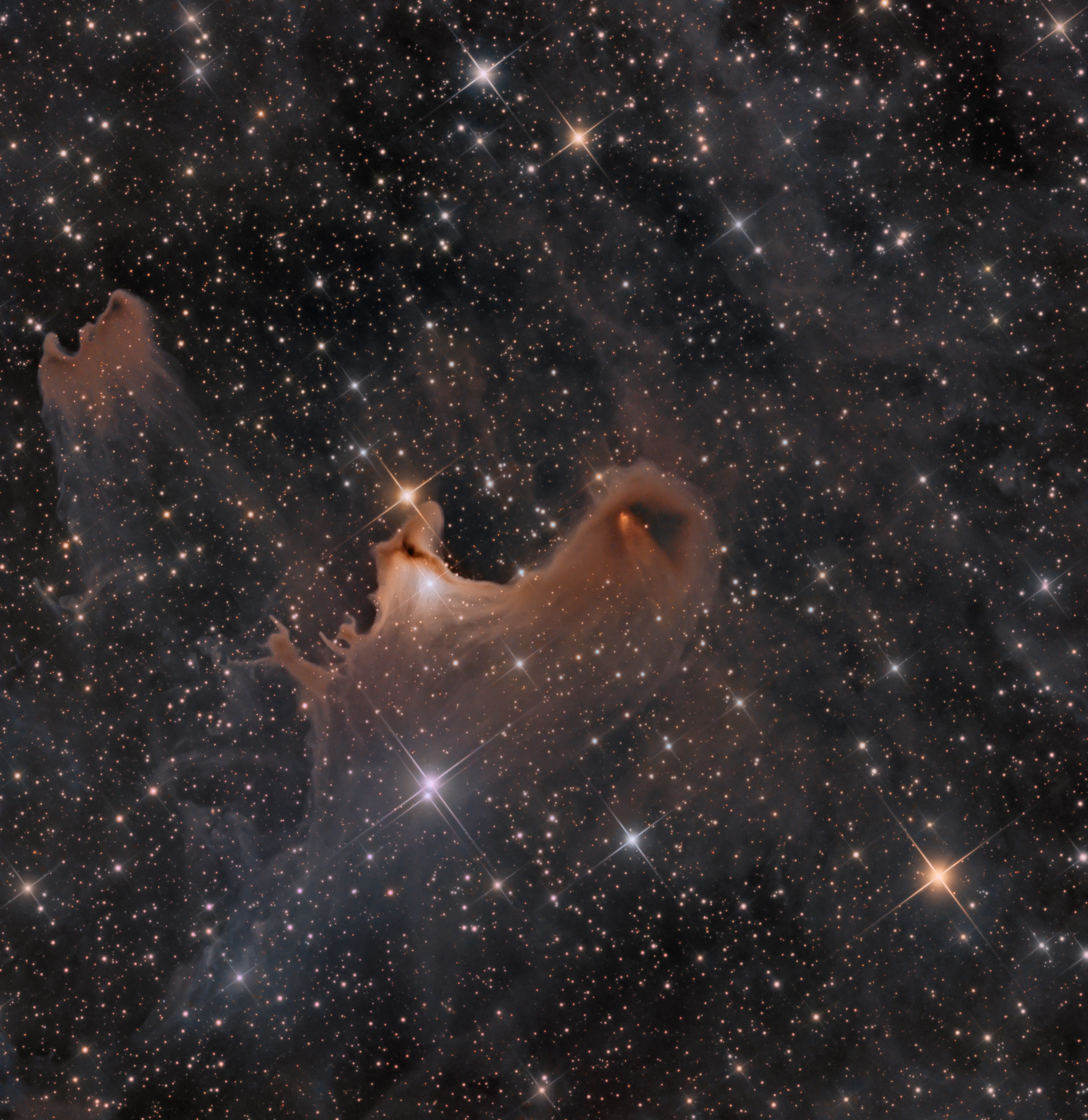
Processed by Nicolas Rolland, Paris. 19.3 hours gathered by Martin Pugh at Sierra Remote Observatories, California, USA.
This nebula produces no light of its own. Everything visible here is starlight that hit dust and bounced.
A globule two light-years across
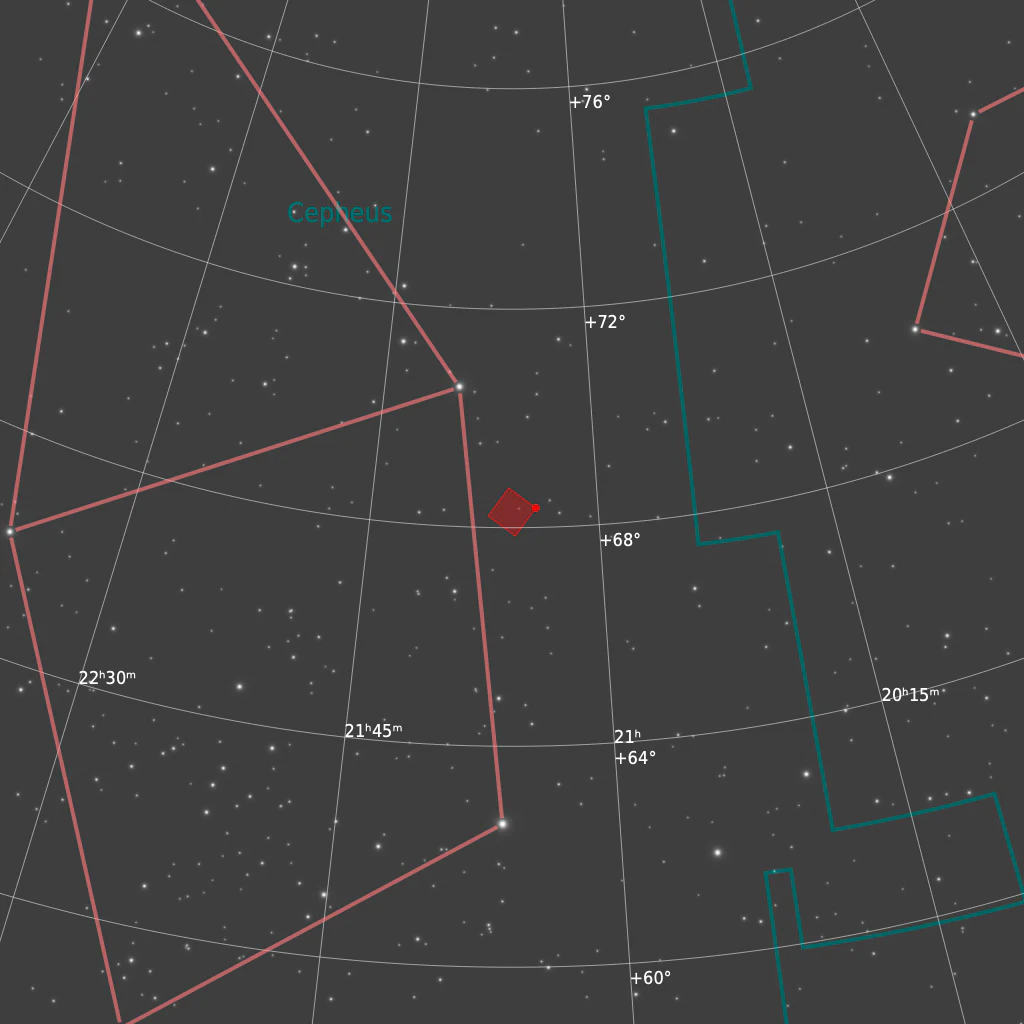
VdB 141 lies about 1,500 light-years away in Cepheus, not far from the Iris Nebula. At its centre is CB 230, a Bok globule a little over two light-years across — a cold, dense knot of gas and dust of the kind that collapses into stars. Several stars are already embedded in it, and it is their light, scattered by the dust around them, that gives the nebula its brown cast.
Brightness as a measure of thickness
Reflection nebulae carry no emission lines. Nothing here is glowing; the dust is only returning light that arrived from somewhere else, which makes brightness a direct reading of how much dust is in the way and how it is arranged. The darker lanes are denser, the paler areas thinner. The ghost is a distribution, not a shape.
Nothing to isolate it with
That has a practical consequence. An emission nebula can be pulled out of a bright sky with a narrowband filter, which passes the wavelength the gas emits and blocks everything else. A reflection nebula has no such wavelength — it reflects the same broad spectrum as the sky glow it competes with. There is no filter that separates the two. The only lever left is time.
Nineteen hours from the Sierra Nevada
The CDK17 was working at f/6.8 with an Apogee U16M behind it, in September 2011 from Sierra Remote Observatories in California. Nineteen hours went to the field, seven of them in luminance and the rest split across red, green and blue. Seven hours is what stands between a faint brown wash and a cloud with structure in it, and there was no shortcut available — no narrowband to lift the signal, only depth. What that reaches is the outer envelope and the dust lanes running through it. What it does not reach is the inside of CB 230: the globule is opaque at these wavelengths, and its interior belongs to the infrared. Martin Pugh gathered the data.