GALAXY
The Antennae Galaxies
— Caldwell 60 / Caldwell 61 —
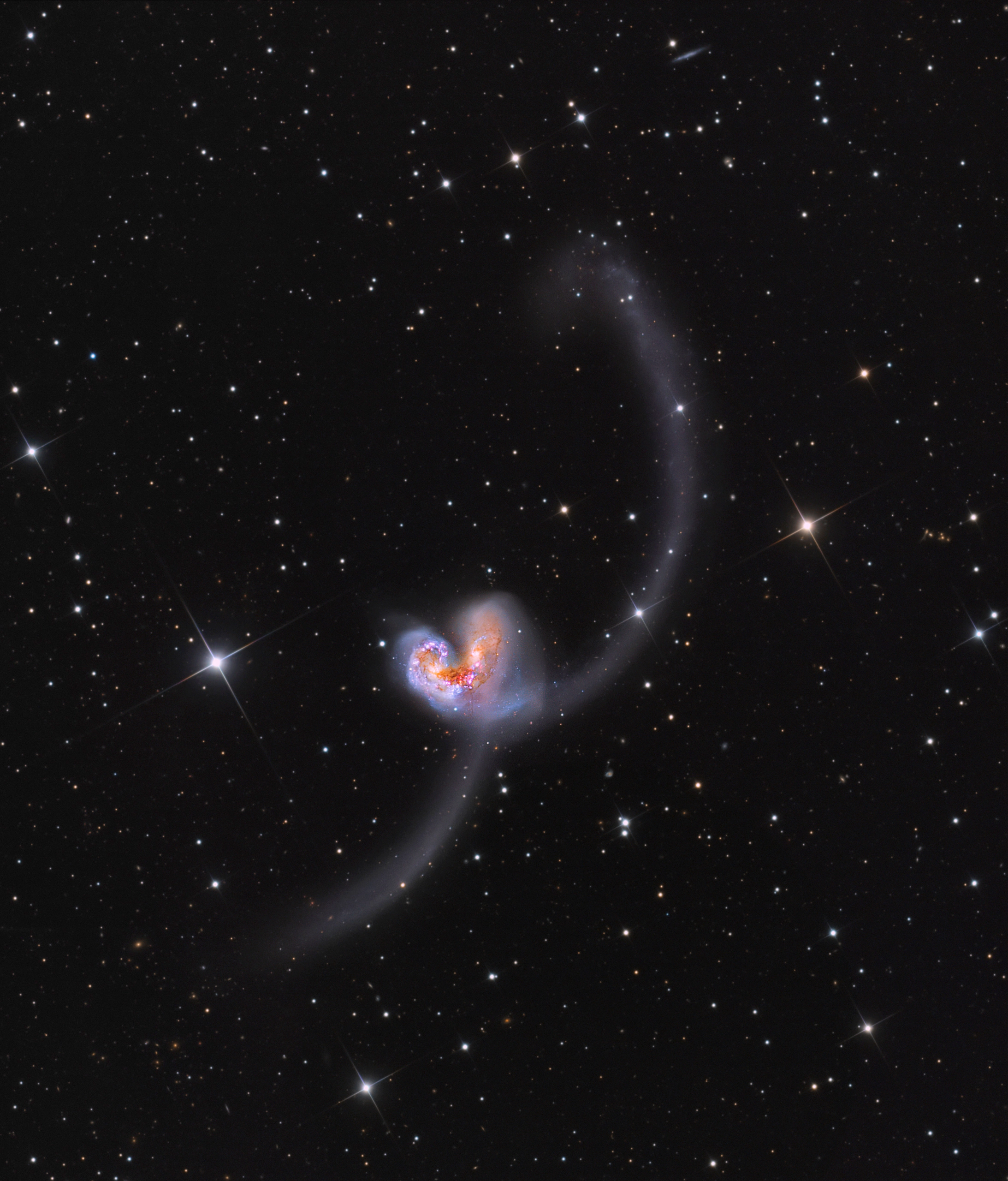
Processed by Nicolas Rolland, Paris. 27.1 hours gathered by Martin Pugh at El Sauce Observatory, Rio Hurtado, Chile.
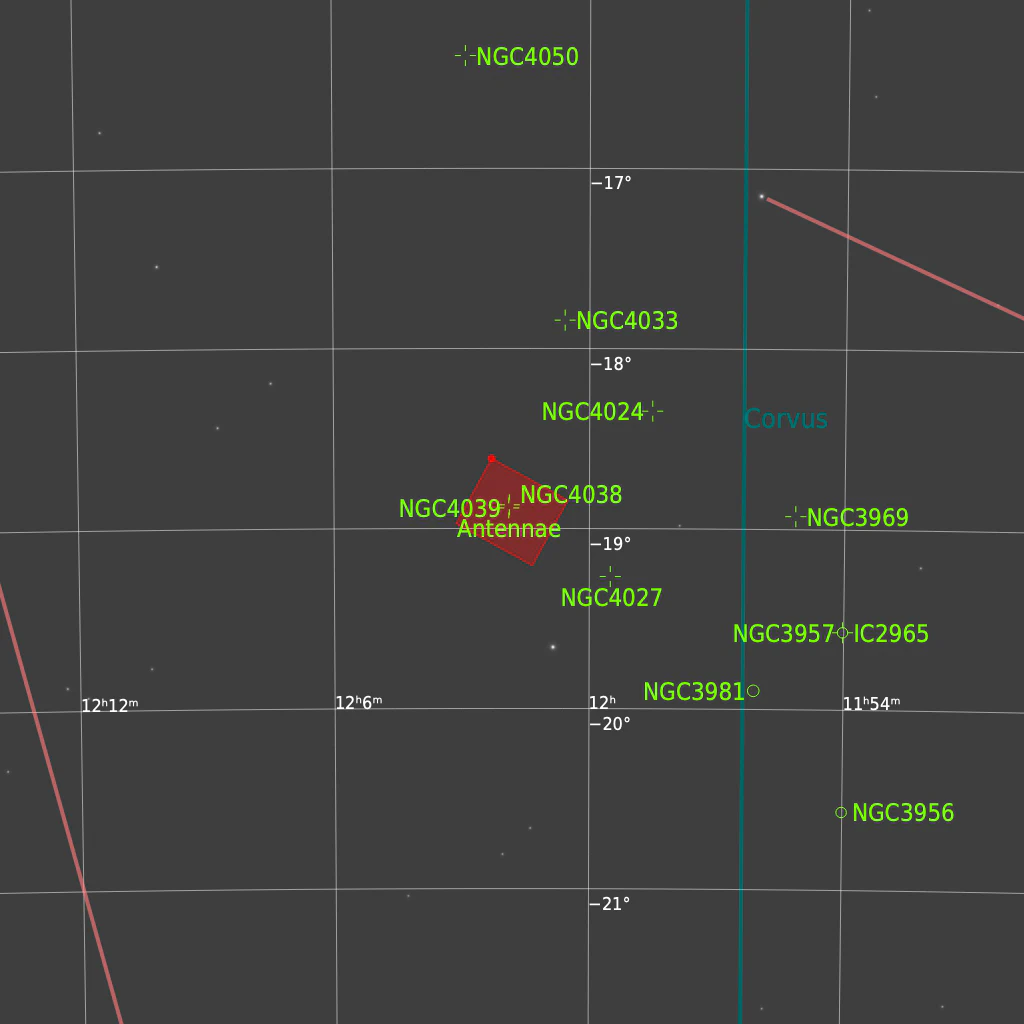
The Antennae Galaxies (NGC 4038/4039, also catalogued as Caldwell 60 and 61) are a pair of interacting galaxies about 45 million light-years away in the constellation of Corvus.
Two galaxies, neither of them ordinary
Both are of the Magellanic type — spiral galaxies with a single arm. NGC 4038 is a barred spiral, NGC 4039 an ordinary one. They belong to a group of at least 27 galaxies, which is part of why they found each other: in a crowded group, an encounter of this kind is a matter of time rather than chance.
Six hundred million years into a collision
The collision began more than 600 million years ago. Stars, gas and dust were thrown out of both discs and now form two vast outgrowths extending over 360,000 light-years — filaments that look like the antennae of an insect, and that gave the pair its name. The two nuclei are still merging, slowly, and will form a single galaxy in something over 400 million years.
Where the new stars are
Clouds of pink and red gas mix with blue regions across both discs, and those are the places where new stars are forming — gas compressed by the encounter itself, collapsing where it would otherwise have drifted. Dark trails of dust from each galaxy sweep across the field and obscure large parts of the scene, which is the other half of the same process: what makes the stars also hides them.
Twenty-seven hours, and a frame that just fits
The data comes from a Planewave CDK17 at f/6.8 with an SBIG STXL-11002 and adaptive optics, at El Sauce Observatory in the Rio Hurtado valley, Chile — a southern site, which for an object 19 degrees below the equator settles most of the question before anything else is decided. The frame runs 24.8 by 29 arcminutes. The tidal tails span roughly 360,000 light-years, which at this distance works out to about 27 arcminutes: they fill the field almost exactly, with no margin at all. Twenty-seven hours went in, and four and a half of those were H-alpha at half an hour a frame — planned before the run, not added afterwards. That layer is there for the HII knots, the pink concentrations where the two discs are compressing each other into new stars, and without it they read as blue clumps like any other.