GALAXIES
A Galaxy in the Dust
— NGC 7497 —
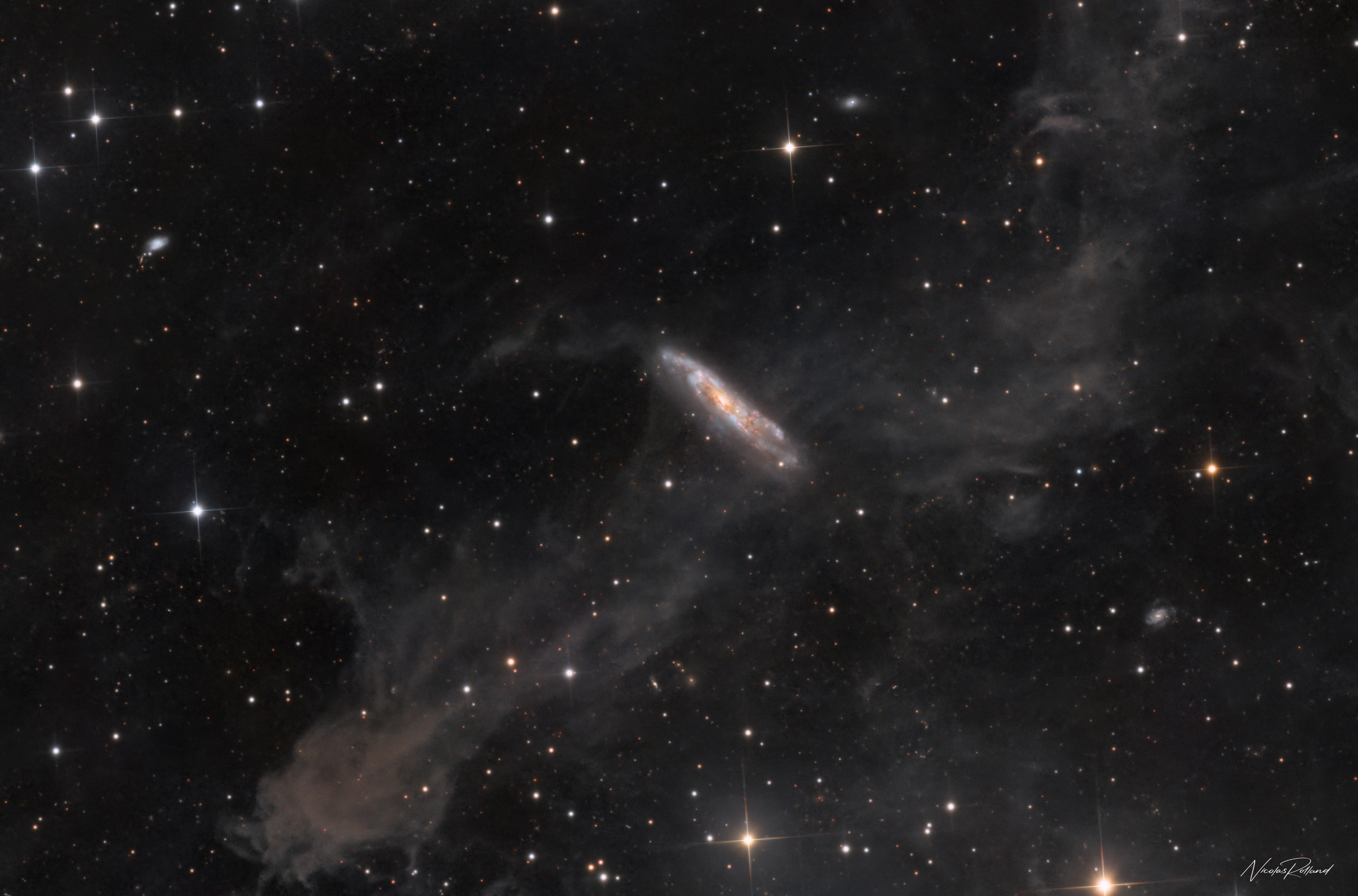
Processed by Nicolas Rolland, Paris. 10.9 hours gathered at El Sauce Observatory, Rio Hurtado, Chile.
There are two faint things in this picture and they are sixty million times apart. Nothing in the image says which is which.
A galaxy you can barely see
NGC 7497 is a barred spiral in Pegasus, and it is faint in a specific technical sense: its surface brightness is 14.38 magnitudes per square arcsecond, which puts it in the low surface brightness class — galaxies at least a magnitude dimmer than the night sky they sit against. William Herschel found it in 1784 and John Herschel observed it again in 1825. Through an eyepiece it shows as a pale grey bar and very little else.
Two distances, both correct
Its recession velocity against the cosmic microwave background gives a Hubble distance of 19.8 ± 1.4 megaparsecs, about 64.6 million light-years. Twenty-two measurements made without using redshift give 17.9 ± 3.7 megaparsecs, about 58.3 million. The two figures overlap inside their error bars, which is what agreement looks like at this range — a galaxy's distance is not a number you read off, it is a range that several methods narrow from different directions.
The veil in front of it
On a long exposure something else appears. NGC 7497 sits behind LBN 419, a molecular cloud listed in Lynds' catalogue of bright nebulae, and the cloud is not distant at all: it lies inside the Milky Way, a few hundred light-years away. It is lit by no single star but by the combined light of our own galaxy, which is why it has no colour to speak of and no shape that resolves. What the frame holds is a galaxy sixty million light-years off, seen through dust that is closer to us than most of the stars around it.
Eleven hours, and nothing to separate them with
A CDK24 at f/6.5 with a monochrome sensor from Rio Hurtado in July 2023, ten hours and fifty minutes in five-minute frames across luminance, red, green and blue. The difficulty here is not depth but discrimination. The galaxy is a low surface brightness object and the cloud in front of it is a low surface brightness object; both shine by reflected or integrated starlight, both across the same broad spectrum, and there is no filter that passes one and blocks the other. Eleven hours brings up both at once, which is the only way either can be reached — and the cloud is at the edge of it. Where the dust fades out in this frame is where eleven hours stops.