GALAXY
Deer Lick Group & Stephan's Quintet
— NGC 7331 GROUP & NGC 7319 GROUP —
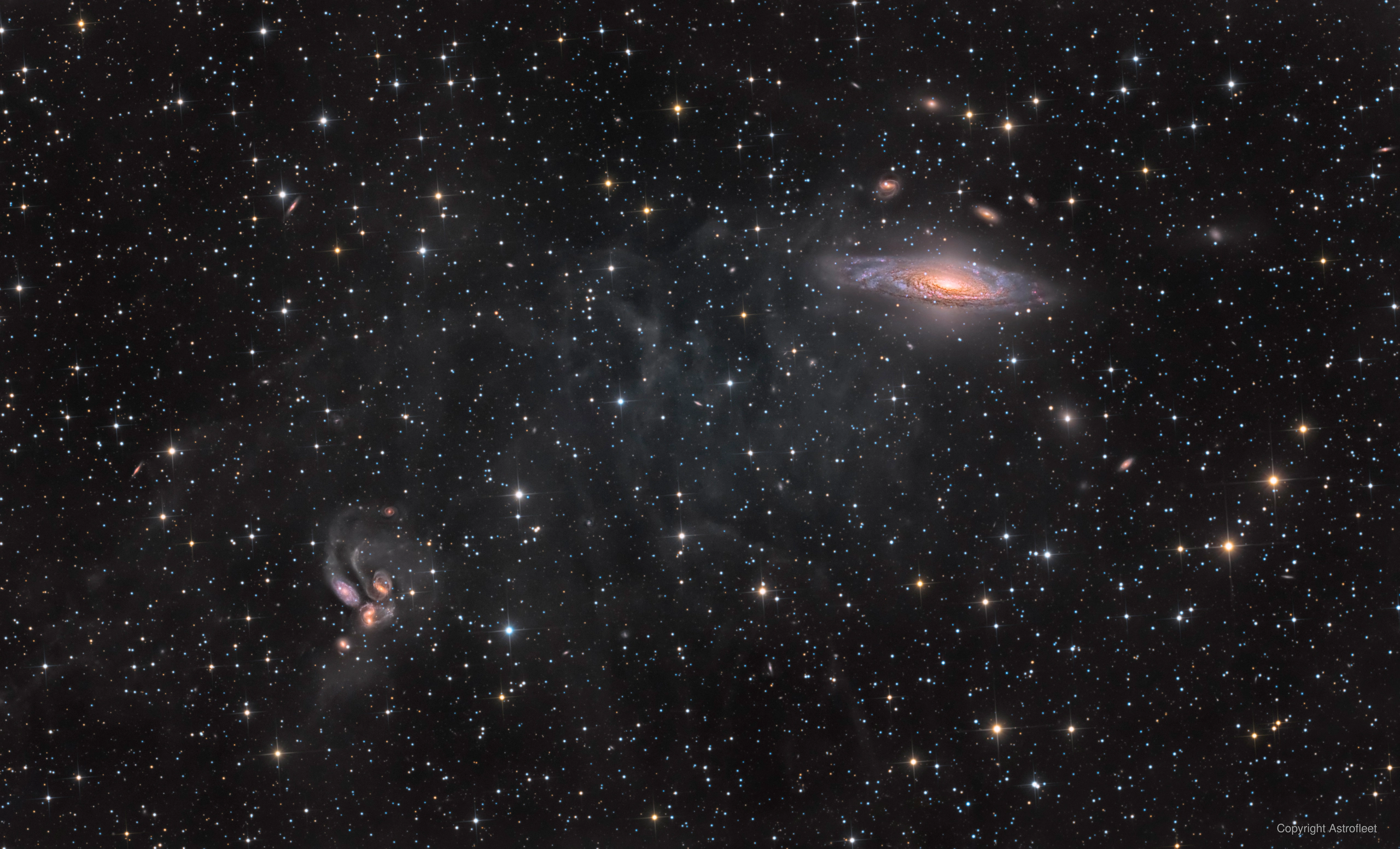
Processed by Nicolas Rolland, Paris, as part of the Astrofleet Team. 39.5 hours gathered at PixelSkies, Castilléjar, Spain, and in Ariège, France.
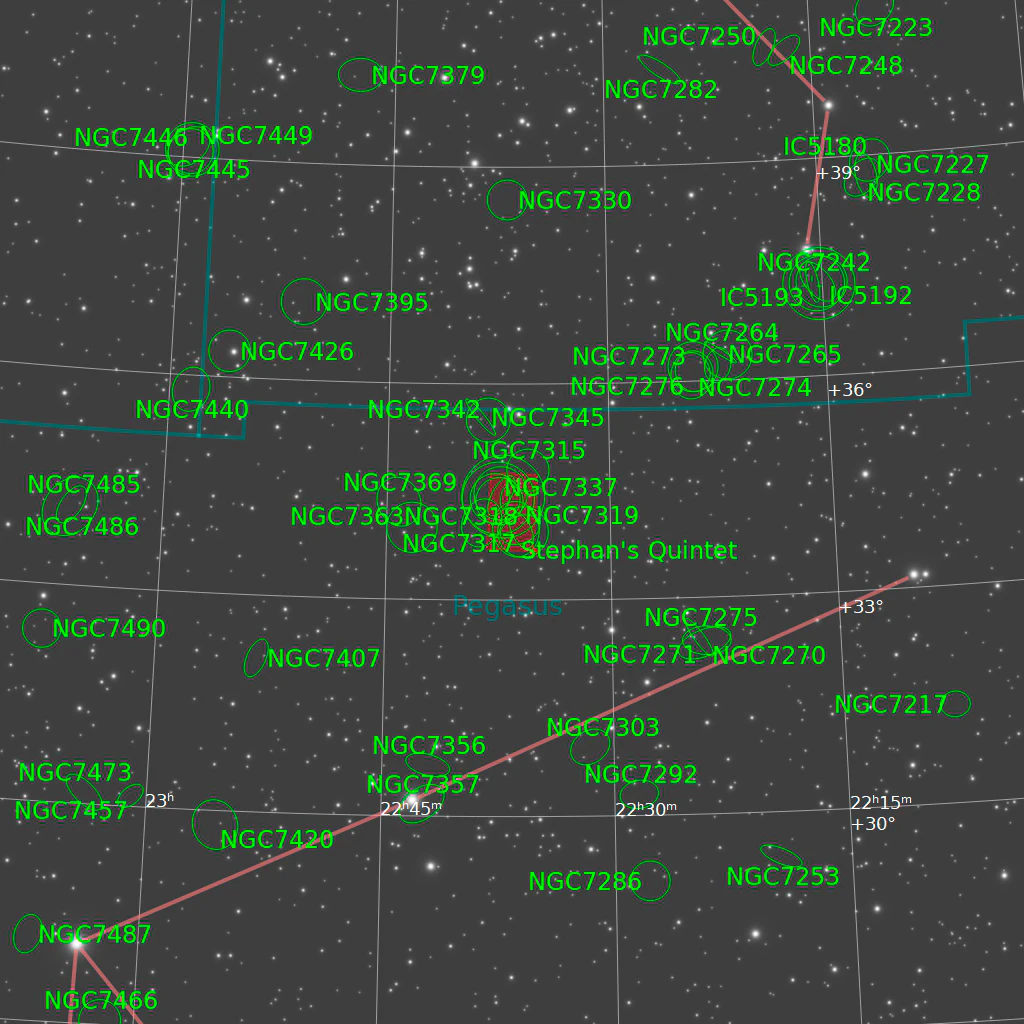
Two groups of galaxies share this field, and each of them contains a member that does not belong to it.
NGC 7331 and the fleas
The bright spiral at one end of the frame is NGC 7331, about 40 million light-years away in Pegasus, with four smaller galaxies gathered beside it: NGC 7335, NGC 7336, NGC 7337 and NGC 7340. They look like companions and they are not. All four lie between roughly 290 and 370 million light-years — eight to nine times further off — and they only appear alongside NGC 7331 because they fall in the same direction. Astronomers call them the fleas. The whole arrangement is known as the Deer Lick Group.
Stephan's Quintet, and the one that is too close
At the other end of the field sit five galaxies catalogued as Stephan's Quintet: NGC 7317, NGC 7318a, NGC 7318b, NGC 7319 and NGC 7320. Four of them are a real compact group at around 340 million light-years, close enough together that tidal forces have visibly bent their arms and pulled their discs out of shape. NGC 7320 is not one of them. It lies between 35 and 40 million light-years away, in front of the others, and it has been dragged into the quintet by nothing more than perspective.
The same illusion, twice, in opposite directions
That leaves this field with two groupings and two intruders, and they fail in opposite ways. Around NGC 7331 the eye adds four galaxies that are far behind; in the Quintet it adds one that is far in front. Nothing visible distinguishes them — a small faint galaxy looks the same whether it is distant and large or nearby and small. Only a spectrum settles it, and until one was taken both mistakes were entirely reasonable.
Forty hours, two telescopes, two countries
Two instruments contributed: a TS-Optics CF-APO of 155 millimetres at f/8 and a TS-Optics ONTC of 250 at f/4, from Castilléjar in Spain and from the Ariège in France, in October 2023. Thirty-nine and a half hours in all, of which twenty-seven are luminance in two frame lengths — three minutes and five — and nearly seven are H-alpha. That luminance is what the field demands: at 340 million light-years the Quintet's galaxies are about an arcminute across, and the faint integrated flux nebulae scattered through the frame are fainter still. What forty hours does not give is the inside of those distant galaxies. Their distortion is visible; the structure that produced it is a matter of arcseconds, and belongs to a longer focal length than either of these. Gathered with the Astrofleet team.